
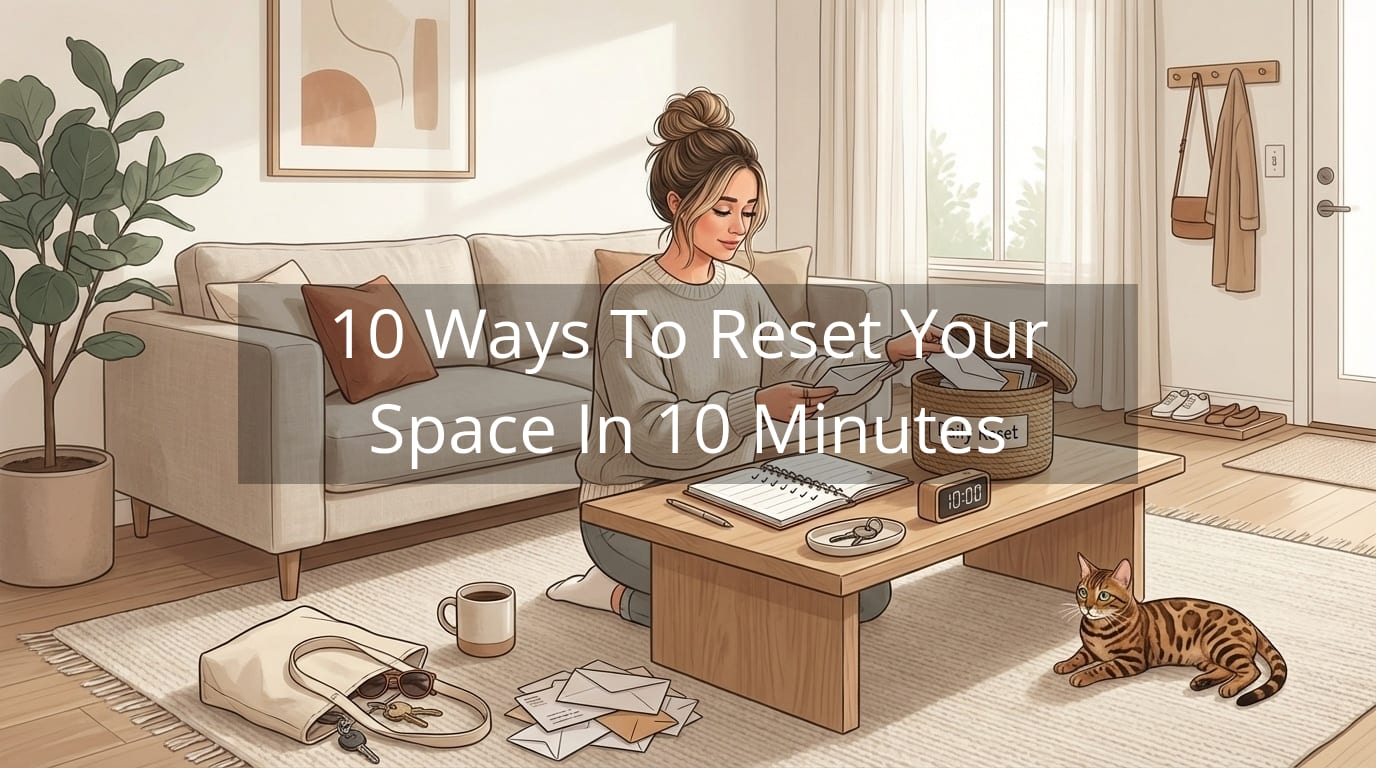
The 10 minute reset is the only cleaning habit I’ve found that genuinely works on a Tuesday, when you’re already tired and your brain is running 37 tabs. A 10 minute reset doesn’t ask you to become a “clean person” overnight—it just helps your space stop shouting at you.
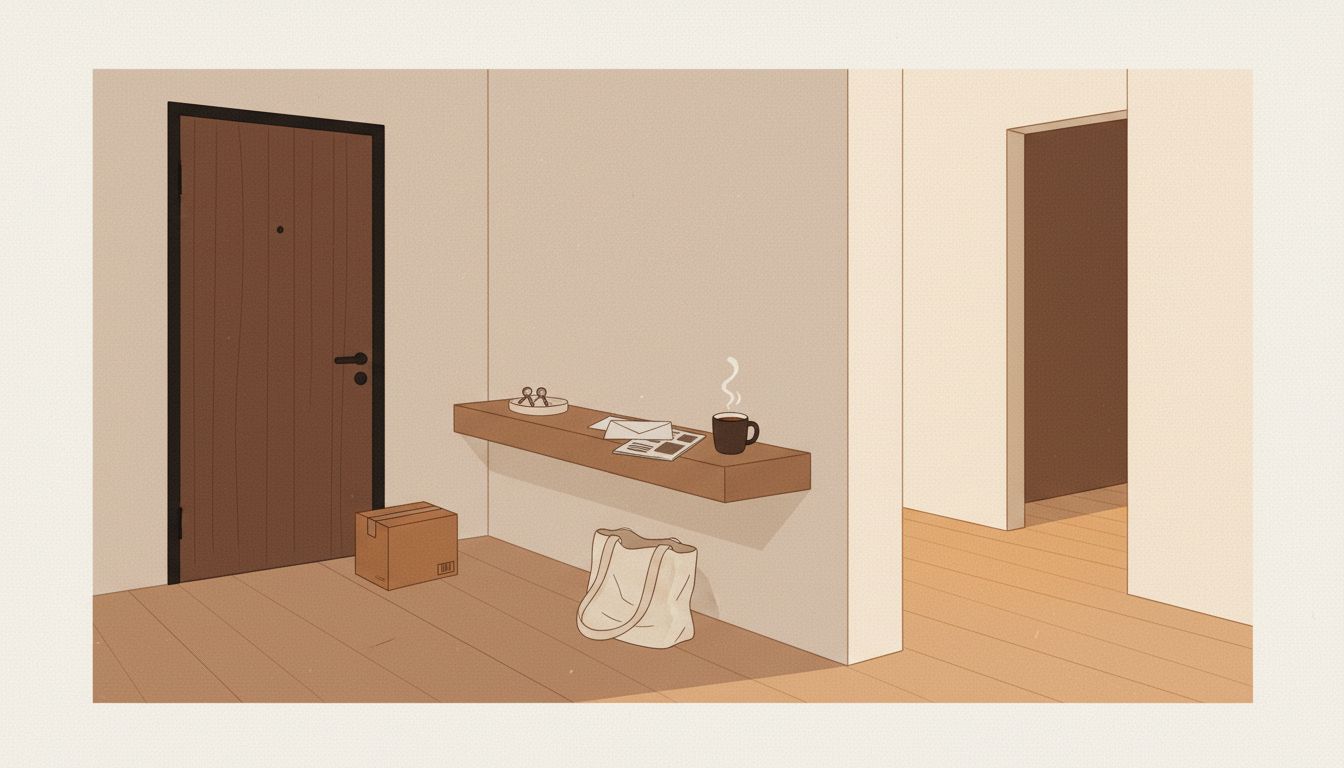
You know the moment: you walk in after a long day and instantly feel… heavier. Not because anything dramatic happened, but because your environment is quietly demanding things from you. The counter is a pile of unopened mail and coffee mugs. The couch throw is tangled. A delivery box is still by the door. Your laptop is open where you left it, like a tiny accusation.
And the frustrating part is that it’s not that messy. It’s just messy enough to make your nervous system feel like it can’t land.
Why modern life creates constant “background mess”
Most of us aren’t living slow, simple lives with long gaps for home admin. We’re managing work, friendships, appointments, health, side projects, personal growth, and the subtle expectation to be reachable and responsive all the time. So what happens at home is predictable:
- Flat surfaces become “temporary storage” (that turns permanent).
- We keep things out so we don’t forget them (and then we can’t relax because we keep seeing them).
- Our space becomes a visual to-do list—whether we mean it to or not.
Clutter isn’t just clutter. It’s unfinished decisions. Every object left out is a tiny open loop: put this away, deal with this, respond to this, clean this, return this. Even if you’re not consciously thinking those thoughts, your brain registers them. That’s why a messy room can make you feel mentally itchy, like you can’t fully focus or fully rest.
And when you’re already mentally overloaded, the idea of a full clean is laughable. A deep clean has an entry fee: energy, time, motivation, maybe even music and a whole personality shift. You don’t need that.
You need a “reset button.”
The 10 minute reset: a small ritual with outsized impact
A reset is different from cleaning. Cleaning is about finishing. Resetting is about restoring baseline calm.
Think of it like closing out all the apps on your phone. You’re not upgrading the operating system—you’re just giving it room to breathe again.
The magic of the 10 minute reset is that it’s short enough to be doable even when you’re fried, but structured enough to create a noticeable difference. Ten minutes is also psychologically friendly: your brain doesn’t have time to argue with it.
“A calm space isn’t a perfect space—it’s a space that isn’t asking you to think about it all day.”
Why it works (even if you’re not “naturally organized”)
This method helps because it targets the highest-impact friction points—air, surfaces, smell, light, and the few “clutter magnets” that make a home feel chaotic fast.
Most mess falls into a small set of categories:
- things that need to go back to a home
- dishes and food packaging (instant visual noise)
- laundry spillover
- trash/recycling
- stray items that migrated to the wrong room
A reset doesn’t solve your entire life. It just stops your space from amplifying your stress.
What a reset looks like in real life (not influencer life)
The most useful time to reset is when your day is shifting—because transitions are when clutter tends to multiply.
1) The post-work “drop zone” effect
You come home and drop everything where you stand: bag, keys, makeup pouch, receipt, maybe a sweater. It’s not laziness—it’s decompression. But the next time you walk past it, you feel that tiny spike of irritation.
A 10 minute reset turns that pile back into an entryway, not a dumping ground.
2) The kitchen counter spiral
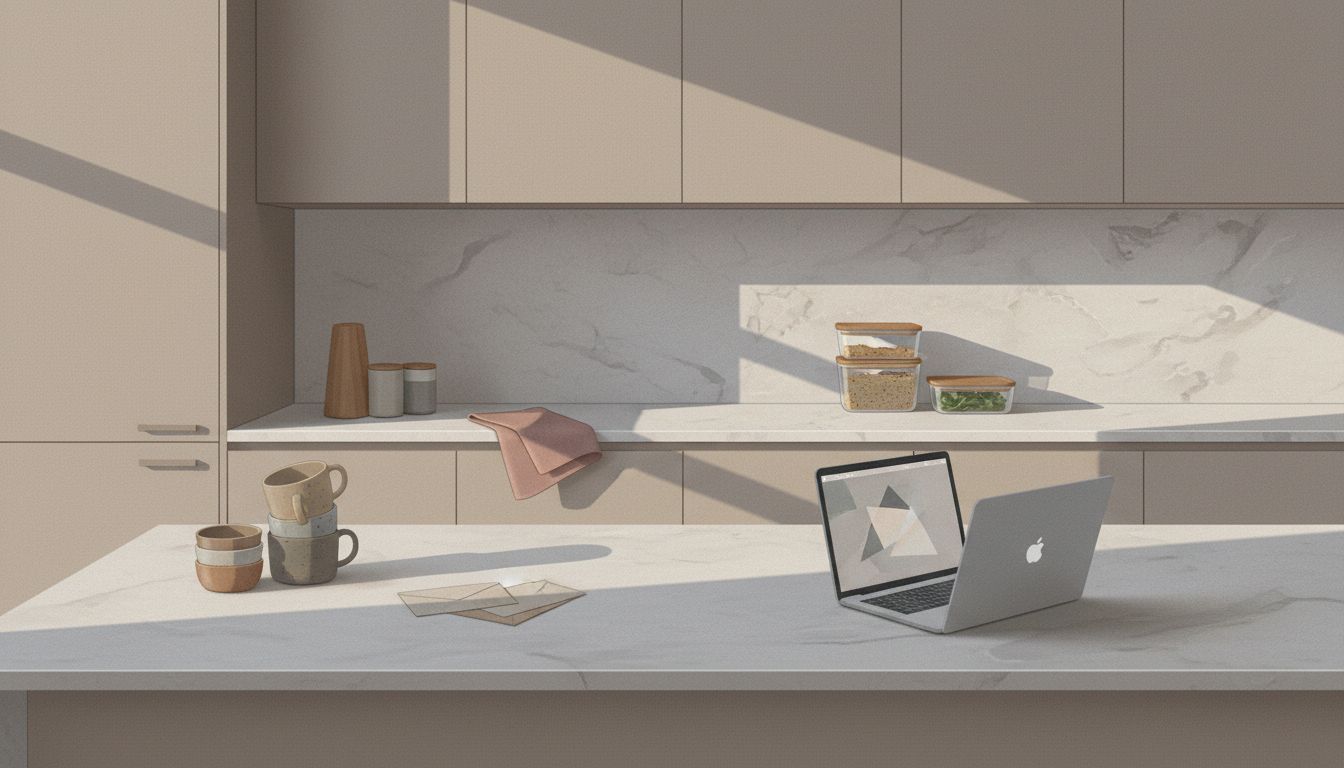
Counters attract stuff because they’re convenient and visible. The problem is that once a counter gets “busy,” cooking becomes harder, and then you order food, and then there are more containers, and suddenly the kitchen feels like a chore you can’t face.
A reset restores your counter to what it’s supposed to be: a workspace that supports you.
3) The “I can’t relax here” living room
You finally sit down, but there are cups on the table, the blanket is crumpled, and something about the lighting feels harsh. You’re technically resting, but your brain is still scanning.
A reset signals: we’re done for the day.
The core 10-minute sequence (simple, sensory, effective)
Here’s the structure I recommend because it hits both the visual mess and the emotional “staleness” that builds up:
- Open a window (or at least crack one)
- Clear one surface (coffee table, counter, desk—pick the loudest one)
- Return obvious strays to their homes (no complicated sorting)
- Wipe the kitchen counter quickly (one small swipe changes the whole vibe)
- Fold/straighten one soft thing (throw blanket, pillows—instant “put together”)
- Start a quick laundry load (if it’s already near overflowing)
- Take out trash or recycling (especially if you can smell it at all)
- Dishes into dishwasher / sink cleared (don’t wash everything—just reduce visual bulk)
- Water plants (only if they’re in your line of sight and looking sad)
- Light a candle or switch on a warm lamp (your nervous system notices lighting)
Do all ten if you can. But the real secret: even doing three of these counts, because you’re shifting the atmosphere, not earning points.
Make it effortless: tiny systems + a couple digital tools
The biggest reason resets don’t stick isn’t discipline—it’s friction. If you have to hunt for supplies, decide what to do first, or remember the steps, you won’t do it when you’re tired.
Here are the simplest ways to reduce friction so the 10 minute reset becomes almost automatic.

1) Use a timer app as your “starter motor”
A timer removes negotiation. You’re not deciding to clean; you’re just running a 10-minute container.
- Phone Timer (honestly perfect)
- Focus To-Do or any Pomodoro-style app if you like a little structure
- A Siri/Google voice command: “Set a timer for 10 minutes” (hands-free really helps)
If you want this to feel less like upkeep, pair it with one specific playlist you only use for resets. Your brain will start associating the first song with “we’re clearing the air.”
2) Create a “reset kit” so you don’t roam the house
This is one of those adult-life upgrades that makes you wonder why you didn’t do it sooner.
A small tote/bin with:
- microfiber cloth
- all-purpose spray (or a simple vinegar mix)
- trash bags
- optional: a candle or matches/lighter
Keep it somewhere central (kitchen under-sink, hallway closet). The goal is: when you decide to reset, you begin immediately.
3) Let one app hold the routine (so your brain doesn’t)
If you like digital support, use something that tracks small tasks without making your life a project.
- Tody (great for flexible cleaning routines; you can add “10 minute reset” as a repeating task)
- Notion (a super simple checklist template you can duplicate daily/weekly)
- Planta (if plant-watering is always a guilt situation for you—this makes it mindless)
You’re not trying to build a perfect home management system here. You’re outsourcing remembering so you can spend that energy on your actual life.
The next piece that makes the 10 minute reset feel almost unfairly effective is knowing where to focus—because not all mess has the same impact. There are a few “high-visibility zones” that change the emotional tone of a room within minutes, and once you start prioritizing those, you’ll notice your home feels calmer even when it’s not spotless…
High-visibility zones: where 10 minutes actually changes your mood
If you only remember one thing, make it this: your home doesn’t need to be evenly tidy. It needs to be strategically tidy. A few visible areas create most of the mental noise—and when those zones feel clear, your whole space feels easier to be in (even if the back bedroom is… doing its own thing).
The “calm cues” list (prioritize these first)
- Entry/first sightline: Whatever you see within the first five steps of walking in.
- Kitchen counter + sink: The fastest way for a home to feel “behind.”
- Coffee table / living room surface: Where clutter becomes visual chatter during rest time.
- Bed area: Not the whole bedroom—just enough that sleep feels supported.
- Bathroom counter: A tiny surface that can make mornings feel chaotic.
When you do a 10 minute reset, pick one calm cue zone and finish it to “baseline.” Not perfect—just not actively stressing you out.
The 10 minute reset “zone rules” (so you don’t get sucked in)
This is where most resets fail: you start with one cup, notice the recycling, remember the closet, then suddenly you’re reorganizing a drawer while still wearing your work pants and wondering how your life got here.
Rule 1: Stay on one side of the room
Choose a boundary (the counter, the couch area, the entry table). If something belongs elsewhere, you’re allowed to move it toward its home—but you don’t follow it there. You’re keeping momentum, not starting side quests.
Rule 2: Touch things once (or as close as possible)
If you pick it up, decide immediately:
- Put away (if it has a home and takes under 20 seconds)
- Trash/recycle
- Dish/laundry
- “Deal with later” bin (more on this below)
Rule 3: Don’t organize mid-reset
Resetting is not the time to label bins, refold a whole drawer, or Marie Kondo your skincare. If an item doesn’t have a home, your job is to place it in a contained “decision zone” so your brain stops tripping over it visually.
A simple “decision-light” system (for the stuff that doesn’t have a home)
The reason clutter creates mental load is because it represents unmade decisions. So instead of trying to make all the decisions in the moment (impossible when you’re tired), give yourself a friendly holding pattern.
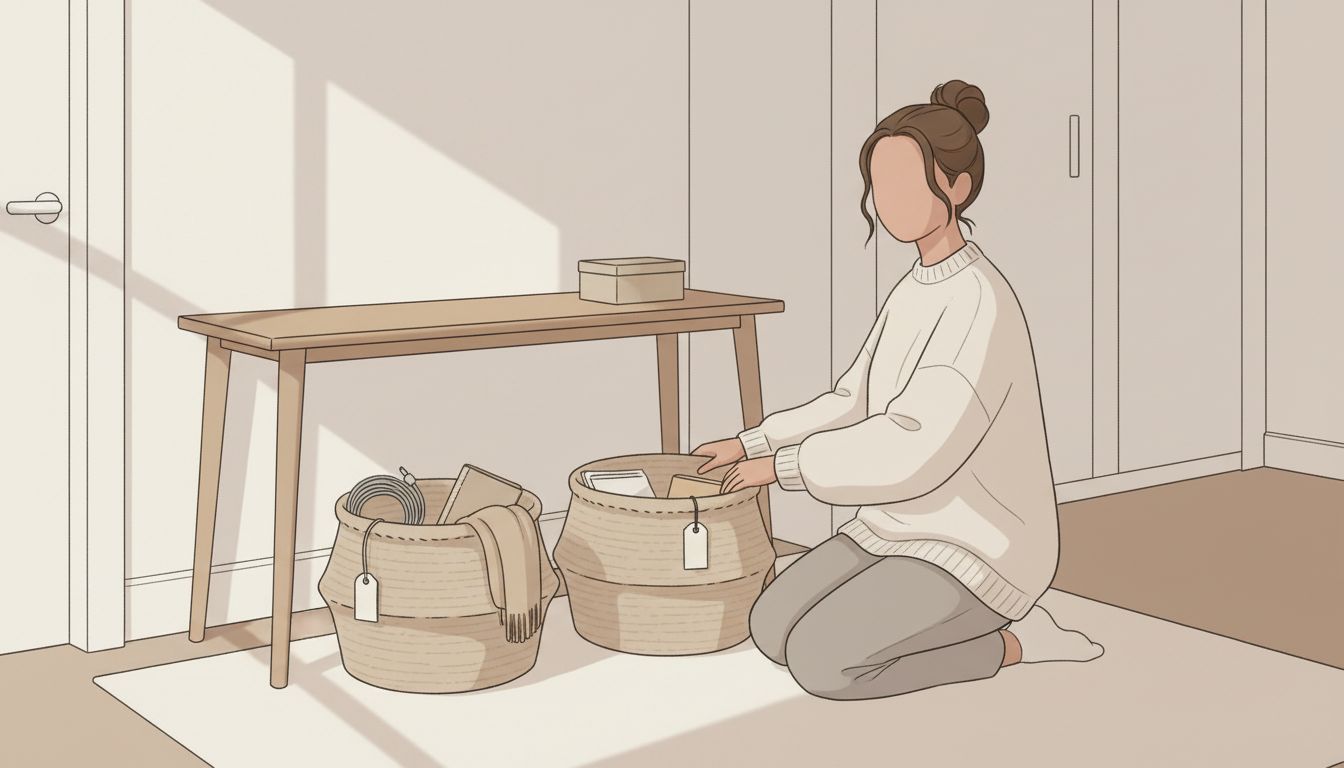
Create 2 baskets: the easiest clutter control that actually sticks
- One “Elsewhere” basket: For items that belong in other rooms. During the reset, you only gather them. Later (or tomorrow), you do a 3-minute drop-off lap.
- One “Decide” basket: For items without a clear home (returns, random cables, new purchases, papers).
This works because you’re not pretending you have time to solve everything. You’re just containing the open loops so your space stops shouting.
Make the “Decide” basket non-scary
Here’s the trick: schedule a tiny appointment with it. Ten minutes once a week is enough.
- Set a recurring reminder: “Decide basket — 10 minutes”
- Do it with tea or while something is in the oven
- If you don’t finish, you’re still winning—you’re reducing the backlog
Anchor your 10 minute reset to transitions (so it becomes automatic)
Habits stick when they’re attached to moments that already happen—especially “hinges” in your day. You’re not trying to remember a new chore; you’re attaching a tiny ritual to a predictable transition.
Choose one reset anchor (start small)
- After work, before dinner: Clears the day’s residue so your evening feels like yours.
- Right after dinner: Prevents the kitchen from becoming tomorrow’s problem.
- Before your shower: Reset first, then wash the day off—mentally satisfying.
- Before bed: A “closing shift” that makes mornings calmer.
- Before guests (even one friend): Not to impress—so you can actually enjoy the visit.
If daily feels like too much, make it a weekday-only habit. Or pick three days. Consistency matters more than frequency.
Mini scripts for common scenarios (so you don’t have to think)
When you’re overloaded, you don’t need more options—you need a default plan. Here are a few “if this, then that” scripts you can run on autopilot.
If the kitchen is the problem
- Clear the sink (move dishes to dishwasher or stack neatly)
- Wipe one counter section fully (yes, just one)
- Trash/recycling out if it’s even slightly full
- Put one “category” away (spices, oils, mugs—pick one)
The goal is a functional landing strip, not a photoshoot kitchen.
If the living room is stressing you out
- Gather cups/plates first (instant visual quiet)
- Fold/straighten the soft things (blanket + pillows)
- Clear the coffee table into a tray or basket
- Warm light on (lamp over overhead)
This is the fastest route to “I can actually rest here.”
If your bedroom feels mentally loud
- Make the bed quickly (even a “lazy make” counts)
- Clear only your nightstand surface
- Put clothes in hamper (no sorting)
- Open a window for 60 seconds or refresh the air
Sleep is a form of productivity too. A baseline-calm bedroom is not indulgent—it’s practical.
Micro-upgrades that make resets easier (without becoming a “project”)
You don’t need a full home overhaul. You need small physical cues that reduce friction.
1) Give the “clutter magnets” a real job
If your counter or entry table keeps becoming a pile, it’s not because you’re failing. It’s because that surface is currently acting as a system—just not a great one. Try:
- A tray for keys/wallet/earbuds (containment is calm)
- A small bowl for loose change and tiny items
- A dedicated mail spot (one vertical file or a single basket)
2) Put a trash bag where the trash actually happens
If you always accumulate packaging by the door, put a small bin there. If you toss tissues on your nightstand, add a tiny bedroom bin. This isn’t messy—it’s designing for reality.
3) Keep cleaning supplies where you use them
One under-sink set for the kitchen, one small set for the bathroom. The less you have to roam the house, the more likely you’ll do the quick wipe that changes everything.
When you’re really tired: the “2-minute version” that still counts
Some days, ten minutes is genuinely too much. On those days, you’re not banned from resetting—you’re just choosing the lowest-energy version.
- One surface: clear it
- One sensory win: crack a window or switch on warm light
- One removal: take out trash or move dishes to the sink
That’s it. That’s the whole deal. The point is to send the signal: my space supports me, even when I’m running on fumes.
“Small actions, done consistently, create the kind of calm you can actually live inside.”
A gentle close: calm living is built, not wished for
The reason the 10 minute reset feels so powerful isn’t that it makes your home spotless. It’s that it lowers the number of decisions your brain has to carry while you’re trying to live your life. It turns your space from a visual to-do list into a place you can land.
And the best part is how forgiving it is. You can miss days. You can do three steps instead of ten. You can reset one zone and ignore the rest. You’re not aiming for “perfect home.” You’re building a system that meets you where you are—busy, capable, sometimes exhausted, and still deserving of a calm environment.
When your space stops demanding your attention, you get more of your attention back. That’s the real win.
More visual help (if you like seeing systems in action)
If you want extra visual guidance and quick reminders you can revisit, there are more resources available here: