
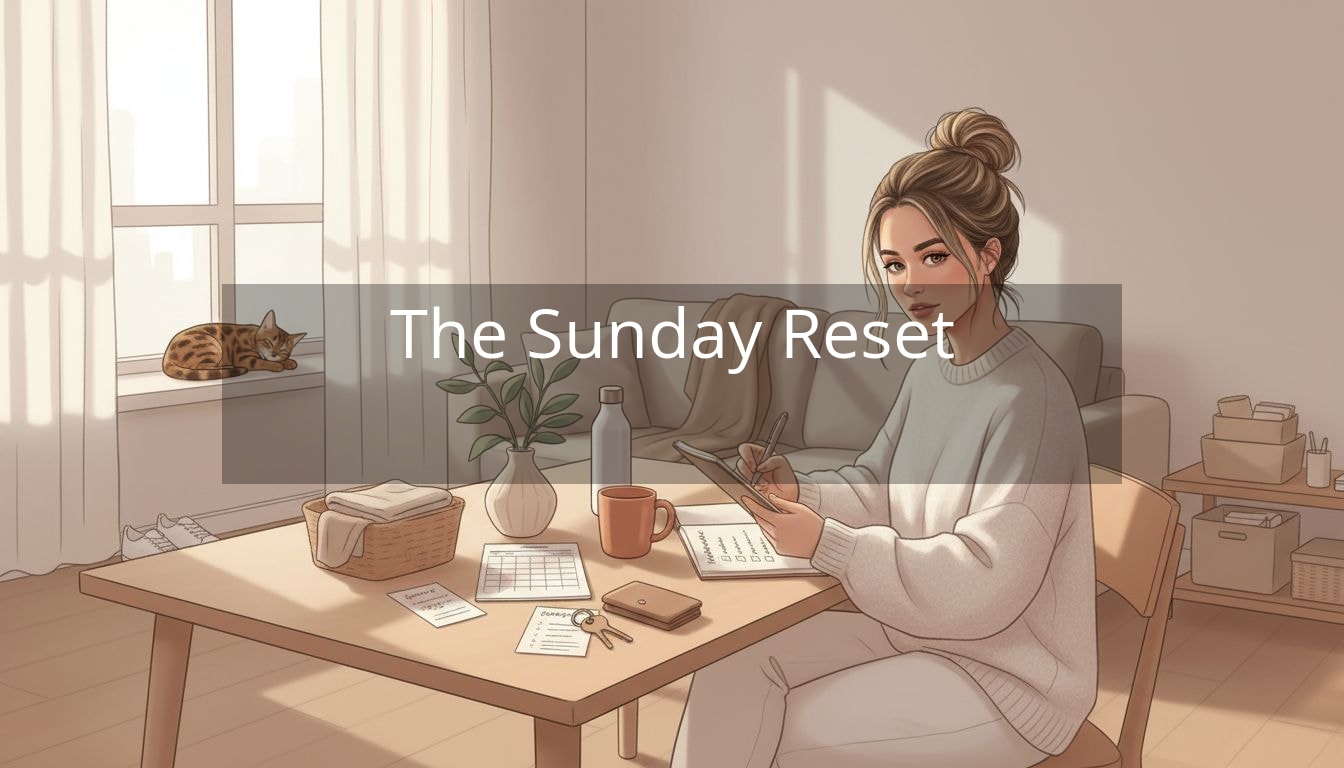
The Sunday reset is one of those quietly-life-changing habits that sounds almost too simple to matter. But if your Sundays tend to dissolve into a weird mix of lounging and low-grade panic (while your brain runs a background tab called “Monday”), a Sunday reset can be the difference between starting the week braced for impact and starting it steady.
You know the feeling: it’s Sunday evening, you’re technically “off,” yet you can’t fully relax. You keep remembering little things—an email you didn’t answer, the appointment you might be late for, the empty fridge, the laundry you meant to fold, the fact that you don’t even know what’s on your calendar until you open it tomorrow and flinch. Nothing is actually on fire… but everything feels slightly urgent.
That’s not you being dramatic. That’s mental load.

Why modern life feels so heavy (even when nothing “big” is happening)
A lot of overwhelm isn’t created by huge crises. It’s created by unfinished loops—tiny open tasks and decisions that keep pinging your attention.
- The package you need to return (no label printed yet)
- The kitchen counter that’s become the “temporary” pile
- The project you’re working on that lives in five different places (email, Notes app, Slack, a notebook, your brain)
- The calendar you don’t trust because you keep adding things last-minute
- The fridge that looks like “ingredients,” but not like “a meal”
Individually, these are small. Collectively, they create that low-level hum of chaos where your mind never fully powers down. And when your mind doesn’t power down, rest stops working. You can sit on the couch for three hours and still feel oddly tired—because you’re not really resting, you’re just pausing while your brain keeps quietly managing.
There’s also the decision fatigue piece. So many modern women are making a staggering number of micro-decisions all week long: what to eat, what to wear, what to reply, what to prioritize, what to postpone, what to buy, what to clean, what to ignore. By the time Sunday rolls around, even “planning” can feel like another job.
So we avoid it. We tell ourselves we’ll “deal with it tomorrow.” And then Monday shows up like a jump scare.
The core idea: a tiny weekly bridge between “weekend you” and “weekday you”
A Sunday reset isn’t a deep-cleaning marathon or an aesthetic “get your life together” performance. It’s a short, intentional ritual that closes open loops and sets up a few easy wins—so Monday doesn’t start with you already behind.
Think of it as a bridge:
- Weekend you deserves rest.
- Weekday you deserves support.
The Sunday reset is the moment where you gently pass resources from one version of you to the other. Not in a “be better” way—more like leaving yourself a glass of water on the bedside table.
Clarity isn’t about doing more—it’s about removing the small frictions that quietly drain you.
And the reason it works is not because you suddenly become “more disciplined.” It works because it reduces the number of choices and surprises waiting for you.
What a Sunday reset actually looks like (and what it is not)
Let’s define it in a way that feels doable.
A Sunday reset is 30 minutes of light organization across a few high-impact areas:
- your space (so it stops shouting at you)
- your calendar (so you know what you’re walking into)
- your priorities (so you’re not guessing all week)
- your food basics (so you’re not panic-ordering Wednesday dinner)
- one small prep (so Monday starts softer)
It is not:
- meal prepping 21 containers of chicken and broccoli
- reorganizing your closet
- scrubbing baseboards
- planning your entire week down to the half-hour
- trying to become a new person by Monday morning
If you’ve ever tried to “fix your whole life” on Sunday and ended up exhausted and resentful, this is the reset you actually needed.
The five-part Sunday reset flow (designed for real life)
Here’s the simple structure I recommend—because it hits the biggest friction points without turning Sunday night into a second job.
1) The 5-minute “can I breathe here?” tidy
This is not cleaning. This is restoring order to the few spots that affect your nervous system the most.
Pick 1–3 “impact zones,” like:
- kitchen counter/sink
- entryway (bags, shoes, mail)
- your desk or the place you tend to open your laptop
Set a timer for five minutes and do the fastest possible version of reset:
- toss trash
- return obvious items to homes
- stack papers into one neat pile (you can deal with it later—just not scattered)
- wipe one surface if it takes 20 seconds
The goal is visual calm, not perfection. When you wake up and the first thing you see is mess, your brain interprets it as “unfinished.” Starting Monday with a clearer surface genuinely changes your mood.
2) Calendar glance: locate the “big rocks”
Now open your calendar (phone or laptop) and do a quick scan of the week. You’re not scheduling every detail—you’re simply getting oriented.
Look for:
- meetings you need to prepare for
- any early morning commitments
- deadlines that will sneak up
- social plans you forgot you agreed to
- commute time (if you leave the house)
- anything that requires leaving earlier than usual
This one step alone reduces that “What even is my week?” dread because uncertainty is stressful. When you know what’s coming, your body relaxes.
Digital tool tip: If you’re not already using Google Calendar or Apple Calendar as your “source of truth,” make that your first upgrade. Put everything there—appointments, plans with friends, reminders like “pay rent,” even “gym class.” Fragmented planning is one of the biggest hidden drains.
A tiny habit that helps: create a recurring event called Sunday reset with a reminder. Treat it like a gentle standing appointment with yourself.
3) A weekly brain-dump + “the Big Three”
Next: open a notes app, a task manager, or an actual notebook and do a quick brain-dump. This is you getting thoughts out of your head and into a container you can trust.
Dump anything that’s floating:
- errands
- messages to send
- work tasks you’re holding in your mind
- personal admin (renewals, bills, bookings)
- “don’t forget” items
Then choose three priorities for the week. Not twelve. Three.
Think of them as:
- one work/project priority
- one life/admin priority
- one self priority (something that supports you, not another “should”)
Examples:
- “Finish the client proposal”
- “Book dentist + return package”
- “Two strength workouts” or “one quiet night with no plans”
This keeps your week from becoming an infinite to-do list where everything feels equal and urgent.
Digital tool tip: If your brain-dump tends to become a messy Notes app graveyard, consider a lightweight task manager like Todoist or TickTick. The magic isn’t the app—it’s having one place where tasks live, so your brain stops trying to remember them all. Natural-language entry (like “pay credit card Friday”) is especially helpful when you’re tired.
4) Grocery list: remove the midweek food panic
So much weekday stress is actually food logistics. Not because you “can’t cook,” but because it’s exhausting to decide what to eat when you’re already depleted.
Your Sunday reset grocery moment can be as simple as:
- open fridge, take a quick inventory
- write down essentials you always run out of
- add 2–3 “default meals” (easy ones you’ll actually make)
- add one treat or comfort item because you’re a human being, not a machine
You’re not building a Michelin-star plan. You’re preventing Wednesday-night desperation.
Digital tool tip: Use AnyList (or your grocery store app) for a running list you can add to during the week. Bonus points if you keep a shared list with a partner/roommate, but it works just as well solo.
5) Prepare one small thing for Monday
This is where the reset turns from “planning” into felt relief.
Pick one tiny prep that will make Monday smoother:
- set out an outfit
- pack lunch
- charge your laptop + headphones
- put your gym clothes by the door
- open the document you need and leave it ready
- queue up a simple breakfast option
Keep it small on purpose. The win here is psychological: Monday morning arrives and you immediately feel, “Past me had my back.”
Why the Sunday reset works when other routines don’t
Most systems fail because they demand too much. They assume you’re going to be consistent, high-energy, and motivated every week—which is… not how real life works.
The Sunday reset works because it’s:
- short (so your brain doesn’t rebel)
- high impact (it targets friction points)
- forgiving (a “minimum version” still helps)
- repeatable (it becomes familiar, not stressful)
It’s basically the difference between “I need to get my life together” and “Let me make next week slightly easier.”
And if you’re someone who lives independently, runs your own projects, or carries a lot of invisible admin alone, that “slightly easier” stacks up fast.

One more important piece: your reset should include digital calm, too
Physical clutter is loud—but digital clutter is sneaky. If you start your week with:
- 47 open browser tabs
- a downloads folder that is a landfill
- unread emails you’re afraid to open
- files scattered across desktop + Google Drive + “final_final_v3”
…your brain feels behind before you’ve even done anything.
You don’t need a full digital overhaul on Sunday (please don’t). But it helps to choose one tiny digital reset that matches your lifestyle, like:
- closing all tabs and bookmarking what matters
- clearing your desktop (just shove it into a “Sort Later” folder)
- responding to the 2 emails that are truly urgent
- writing down the top 3 tasks for Monday somewhere visible
If you like a little structure, a visual planning app like Structured can be a great companion here—especially if timers help you stay gentle and contained instead of spiraling into “just one more thing.”
Because the point of a Sunday reset is not to become hyper-optimized. It’s to reduce the number of open loops your brain has to carry so you can enter the week with a steadier baseline.
And once you have that baseline, you can start shaping the reset around your actual life—your energy, your capacity, the seasons when work is intense, the weeks when you need more rest than ambition, the weeks when you want more momentum than recovery. That’s when this stops being a checklist and starts becoming a system you can trust… even when everything else is loud.
The next step is making the Sunday reset feel natural enough that you don’t have to “motivate” yourself into it—and choosing a few personal rules and templates so the whole thing practically runs itself when you’re tired.
Make the Sunday reset automatic (so it works even when you’re tired)
The goal isn’t to “be motivated” every Sunday. The goal is to make the whole thing so frictionless that you can do it on low battery. That’s where a few personal rules, templates, and defaults come in.
Create a “minimum viable Sunday reset” (your 12-minute fallback)
Some Sundays you’ll have 30 minutes. Other Sundays you’ll have 12 and a vague desire to stare at a wall. Your system should work for both.
- 3 minutes: clear one surface (usually the kitchen counter or your desk)
- 3 minutes: calendar glance + note any morning you need to leave early
- 3 minutes: write the Big Three for the week
- 3 minutes: prep one Monday thing (outfit, lunch, charger, open the doc)
If you do only that, you still get the core benefit: fewer surprises, fewer open loops, and a Monday that doesn’t feel like a trapdoor.
Use “defaults” to kill decision fatigue before it starts
Most of the mental load isn’t the doing—it’s the deciding. Defaults reduce the number of decisions you have to make when you’re already drained.
- Default meals: pick 3–5 easy meals you genuinely like and keep them on a list. When Sunday comes, choose two and repeat without guilt.
- Default groceries: keep a running essentials list (eggs, greens, yogurt, olives, coffee, whatever your life runs on). You’re not reinventing food weekly.
- Default “low-energy week” plan: one social thing, one workout goal, one admin task. That’s it.
- Default “high-energy week” plan: one extra project block + one fun plan you’ll look forward to.
This is how you stop paying the “what should I do?” tax every week.
Turn your Big Three into calendar blocks (without over-scheduling your life)
Writing priorities is helpful. But if they never touch your calendar, they tend to become guilt decorations.
A simple, calm approach:
- Pick one work priority and block two sessions for it (even 45 minutes each).
- Pick one life/admin priority and block one slot (20–30 minutes).
- Pick one self priority and block it like it matters (walk, class, quiet evening).
You’re not timeboxing every hour. You’re just giving your priorities a home so they stop floating around in your mind all week.
Sunday reset templates you can reuse (so you’re not reinventing the wheel)
The “Open Loops” list: one page, once a week
If your brain loves to whisper tasks at inconvenient times (shower, commute, 2 a.m.), give it a trusted capture spot. During your Sunday reset, create one short list called Open Loops. Keep it intentionally boring and practical.
- To schedule: appointments, calls, overdue bookings
- To buy: essentials, replacements, one nice thing
- To handle: returns, forms, reimbursements, renewals
- To decide: anything you keep postponing because it’s emotionally annoying
Then do one powerful thing: circle the two loops that would make the biggest difference to close this week. That’s how you reduce mental load without trying to become a superhero.
The “Monday Landing Pad” setup (5 minutes that changes your whole morning)
Think of Monday morning like an airplane landing: you want the runway clear.
- Put your keys/wallet/work badge in the same place
- Set up your coffee/tea basics (even just clean the mug you’ll want)
- Charge what you always forget (phone, laptop, headphones)
- Leave one note where you’ll see it: “Monday: start with ___.”
This is especially helpful if you start work already feeling behind. The landing pad gives you an easy first step and cuts the frantic scavenger-hunt energy.
A tiny “digital reset” that doesn’t become a black hole
Digital cleanup can become a procrastination masterpiece, so keep it choice-based. Pick just one:
- Tab zero: close everything, bookmark 3 tabs you actually need
- Desktop sweep: drag stray files into one folder called “Sort Later”
- Email fear reduction: reply to two messages you’ve been avoiding and archive the rest for now
- Monday top list: write the first 1–3 tasks you’ll do when you sit down
Notice the theme: we’re not chasing “inbox zero.” We’re creating mental quiet.
Make it feel good: the habit-details that help it stick
Choose a consistent “reset moment,” not just a day
Sunday can still be flexible. What matters is picking a time that matches your real rhythm: Sunday afternoon before plans, Sunday evening after dinner, or even Sunday morning with coffee.
- If nights make you anxious, do your reset earlier.
- If afternoons disappear, set a 30-minute “soft appointment” after breakfast.
- If Sunday is chaotic in your life, move it—your reset can be Saturday or Monday morning. The point is a weekly bridge, not a specific weekday.
End the reset with a “done signal”
Your brain needs closure. Pick a small ritual that says: we’re finished.
- Light a candle for 10 minutes while you relax
- Make a shower extra cozy (music, lotion, clean pajamas)
- Watch one episode of something without multitasking
- Take a short walk and leave your phone at home
That “done signal” is what turns the Sunday reset into calm—not just another task.
“You don’t rise to the level of your goals—you fall to the level of your systems.”
Conclusion: calm is something you can build
A Sunday reset isn’t about controlling your whole week. It’s about removing the small frictions that quietly drain you—so you start Monday supported instead of scrambling.
When you keep it light, repeatable, and kind, it becomes less like “planning” and more like a weekly exhale. You’re closing loops, setting gentle priorities, and making space for the version of you who deserves to move through her week with steadier energy.
You don’t need a perfect routine. You need a few smarter systems you can trust—especially when life is loud. Start small, keep it doable, and let the calm stack up.
Additional visual resources are available if you want to see these routines in action or explore more guidance:

Leave a Reply