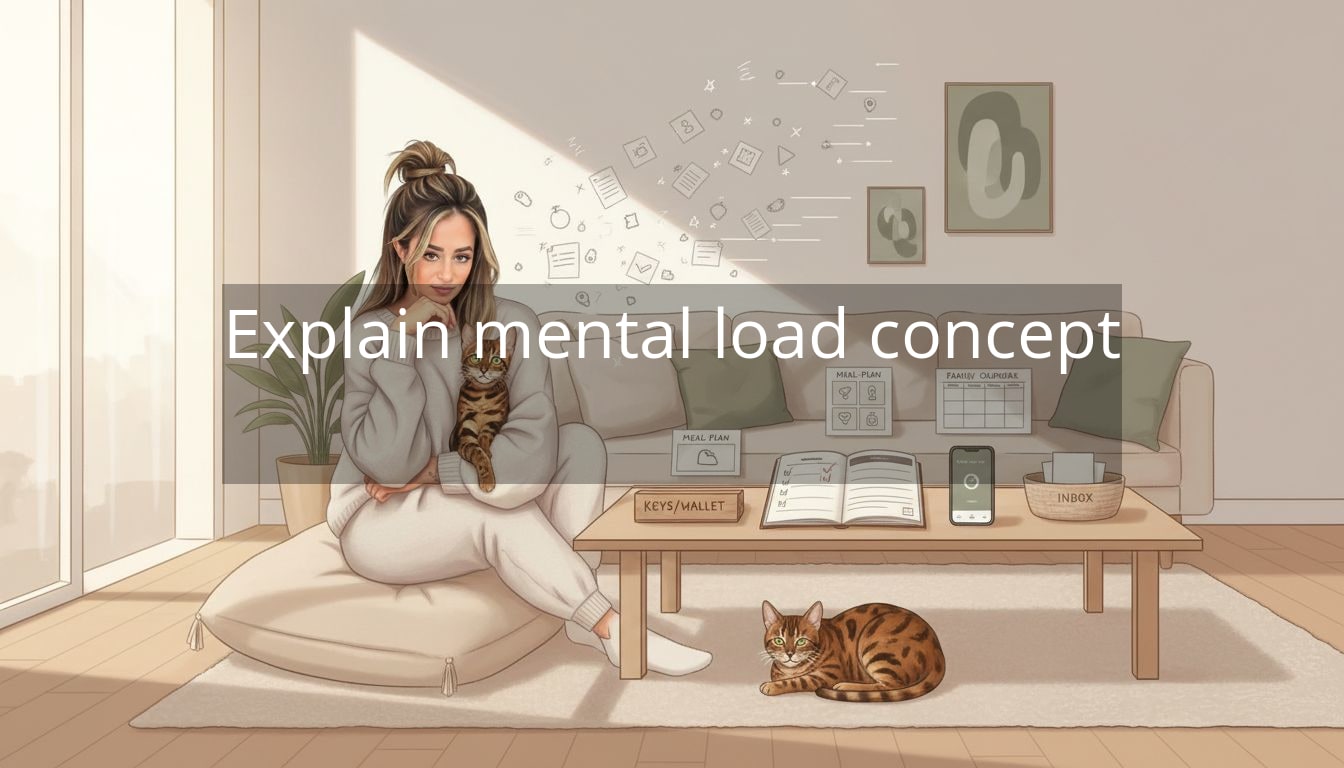
You know that feeling when your brain is still “open” at 10:47 p.m.—replaying tomorrow’s meetings, the groceries you forgot, and the birthday gift you still haven’t ordered? That spiral is often the clearest clue to the mental load meaning: the invisible work of keeping life from falling apart.

Mental Load Meaning: the invisible work behind your busy life
Mental load isn’t just the tasks you do—it’s the thinking about the tasks. It’s noticing the toilet paper is low, remembering the dentist appointment, planning something healthy for dinner, anticipating a client follow-up, and quietly tracking everyone’s needs so nothing gets dropped.
A big reason it feels so heavy is that it’s boundaryless. Your brain carries it everywhere: grocery aisles, Slack messages, workouts, the shower. And because it’s mostly invisible, it rarely gets “counted” the way physical chores do. If you live with a partner or family, mental load also tends to pile onto the person who naturally plans, remembers, and anticipates—often without anyone deciding that’s how it should be.
“Clarity isn’t more effort—it’s fewer open loops.”
The mindset shift: make the invisible visible
The first calming shift isn’t doing more. It’s seeing what you’re already carrying. When mental load stays in your head, it feels like you should be able to handle it—until you can’t. When it’s out in the open, it becomes something you can organize, share, and improve.
Try this simple mini-system for the next few days: keep a running “mental tabs” list in your notes app. Not a perfect to-do list—just capture the stuff your brain keeps pinging you with (“book vet,” “pay invoice,” “check in on mom,” “wash gym clothes”). Apple Notes, Google Keep, or a Notion page works fine.
Two small tools that reduce daily decision fatigue
- Shared calendar (Google Calendar or iCal): Put everything with a time on it in one place—appointments, deadlines, even “order prescription.” The goal is fewer silent reminders living in your head.
- 5-minute nightly brain dump: Before bed, write tomorrow’s top three priorities and any nagging “don’t forget” items. This is less about productivity and more about letting your nervous system unclench.
Once you start tracking what’s actually taking up space in your mind, patterns show up—especially the few categories that create the most pressure day after day.
Where the pressure really comes from: “ownership,” not effort
When you look at your “mental tabs” list, you’ll probably notice something important: the heaviest items aren’t always the hardest tasks. They’re the ones that require ongoing ownership.
Ownership is the full loop—remembering it exists, deciding when it should happen, planning how, gathering what’s needed, following up, and noticing if it didn’t get done. This is why mental load can feel so exhausting even on days when you “didn’t do that much.” Your brain was still running project management in the background.
A helpful question to ask is: What areas of my life am I the default owner of? Common ones:
- Food (planning meals, keeping staples stocked, thinking ahead)
- Schedules (appointments, school/work deadlines, vacations, social plans)
- Home maintenance (supplies, repairs, “we should really…” tasks)
- Relationships (remembering birthdays, checking in on family, emotional temperature-checking)
- Life admin (insurance, bills, forms, renewals, returns)
Mental load meaning in real life: how to share it without creating more work
If you live with a partner, roommate, or family, “helping” often doesn’t solve the real issue—because help can still leave you holding ownership. (You know the pattern: you delegate a task, but you’re still reminding, answering questions, and checking if it happened.)
Instead of splitting individual chores, try splitting domains—clear areas someone fully owns end-to-end. Here’s what that can sound like:
- “Can you own all pet stuff?” (food inventory, vet appointments, meds, grooming reminders)
- “Can you own dinner two nights a week?” (planning, groceries for that meal, cooking, cleanup plan)
- “Can you own utilities and household supplies?” (when things run out, reordering, tracking bills)
This works because it removes the constant “mental supervision” layer. It also makes it clearer when something is dropped, without you automatically becoming the fixer.
A simple script for a calm, non-defensive reset conversation
If you’ve never talked about this explicitly, it can feel surprisingly emotional—because mental load is tied to feeling supported. Here’s a gentle way to open the conversation without turning it into a debate about who’s doing more:
Try: “I’ve noticed my brain is always tracking a lot of things, and it’s starting to affect my sleep and mood. I don’t need us to be perfect—I just want a system where we both own pieces so I’m not the default manager. Can we go through the week and decide who owns what?”
Keep it practical. You’re not asking for mind-reading—you’re building a shared operating system.
Build a “default week” so your brain stops reinventing everything

One of the fastest ways to lower decision fatigue is to create gentle defaults—small routines that remove repeated choices. Not rigid rules. Just “this is usually how we do it.”
Three defaults that make life feel instantly calmer
- Default meals: 6–10 go-to dinners you can rotate (with one “backup” like eggs, soup, or frozen dumplings). Less staring into the fridge wondering what dinner’s supposed to be.
- Default admin day: One block (even 30 minutes) that’s for bills, scheduling, forms, and emails that nag you. Your brain relaxes when it knows there’s a container for that stuff.
- Default reset: A weekly “house sweep” where you do a quick trash/recycle, laundry start, restock check, and glance at the calendar. The goal is not a perfect home—just fewer surprises.
Think of defaults as guardrails. They reduce the number of times your brain has to ask, “Wait—when are we supposed to do that?”
Tools that actually help (because they reduce open loops)
The best tools don’t turn your life into a spreadsheet—they simply move the remembering out of your head and into a trusted place.
1) A shared calendar that becomes the “source of truth”
You already started this—now make it a little stronger:
- Put everything with a time on the calendar: appointments, school/work events, travel, “call plumber,” even “renew passport.”
- Add simple reminders that protect future-you (e.g., “order gift” one week before a birthday).
- If you share life with someone, agree: if it’s not on the calendar, it’s not real. (Said kindly. Enforced consistently.)
2) One running list for life admin (so it stops haunting you)
Create a note called “Life Admin.” Any time you think “Oh, I need to…” it goes there. Not because you’ll do it immediately—because your brain needs proof it won’t be forgotten.
Example items:
- Schedule annual physical
- Return the shoes
- Submit reimbursement form
- Check car registration date
Then, during your default admin day, you pick from that list. No more carrying it around mentally like a fragile egg.
3) A shared “Running Low” list for household supplies
This sounds almost too simple, but it’s one of the highest-return systems:
- Create one shared note called “Running Low.”
- If you use the last of something (toilet paper, olive oil, dish tabs), you add it immediately.
- Whoever does the next grocery/Target run checks the list.
This single habit prevents that low-grade stress of constantly scanning the house for what’s about to run out.
Small habits that protect your nervous system (not just your schedule)
Mental load isn’t only about logistics—it’s also the feeling of being “on” all the time. These habits help your brain believe it’s safe to power down.
The “closing shift” ritual (5 minutes, end of work or end of day)
Before you transition—work to home, or day to night—do a quick closing shift:
- Write tomorrow’s top 1–3 priorities
- Capture any loose worries (“email Sarah,” “pay parking ticket”)
- Choose the first next step for the most annoying item (even “find the login” counts)
This is subtle but powerful. Your brain doesn’t relax when everything is done—it relaxes when everything is contained.
Use “if-then” rules for repeat stress points
If you keep hitting the same mental speed bumps, turn them into an if-then rule:
- If an invitation arrives, then I answer within 24 hours (yes/no/maybe), so it doesn’t live in my head.
- If I notice I’m out of something, then it goes on the Running Low list immediately.
- If I’m tempted to remember something “later,” then I capture it in notes right now.
These tiny rules eliminate whole categories of background stress.
You don’t need a more disciplined brain—you need a kinder system.
A gentle way to know it’s working
You’ll know your systems are helping when:
- You stop rehearing reminders in your head (“Don’t forget… don’t forget…”)
- You fall asleep faster because tomorrow feels handled
- You feel less resentful because ownership is clearer
- You can be present—without scanning for what you’re missing
Also: you don’t need to fix every category at once. Choose the one that creates the most daily friction—food, scheduling, supplies, or life admin—and build one simple “container” for it.
More support (if you want to go deeper)
If you’d like additional resources to make this easier, here are a few ideas to explore next:
- A printable or digital weekly review checklist (to reduce “Did I forget something?” anxiety)
- A shared household responsibilities list by domain (ownership-based, not chore-based)
- Meal-planning templates with a rotating “default week”
- Guided journaling prompts for decision fatigue and boundary-setting
Conclusion: calmer doesn’t mean doing less—it means carrying less
Understanding the mental load meaning gives you something incredibly valuable: language for what’s been draining you. And once it’s named, it’s workable.
You don’t need a total life overhaul. You need a few smart places to put the remembering, a couple of shared agreements about ownership, and one or two gentle defaults that keep your week from constantly restarting at zero.
Start small. Make one invisible loop visible today. Then choose one system that lets your brain clock out a little earlier tonight. Calm living isn’t a personality trait—it’s the result of support, clarity, and systems that love you back.
Telegram Galelar
Instagram @galelar_lis
YouTube @galelar
TikTok @galelar_lis