
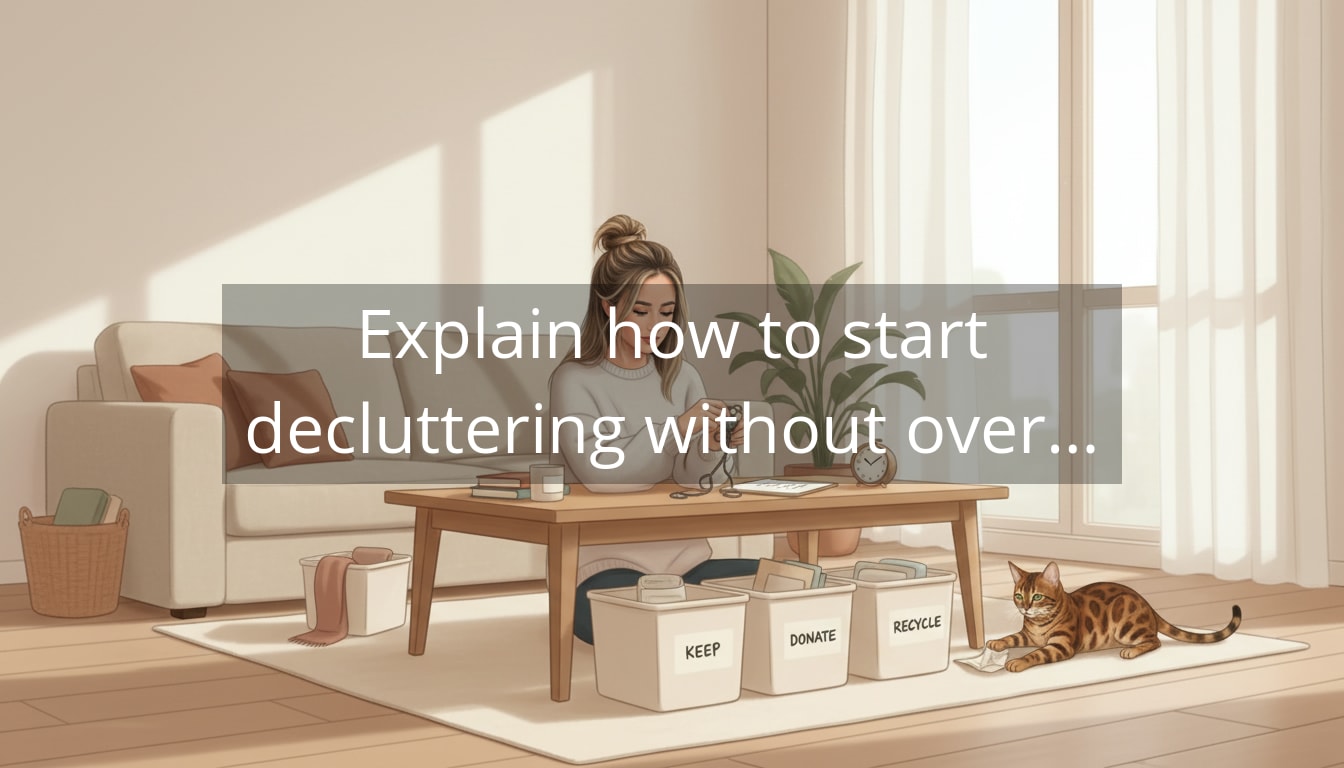
Your calendar is packed, your brain is running 14 tabs at once, and somehow the physical clutter is the thing that finally pushes you over the edge. If you’re wondering how to start decluttering, you’re not alone—and you’re not failing. You’re dealing with a totally normal overload problem: too much input, not enough breathing room.
Why decluttering feels so hard (especially when you’re already tired)
Decluttering gets framed as a “big clean” project, but that’s exactly why it stalls. When you look at everything—the overstuffed closet, the mystery piles on the dining table, the bathroom drawer that won’t close—your brain reads it as one giant task. Cue decision fatigue.
Overwhelm usually comes from three very human things:
- Scope creep: you start with one shelf and suddenly you’re holding old cables from 2016 asking existential questions.
- Emotional friction: sentimental stuff and “just in case” items require more energy than you have on a Tuesday night.
- No visible wins: if nothing looks different after 30 minutes, motivation disappears fast.
“Clarity isn’t created by doing everything—it’s created by removing what isn’t essential.”
How to start decluttering: the mindset shift that changes everything
The calmest approach is simple: stop aiming for a “decluttered home,” and aim for a clear surface. Visible clutter is loud. Clear one small spot, and you get immediate mental relief—which creates momentum without the drama.
Try this tiny system: one space, one timer, one decision rule.
- One space: pick a micro-zone (one counter, one drawer, one shelf).
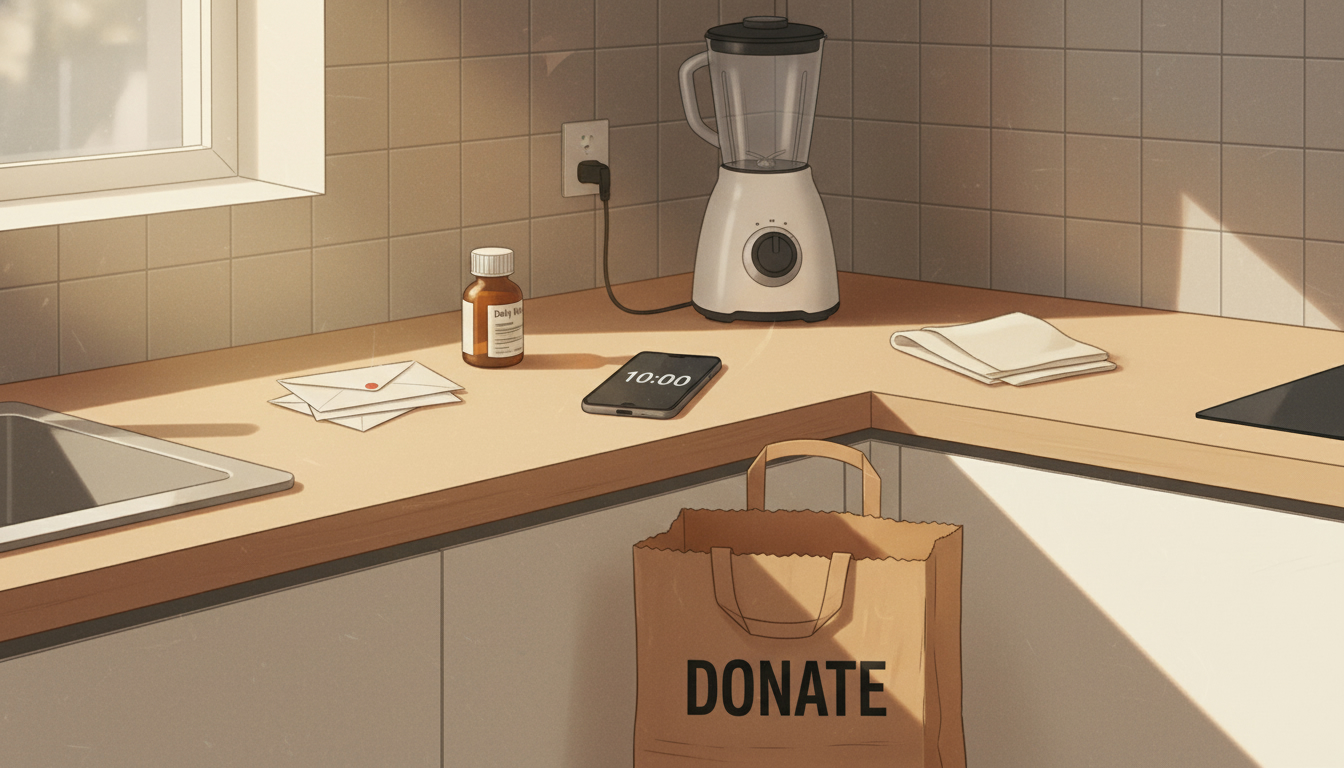
- One timer: set 10 minutes using your phone’s Clock app (or a gentle-focus app like Forest). When it ends, you stop.
- One decision rule: as you touch each item, ask: Do I love and use this? If not, it goes into a donation bag or trash immediately.
Start with “easy wins” first—obvious trash, duplicates, and items that already have a better home elsewhere. You’re not organizing yet; you’re creating space so organizing actually works later. And once that first small zone looks calmer, you’ll be ready to choose the next spot with a lot less resistance.
How to start decluttering when you only have 10 minutes
Now that you’ve proven you can create a clear surface, the next question is usually: Okay… but how do I keep going without turning my whole week into a mess?
Here’s the gentle truth: you don’t need more time. You need a repeatable format that protects your energy.
Try this “10-minute loop” that works especially well when you’re juggling work, life, and a brain that’s already doing a lot:
- Minute 1: Pick the next micro-zone (one drawer, one shelf, one corner of the counter).
- Minutes 2–8: Pull items out quickly and sort into simple categories: Keep here, Put elsewhere, Donate, Trash/Recycling.
- Minutes 9–10: Put back only what belongs in that zone. Stop when the timer ends—even if it’s not “perfect.”
This structure matters because it prevents the classic decluttering trap: pulling everything out, getting interrupted, and living with chaos piles for three days.
A decision rule that stops the “But what if I need it?” spiral
When you’re tired, your brain will try to turn each item into a courtroom case. So give yourself a default verdict. A few calm rules that speed things up:
- The “love and use” rule: If you don’t love it and you don’t use it, it’s not earning space in your home.
- The duplicate rule: Keep the best one. Let the rest go (especially with kitchen tools, travel toiletry bags, extra phone chargers).
- The 20/20 concept: If you can replace it in 20 minutes for under $20, it’s usually not worth storing “just in case.”
- The container rule: The drawer/shelf is the boundary. When it’s full, something has to leave before something new stays.
If you get stuck on an item, don’t force a dramatic decision. Put it in a tiny “maybe” pile and move on. Momentum first, perfection later.
What to declutter first (so you feel it immediately)
If you want relief fast, start where clutter creates the most daily friction—places you touch constantly. These areas give you visible wins and reduce mental load almost instantly:
- Kitchen counter hot spots: papers, random vitamins, half-empty bags, appliances you never use.
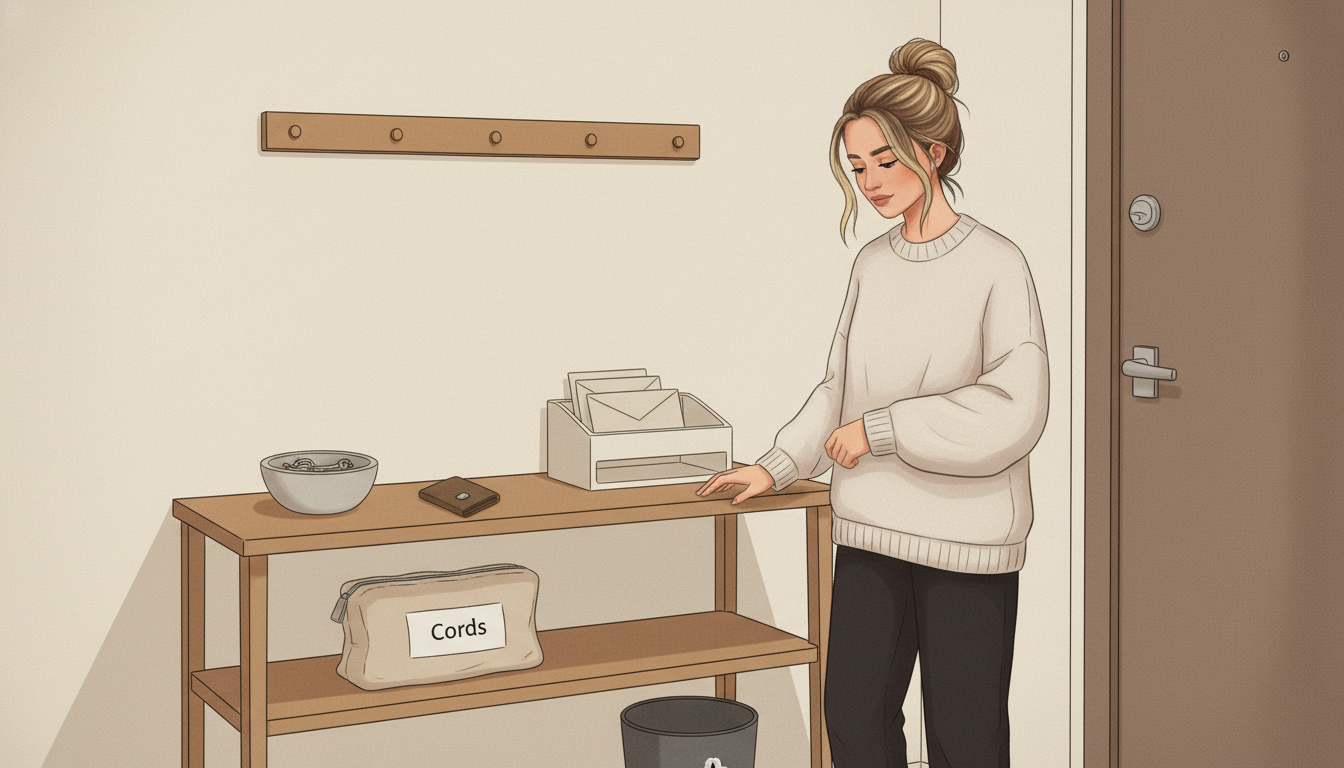
- Your “launch pad” area: where keys, bags, mail, and sunglasses pile up.
- Bathroom drawer: expired makeup, old samples, hair ties that multiply like they’re on payroll.
- Nightstand: the quiet stress pile (receipts, cords, skincare you don’t like, books you feel guilty about).
Notice we’re not starting with the garage or the sentimental storage bins. Those areas ask a lot of you. Build confidence on easy zones, and the harder spaces get easier later.
A simple “one-touch” setup for daily clutter magnets
Most clutter isn’t a stuff problem—it’s a “no home” problem. Create homes for the items that constantly float around, using the fewest steps possible:
- Mail: a small tray + recycling bin nearby. Junk goes straight to recycling. Important mail goes in the tray.
- Keys/wallet: one hook or bowl by the door. Not two. One.
- Cords: one labeled pouch or small box. If it doesn’t fit, you have too many.
- Returns: one bag near the door. When it’s full, schedule one errand drop-off.
This is how you stop re-cluttering: fewer steps, clearer homes, less thinking.
How to start decluttering with a donation system that actually leaves your house
Donation piles are where good intentions go to stall. The trick is to make “out” as easy as “keep.”
Set up a basic exit system:
- One donation bag/box that lives in an accessible spot (laundry room, coat closet, near the front door).
- A non-negotiable trigger: when the bag is 80% full, it gets scheduled to leave—drop-off on your next grocery run, or a pickup if that’s available in your area.
- Remove it quickly: the longer it sits, the more likely you’ll second-guess and “shop your own donations.”
If you’re worried you’ll regret donating something, seal the bag and write a date on it. If you don’t open it within 30 days, donate it. You get the comfort of a safety net without keeping the clutter indefinitely.
Real-life examples (because this is where it gets messy)
If you keep moving piles from the dining table to the counter: you don’t need more willpower—you need categories. Create three small landing zones: “to file,” “to act on,” “to return.” Then set a 10-minute timer twice a week to clear them.
If your closet is full but you still feel like you have nothing to wear: pull out the items you reach for repeatedly and hang them together. That’s your “real wardrobe.” Then work through the rest using quick checks: uncomfortable, itchy, needs fixing you never do, not your current life. Let your closet match the life you actually live.
If you get stuck on sentimental things: choose one small container (a shoe box-sized bin) as your “memories box.” Keep what truly matters inside that boundary. Take photos of items that hold meaning but not function. You’re allowed to keep memories without keeping everything.
Small clears done consistently are more powerful than one perfect weekend you never have.
Keeping it calm: the maintenance habits that prevent re-cluttering
Decluttering isn’t a one-time personality overhaul. It’s a few tiny habits that keep your space from getting loud again.
- The 2-minute reset: before bed (or after dinner), set a 2-minute timer and clear one surface. Not the whole house—one surface.
- One in, one out: when a new item enters a category (new lipstick, new mug, new workout top), one leaves. This single rule keeps storage from quietly overflowing.
- “Touch it once” for papers: open mail near the recycling bin. Decide immediately: trash, file, or action tray.
- Weekly mini-check: pick one zone each week (bathroom drawer, fridge shelf, entryway). Ten minutes. Done.
If you fall off for a week (or three), nothing is ruined. You just return to the smallest possible step: one space, one timer, one decision rule.
Extra resources if you want more structure
If you’d like gentle guidance you can follow without thinking too hard, additional resources are available to support your momentum:
- Printable micro-zone checklists for quick wins (counters, drawers, bags, and bathroom shelves)
- Simple room-by-room declutter maps so you always know what to do next
- Donation and “outbox” reminders to help items actually leave your home
- Short guided declutter videos for 10–15 minute sessions when you need body-doubling energy
A calmer home is a lighter brain
You don’t have to earn a peaceful space by doing a massive purge. The calm you want is built in small, steady choices—clear one surface, make one decision a little faster, set up one simple home for the things that keep drifting.
When you learn how to start decluttering in a way that respects your energy, you’re not just tidying. You’re reducing the background noise in your life. And that means fewer decisions, fewer frantic searches, and more room to breathe—right in the middle of your real, busy, beautiful days.
Telegram Galelar
Instagram @galelar_lis
YouTube @galelar
TikTok @galelar_lis