
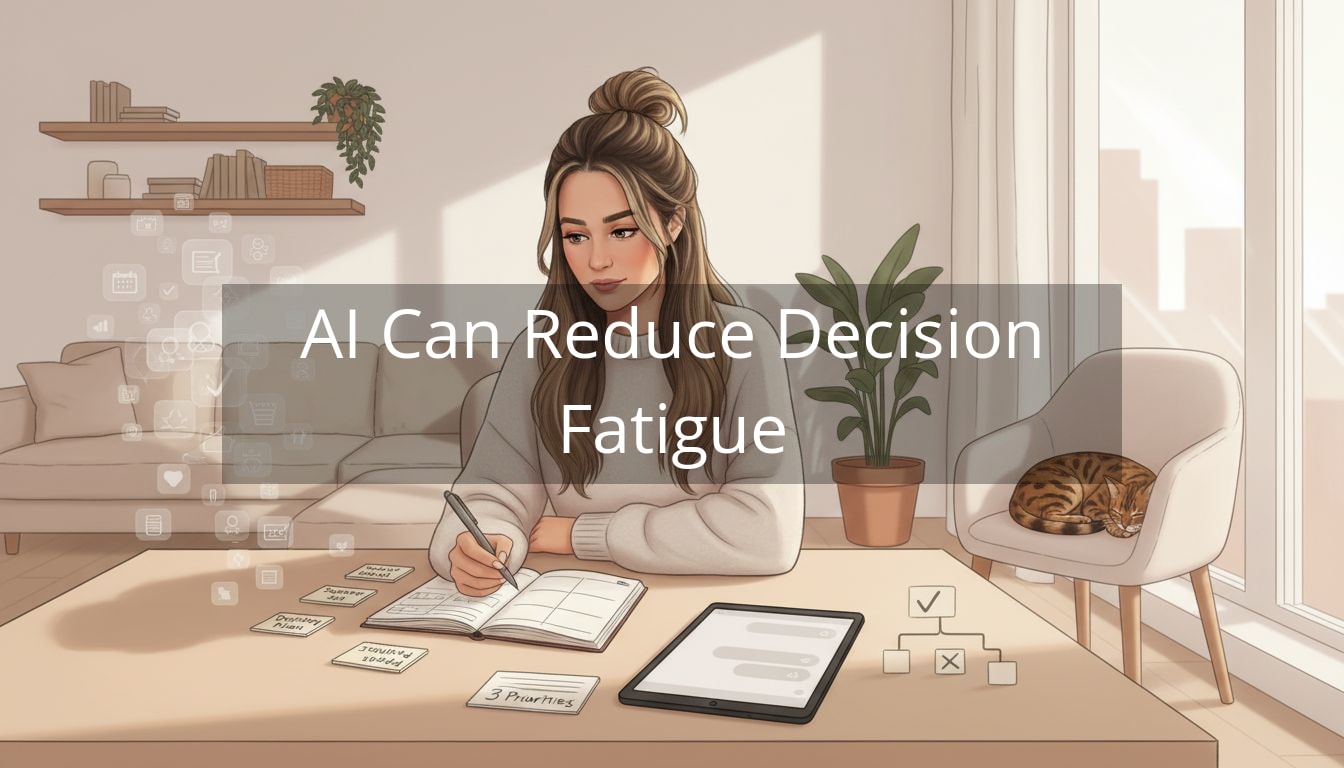
If you’ve been feeling weirdly exhausted by 6 PM—like you’ve run a marathon even though you “only” worked, commuted, and kept yourself alive—AI decision fatigue might be the missing explanation. Not because AI is burning you out, but because it can finally be the thing that helps you stop spending your best brainpower on the smallest choices.
Picture a normal weekday: you wrap up the last call, close the laptop, and immediately your brain gets hit with a rapid-fire quiz. What’s for dinner? Do you work out or do laundry? Reply to that email now or tomorrow? Is tomorrow too late? Should you order groceries or just “make something work”? None of these decisions are dramatic on their own. But they stack—quietly, relentlessly—until you feel snappy, foggy, and oddly incapable of doing one more thing.
This is the modern trap: we’re not doing one hard thing. We’re doing hundreds of tiny things, all day long, with almost no empty space between them.

The real reason you feel overloaded (and it’s not a character flaw)
Decision fatigue isn’t a motivational problem. It’s a capacity problem.
Your brain has a limited amount of high-quality “executive” energy—the kind you use for planning, prioritizing, resisting distractions, making careful choices, and regulating emotions. Every time you decide anything—even small stuff like “which leggings are least wrinkled” or “what subject line won’t sound annoying”—you spend a little of that energy.
By late afternoon, the same brain that handled a complex meeting at 10 AM can feel personally victimized by choosing a sandwich.
And modern life is basically an endless buffet of options:
- 300 open browser tabs (or it feels like it)
- 17 ways to meal prep, but also 17 opinions about why your way is wrong
- an inbox full of messages that all sound “quick”
- a to-do list where everything looks equally urgent
- content and advice coming at you nonstop—most of it framed like you’re one perfect routine away from greatness
So instead of doing fewer things, we do more deciding. We second-guess. We research. We compare. We keep mental notes running in the background like a dozen apps draining our battery.
That’s where AI decision fatigue becomes such a useful lens: it helps you see that the pain isn’t only “too much work.” It’s also too many choices—especially the repetitive, low-stakes ones that don’t deserve your best attention but still consume it.
Why the small decisions are the ones that break you
Big decisions can be tiring, sure. But they’re usually occasional, meaningful, and you can often prepare for them.
Small decisions are sneakier. They show up constantly, demand immediate attention, and create friction right when you’re already stretched. They’re the micro-pauses that interrupt your momentum all day:
- “What should I start with?”
- “What’s the best way to respond to this?”
- “Do I need to do this today or can it wait?”
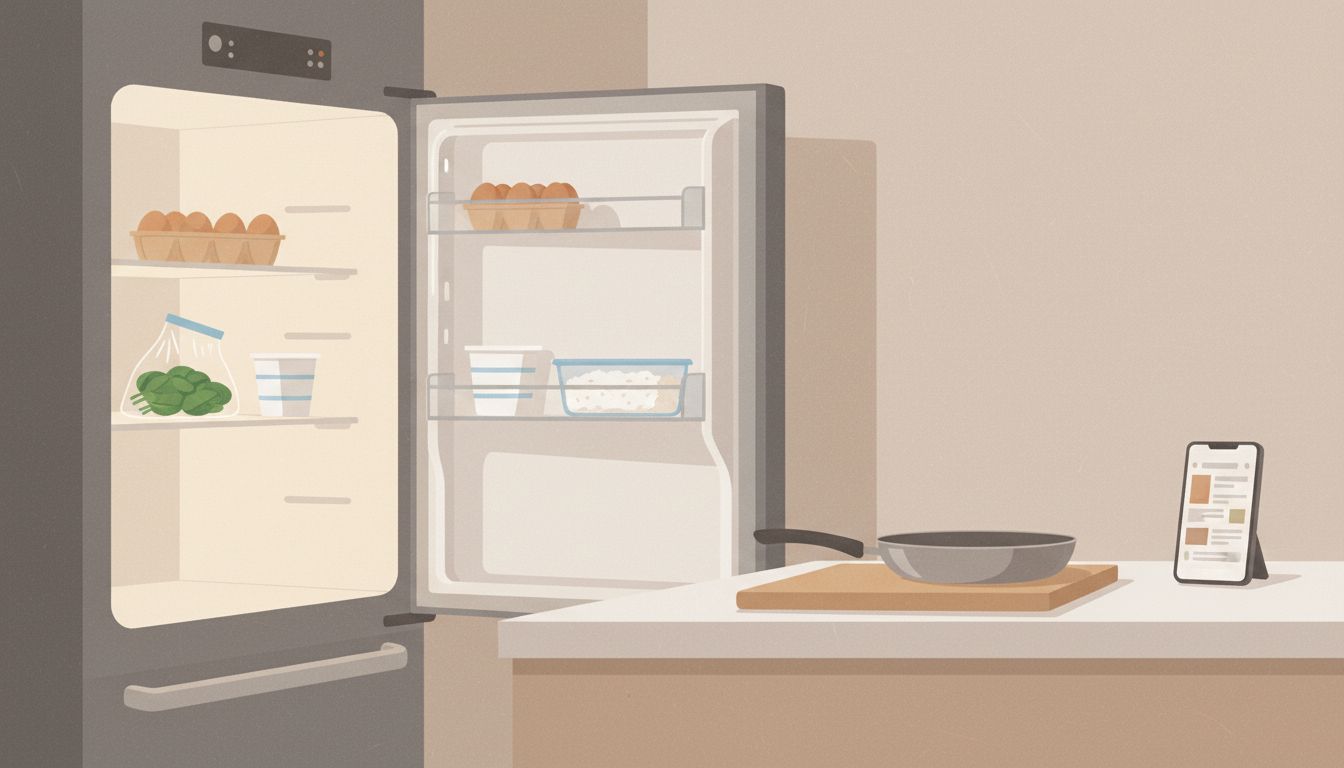
- “What’s a healthy dinner that won’t take forever and won’t waste what’s in the fridge?”
It’s not that you can’t answer these. It’s that you shouldn’t have to answer them from scratch every single time.
Clarity isn’t found by trying harder—it’s built by deciding less.
That’s the shift: instead of muscling through decision overload, you build a calmer system that reduces the number of times you have to “figure it out.”
The core idea: let AI handle the low-stakes thinking
When people hear “use AI,” they sometimes imagine handing over their entire life to a robot. That’s not the vibe. The sweet spot is much simpler—and much more humane.
Think of AI as a junior assistant for the boring decisions. Not your boss. Not your brain. Just the helpful support that can:
- generate options quickly
- narrow your choices
- take your rough thoughts and turn them into a usable draft
- summarize information so you don’t have to wade through it
- create a default plan so you can stop reinventing the wheel
The relief comes from one big thing: less wrestling with “what should I do?”
You still choose. You’re still in charge. But you’re not starting from a blank page when your energy is already low.
If you’re susceptible to perfectionism (many of us are), this is especially powerful because AI can move you from “ideal plan fantasy” to “good enough plan I can actually do tonight.”
How AI decision fatigue shows up in real life (and where to start)
The best place to use AI isn’t in your most sensitive, high-risk decisions. It’s in the repeatable areas where you regularly lose time and energy.
A helpful way to spot these: look for the moments you sigh and think, “I can’t believe I have to decide this again.”
Here are a few high-impact categories where AI decision fatigue relief tends to be immediate.
1) Dinner decisions (the daily energy vampire)
Dinner isn’t just one decision. It’s a chain of them:
- What do I feel like?
- What do I have?
- What will be fast?
- What won’t create a sink full of dishes?
- What will future-me be happy about?
When you’re tired, this chain turns into scrolling recipes, ordering takeout you didn’t even want, or eating random items while standing. Very “adult woman in a thriving era,” right?
This is where a simple AI prompt can replace 20 minutes of mental negotiation. You can ask:
- “Create a 5-day dinner plan with 30-minute meals, higher protein, and repeat ingredients to reduce waste.”
- “Use what I already have: chicken, rice, spinach, yogurt, eggs. Give me 3 dinners and a grocery list for missing items.”
- “Plan 3 lazy dinners for a stressful week—minimal prep, minimal dishes.”
If you want the calmest version of this: ask AI for one default weekly template (like “Taco Tuesday, sheet-pan Thursday”) and rotate variations. Fewer novel decisions, more automatic ease.
2) Picking your top 3 tasks (when your to-do list becomes a fog)
A modern to-do list isn’t a list. It’s a pile. And piles make your brain freeze because everything looks equally important when you’re already overloaded.
AI can help by turning the pile into an ordered plan—especially if you give it context. Try:
- “Here’s my task list. Identify the top 3 tasks that will reduce stress the most today.”
- “Prioritize these based on revenue and urgency. I’m a freelancer and I have 4 focused hours.”
- “Group these into: must-do today / can-wait / delegate / delete.”
Notice what’s happening: you’re not asking AI to do your life. You’re asking it to remove the indecision that keeps you stuck at the starting line.
3) Routine emails and messages (the invisible time leak)
So much mental energy goes into writing tiny messages that aren’t hard, just… draining:
- the polite follow-up
- the “circling back”
- the decline that doesn’t sound cold
- the reschedule that doesn’t sound flaky
- the “yes, but” boundary-setting reply
AI is excellent at giving you a solid draft you can edit in your own voice. The key is to tell it the tone:
- “Write a short, warm, professional reply declining this request.”
- “Draft a boundary-setting message that’s kind but firm. Keep it under 90 words.”
This is one of the fastest ways to reduce AI decision fatigue because you’re removing a high-frequency, low-reward drain.
A simple starter setup (so this doesn’t become “one more thing”)
You don’t need a complicated tech stack. In fact, too many tools can create a new kind of overwhelm. Start with one AI assistant you like and use it for a few repeating scenarios.
A calm, low-friction “starter kit” could be:
- ChatGPT for meal planning, task prioritization, drafts, and lists
- Claude if you prefer responses that feel more conversational and nuanced
- Perplexity when you want AI-powered searching and quick summaries (less rabbit-holing)
If you already live in Notion, Notion AI can be helpful because it keeps your thinking and your plans in the same place—less app hopping, less friction.
The goal isn’t to become an AI power user. The goal is to create a tiny ritual of support—like delegating a few small choices so you can keep your actual life feeling spacious.
One surprisingly effective approach: choose two “AI zones” in your day.
- Morning (5 minutes): paste your to-do list → ask for top 3 + first step
- Late afternoon (5 minutes): ask for dinner plan using what you have → get a grocery mini-list
That’s it. Not a reinvention. Just fewer moments where you hit a wall and have to think from scratch.
And once that starts working, you’ll notice something important: the biggest relief isn’t even the time saved. It’s the feeling of moving through your day with fewer tiny internal negotiations—because those are what quietly create the sense that everything is “too much,” even when nothing is technically going wrong.
From here, the next step is making your AI prompts and routines feel like a system you can trust—so you’re not constantly re-explaining your preferences, rewriting the same requests, or getting options that don’t actually fit your real life…

…so you’re not constantly re-explaining your preferences
The easiest way to make this sustainable is to stop treating AI like a “fun idea” and start treating it like a dependable assistant with a few saved briefs. The goal is simple: set your defaults once, then reuse them when your brain is tired.
Here’s the approach that tends to work best for busy women: build a tiny “prompt library,” create two or three life templates, and add a quick review step so you stay in charge without doing extra thinking.
Build a tiny prompt library (so AI actually sounds like it knows you)
If you’ve ever tried AI once or twice and thought, “Okay…but I’d have to explain my whole life every time,” this is the fix. You don’t need 50 prompts. You need 5–7 solid ones that cover your highest-friction moments.
Start with a “My Preferences” note (copy/paste once)
Keep this as a note on your phone (or in Notion). When you want better results, paste it in before your request.
- Food: dietary needs, dislikes, cooking time limit, budget range
- Schedule reality: commute, workout preferences, childcare/pet care, late meetings
- Energy patterns: “I’m sharp 9–12, slow at 3 PM,” “I crash after social plans”
- Non-negotiables: bedtime, no work after X, one night for friends, etc.
- Tone settings: “No hustle language,” “Give me fewer options,” “Be direct”
That one note prevents a lot of the frustration that can make AI decision fatigue feel like “another tool that needs managing.”
5 prompts that remove a surprising amount of mental load
-
1) “Give me 3 options and choose one.”
“Based on the ingredients I have (list), give me 3 dinners under 30 minutes. Then recommend the best one for the lowest cleanup.” -
2) “Tell me the first step.”
“Here are my tasks. Pick the top 3 and tell me the first physical step for each (what I do first, not what I should ‘think about’).” -
3) “Make this decision smaller.”
“I’m stuck choosing between A and B. Ask me 5 questions that would make this obvious, then summarize what you think I’m prioritizing.” -
4) “Draft the message in my tone.”
“Write a short reply that’s warm, confident, and firm. I want to say no without over-explaining. Keep it under 80 words.” -
5) “Create a default plan I can repeat.”
“Build me a weekly routine template (morning, work blocks, evening) that’s realistic for someone with low evening energy. Include two ‘catch-up’ buffers.”
The pattern here is intentional: you’re repeatedly asking for fewer choices, clearer steps, and reusable defaults. That’s how you reduce decision load without creating a new kind of overwhelm.
Create “default decisions” (the calmest way to beat AI decision fatigue)
Even with AI support, you’ll still burn out if everything is an open-ended choice. The win is having a handful of defaults that you trust—so on a normal weekday, you’re mostly executing, not negotiating with yourself.
Default #1: The “Weeknight Dinner Formula”
Instead of asking “What should we eat?” ask “Which category is tonight?” Create 3–5 categories and rotate.
- Sheet pan (protein + veg + one sauce)
- Bowl night (grain + protein + crunchy thing + dressing)
- Breakfast for dinner (eggs + something green + toast)
- Freezer friend (something you planned for on purpose)
- Leftovers remix (turn “sad leftovers” into wraps, fried rice, salads)
Then use AI only for the part that drains you: the specific idea. Example prompt: “Tonight is bowl night. Give me 4 variations using chicken or chickpeas, minimal chopping, and a simple sauce.”
Default #2: The “End-of-Work Shutdown” mini-script
If your brain spins all evening, it’s often because it never got a clear “we’re done” signal. A shutdown routine reduces the mental background tabs.
- Capture: dump loose thoughts into one list (2 minutes)
- Choose: pick tomorrow’s top 1–3 outcomes (2 minutes)
- Close: send/park any final messages, then physically close the laptop (1 minute)
If picking the top 3 is where you freeze, that’s a perfect AI assist: paste your dump and ask, “Pick tomorrow’s top 3 that reduce stress and protect deadlines, then tell me what to start with.”
Default #3: A “Good Enough” standard (so you stop optimizing everything)
This is the sneaky one. A lot of exhaustion comes from treating low-stakes decisions like they deserve a high-stakes process. If you struggle with perfectionism, give yourself a standard that’s kind and clear:
- Dinner: “Protein + fiber + something I’ll actually eat.”
- Work: “A clear draft by 4 PM is better than a perfect draft by midnight.”
- Home: “Reset the visible surfaces, ignore the rest.”
When you pair that with AI-generated options, you stop chasing the mythical “best” choice—and you start moving.
Use AI like a boundary, not a rabbit hole
One honest downside: AI can create its own version of decision overload if it gives you endless options, endless follow-ups, endless “you could also…”
So give it constraints that protect your attention.
Two constraints that keep you out of the weeds
-
Limit the menu.
Ask: “Give me 3 options max.” Or even: “Give me 2 and pick one.” -
Force a next action.
Ask: “End with the first step I should do in under 2 minutes.”
This is a subtle but powerful reframe: AI isn’t there to entertain your planning brain. It’s there to help you finish things.
Make it real: three tiny “systems” you can copy this week
The 10-minute Sunday reset (that prevents weekday spirals)
-
2 minutes: ask AI for 5 dinners using repeat ingredients
-
3 minutes: generate one grocery list
-
3 minutes: choose your 3 “anchor tasks” for the week (the things that make life feel handled)
-
2 minutes: put two buffer blocks on your calendar
Anchor tasks are not “do everything.” They’re the handful of actions that reduce stress the most—like groceries, one load of laundry, and paying the one annoying bill.
The “I’m overwhelmed” script (copy/paste to AI)
When you’re at capacity, you don’t need motivation. You need triage.
Prompt: “I’m overwhelmed. Here’s what’s on my mind (paste). Please: 1) identify what’s actually urgent in the next 24 hours, 2) pick one small action I can do in 10 minutes to feel relief, and 3) suggest what can wait without consequences.”
This is where AI can be surprisingly soothing: it reflects the mess back to you in a calmer shape.
The “message bank” (to stop rewriting the same texts)
Ask AI to draft and save versions of:
-
a polite follow-up
-
a kind no
-
a reschedule
-
a boundary (“I can’t take this on, but I can do X.”)
Then you’re editing from a template, not composing from scratch when your energy is low.
You don’t rise to the level of your intentions—you fall to the level of your systems.
Conclusion: calmer living is built, not wished for
If your days have been feeling heavy, it’s not because you’re doing life “wrong.” It’s because modern life asks for constant micro-decisions, and your brain was never meant to run that many tabs at once.
The most practical gift of addressing AI decision fatigue is this: you get to reserve your best thinking for the things that actually deserve you—your work that matters, your relationships, your health, your rest. Let AI take the low-stakes friction. Let defaults carry you on ordinary days. Let your systems be the thing that catches you when your energy isn’t heroic.
You don’t need a perfect routine. You need a few supportive ones you can trust—so your life feels calmer, lighter, and more yours again.
Additional visual resources
If you’d like extra visual guidance and updates, you can find more resources here: