
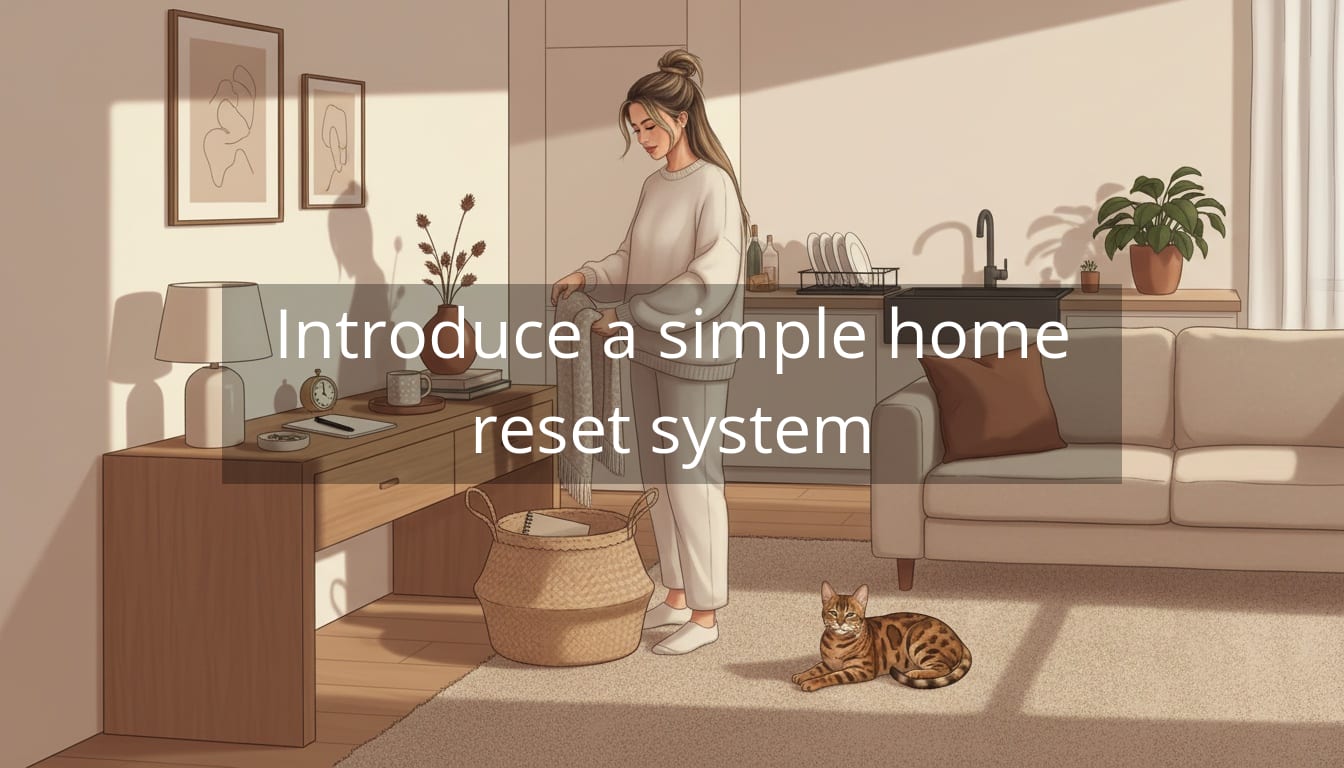
You know that moment when you finally sit down… and the mess on the counter is somehow louder than your thoughts? An evening reset routine is the simple way to lower that noise in under 30 minutes—so your night feels like a landing, not another shift.
The problem isn’t that you “can’t keep up.” It’s that modern life creates endless micro-piles: a delivery box by the door, half-sorted laundry, tomorrow’s bag on the chair, tabs still open from work, texts you meant to answer. By evening, decision fatigue hits hard, and your brain starts treating every visible item like an unfinished task. That’s why clutter can feel weirdly emotional at night—your environment is echoing your mental load.
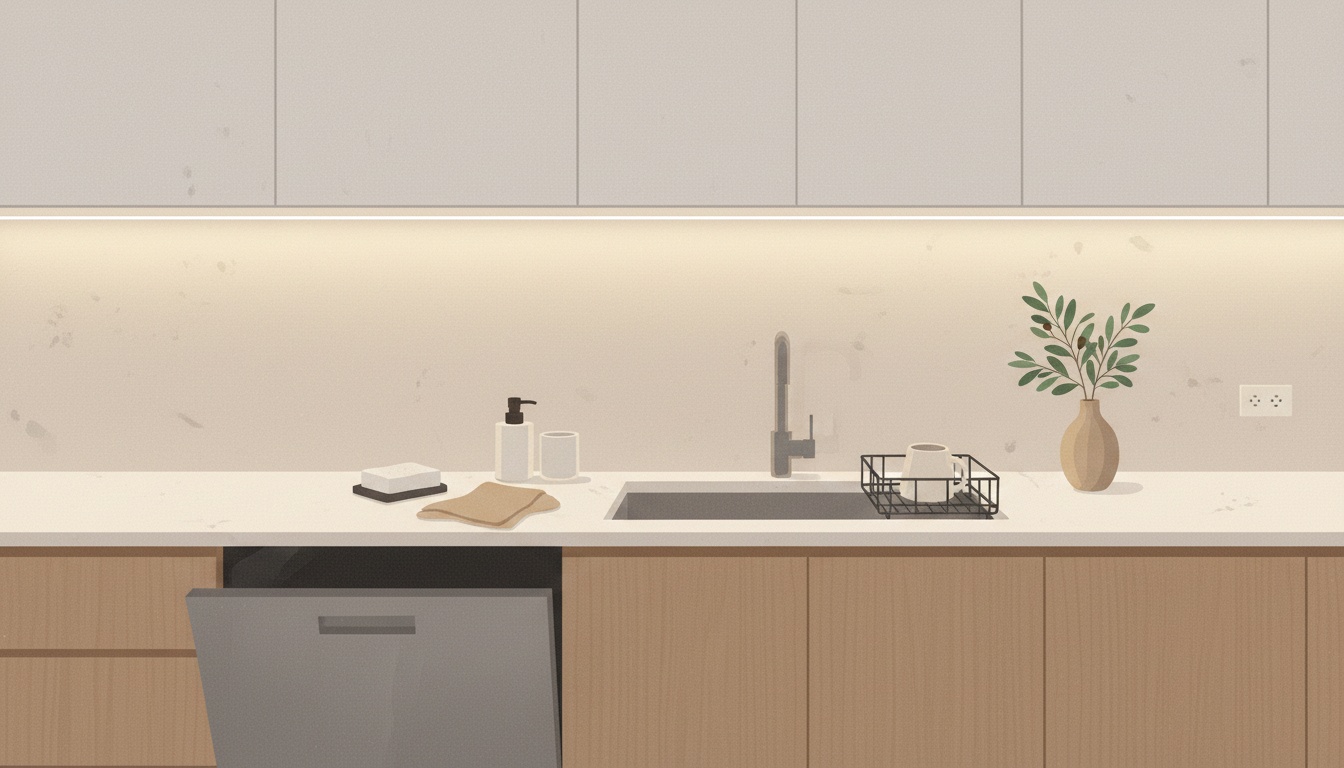
“Clarity isn’t a big breakthrough—it’s the quiet result of small things being put back in place.”
This is where the mindset shift matters: an evening reset routine isn’t cleaning. It’s “returning your home to baseline.” Think of it like putting your space (and your brain) to bed. You’re not aiming for perfect—just a calmer default that makes tomorrow easier.
Start with a short, repeatable flow you can do even when you’re tired:
- Set a timer for 10 minutes. (Your phone works—use Clock or a gentle routine app like Structured.) A timer turns it from “endless chores” into a contained reset.
- Do a quick kitchen reset first. Load the dishwasher or wash the few essential items, clear the sink, wipe the counters. This one step changes the whole mood of the house.
- Create a tiny “launch pad.” Put a basket or tray by the door for keys, wallet, headphones, and anything that must leave with you. Fewer morning scavenger hunts = immediate mental relief.
- Do a 60-second digital offload. Close work tabs, put your phone on Do Not Disturb, and jot tomorrow’s top 3 priorities in Notes, Notion, or a paper journal—whatever you’ll actually check.
Once those pieces are in place, you can build a routine that feels less like discipline and more like a nightly exhale.
Build Your Evening Reset Routine Around “Friction Points”
The easiest way to make an evening reset routine feel natural is to base it on what regularly trips you up. Not what you think you should do—what actually creates stress in your real life.
So before you add more steps, take a quick inventory:
- Where do mornings break down? (Missing keys, no clean mug, can’t find your laptop charger.)
- What makes you feel tense at night? (A messy kitchen, piles on the chair, ten open work tabs.)
- What steals time tomorrow? (Packing lunch last-minute, choosing an outfit, hunting for paperwork.)
Your routine should target the top 2–3 friction points first. That’s how you get a big calm payoff without turning the night into a cleaning marathon.
A simple “zones” approach (so you don’t tidy the whole house)
Instead of trying to reset everything, rotate through a few high-impact zones. Most nights, you only need three:
- Kitchen zone: sink, counters, dishwasher, trash
- Landing zone: entryway + your “launch pad” tray/basket
- Living zone: coffee table, couch area, the chair that collects everything
If you have energy, add one “bonus zone” on certain nights (bathroom counter, a laundry sweep, quick vacuum). If you don’t, you still go to bed with the core areas handled—which is usually what your brain is craving.

A 20-Minute Evening Reset Routine You Can Actually Repeat
Here’s a realistic flow that works even when you’re tired, even when you didn’t have a perfect day, even when the apartment got away from you. Keep it simple enough that you’ll do it on a random Tuesday.
Minute 0–2: Set the scene
Start the timer. Put on one song, a short playlist, or an ambient track. This sounds small, but it helps your nervous system register: we’re closing the day.
Minute 2–10: Kitchen reset (the mood-changer)
This is the “make the whole home feel calmer” step.
- Load the dishwasher or wash the few essentials (mugs, knives, your favorite pan)
- Clear the sink (even if you just stack neatly)
- Wipe the counters and stove area
- Quick trash/recycling check
Real-life version: If you cooked and the kitchen looks chaotic, you’re not aiming for spotless. You’re aiming for “tomorrow-me won’t sigh when she walks in.” That’s the bar.
Minute 10–15: Surface sweep + “return to home” basket
Grab a small basket (or tote) and do a fast sweep of the main area. The rule: don’t organize, just collect.
- Anything that belongs elsewhere goes in the basket
- Put away only what’s easy and obvious
- Leave the basket in a designated spot to empty tomorrow (or during a weekend reset)
This prevents the classic trap where you start tidying and suddenly you’re reading old mail or reorganizing a drawer at 10:47 p.m.
Minute 15–18: Tomorrow prep (small steps, big relief)
This is where you buy yourself a calmer morning with a few tiny decisions made tonight.
- Put essentials on the launch pad: keys, wallet, badge, headphones
- Charge what you’ll need: phone, watch, laptop
- Do a quick glance at tomorrow’s calendar
If mornings are your hardest time, add one more thing: set out a mug and your preferred breakfast option (even if it’s just a yogurt on the front shelf). When you remove one morning decision, your whole day starts softer.
Minute 18–20: 60-second mental offload (so your brain stops spinning)
Write down:
- Your top 3 priorities for tomorrow
- One open loop you’re worried you’ll forget
- One small win from today (yes, it counts if you just got through it)
Then close the laptop tabs. Put your phone on Do Not Disturb. Let the day have an ending.
Make It Stick Without Needing “Motivation”
The secret to consistency isn’t discipline—it’s design. A good evening reset routine is built to be easy on your lowest-energy days.
Use “if-then” plans for chaotic evenings
Some nights are not routine-friendly. That’s normal. Give yourself a fallback plan you can do even when you’re running on fumes:
- If you’re exhausted, then do a 5-minute kitchen-only reset.
- If you had people over, then do trash + dishes + surface sweep (skip everything else).
- If work overflowed into the evening, then do a digital shutdown + tomorrow’s top 3, and leave the rest.
Consistency comes from having an “easy mode,” not from demanding the full routine every night.
Create visual homes for the things that always wander
Most clutter isn’t a cleaning issue—it’s a “no assigned parking spot” issue. Pick 1–2 repeat offenders and give them a home:
- Mail: one tray (not three surfaces)
- Bags: one hook or one chair (not every chair)
- Chargers: one basket near an outlet
- Skincare/makeup: one container that fits your counter space
When an item has an obvious home, your brain stops negotiating with it every night.
Try a gentle “closing shift” script
If your mind tends to stay in work mode, a short phrase can help you transition. Something like:
“The day is closed. The essentials are handled. The rest can wait.”
It sounds almost too simple, but it gives your nervous system an off-ramp—especially if you’re someone who keeps mentally reopening the day after dinner.
“You don’t need a different life—you need a softer way to end the day you already have.”
Tools That Make Your Evening Reset Routine Easier
You don’t need a perfect setup, but a few small tools can remove friction and make the routine feel automatic.
- A small basket or bin: for the “return to home” sweep
- A launch pad tray: keys, wallet, earbuds, badge—whatever you’re always looking for
- A simple timer: phone timer, smart speaker, or a visual timer if you like a gentler cue
- A note system you trust: a bedside notebook, Notes app, or a minimal task list that doesn’t overwhelm you
When you live with other people (and don’t want to be the reset manager)
If you share a space, the routine works best when it’s shared—without turning into a lecture or a negotiation.
- Keep it short: “10-minute reset, then we’re done.”
- Assign micro-jobs: one person dishes, one person surface sweep, one person launch pad.
- Make it visible: a tiny checklist on the fridge (3 items max) helps everyone remember without you carrying it mentally.
If you live alone, you still get the benefit: you’re building a home that supports you, not one that asks you to continually catch up.
Extra resources (when you want more structure)
If you like having a little more guidance, here are a few resource ideas to explore and save for later:
- A simple printable evening checklist you can keep on the fridge or inside a cabinet door
- A short guided “clean with me” reset video for a 10–20 minute timer
- A weekly reset template (Sunday or Monday) to support your nightly baseline
- A minimalist “top 3 priorities” note format you can copy into your phone
A Calm Ending Is a Smart System
An evening reset routine isn’t about having a perfect home or a perfectly optimized life. It’s about giving your brain fewer loose ends to hold onto at night—and giving tomorrow a softer start.
Start small. Keep it repeatable. Let “baseline calm” be the goal.
You deserve evenings that feel like relief, not another round of catching up. With a few simple systems in place, your home can support you back—and your mental load doesn’t have to follow you all the way to bed.
Telegram Galelar
Instagram @galelar_lis
YouTube @galelar
TikTok @galelar_lis