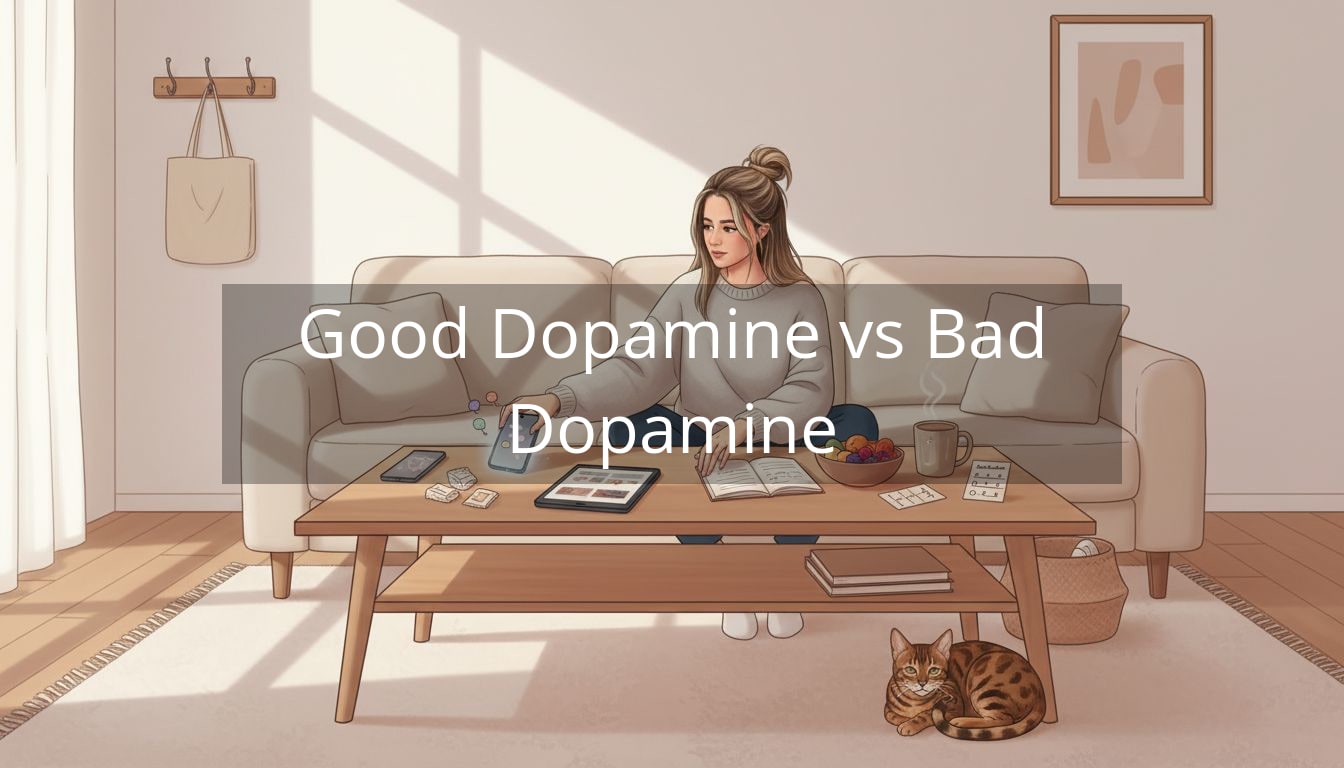
Good dopamine vs bad dopamine explains why you can feel “tired but wired” even on days when you technically didn’t do that much. If you’ve been stuck in the loop of scrolling, snacking, and still feeling oddly depleted, good dopamine vs bad dopamine is the missing lens that makes the whole thing make sense.
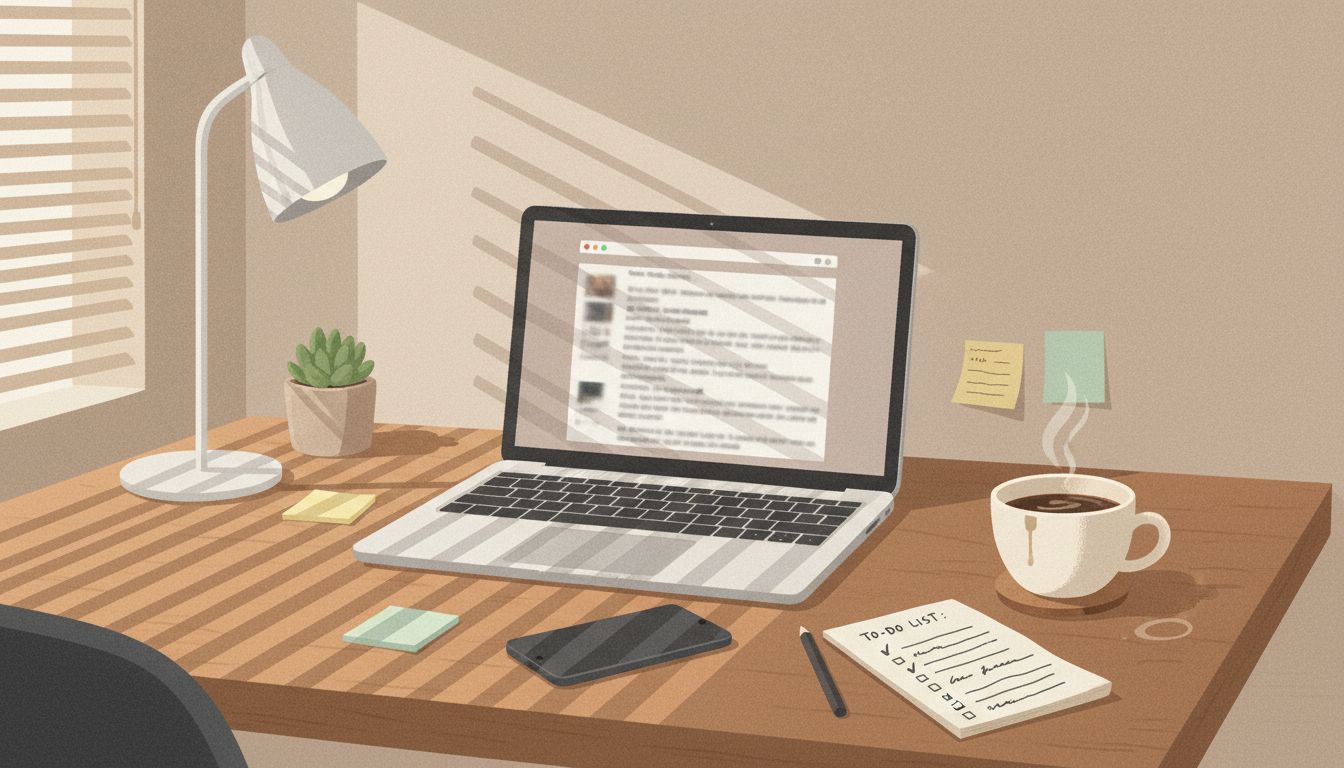
It usually shows up in the most unglamorous moment: 3:07 PM, laptop open, brain blank. Your inbox is loud, your to-do list is louder, and your body starts negotiating. Just a quick check. You pick up your phone for a tiny hit of relief… and resurface 45 minutes later in a haze of reels, messages, and “wait, what was I doing?” By evening you’re running on fumes, dinner feels like a problem to solve, and you’re somehow irritated at everyone you love.
This isn’t a character flaw. It’s a modern-life pattern—and your brain is doing exactly what it was designed to do: seek reward and relief.
Why you feel overloaded (even when you’re “doing fine”)
Most of us aren’t overwhelmed because we can’t manage life. We’re overwhelmed because life now comes with a constant background hum of inputs:
- endless micro-decisions (what to eat, what to wear, what to answer first)
- constant availability (Slack, texts, DMs, calendar pings)
- emotional labor (remembering birthdays, checking in, keeping relationships warm)
- ambient comparison (seeing other people’s “productive mornings” while you’re reheating coffee)
Your brain, trying to protect you, looks for quick ways to feel better—small rewards that interrupt stress. And that’s where dopamine comes in.
Dopamine isn’t just “pleasure.” It’s your motivation-and-reward chemical. It helps you anticipate a payoff, chase it, and learn, “Oh—do that again.” Which is amazing when the payoff is something that actually supports your life (finishing a task, moving your body, connecting with someone). It’s not so amazing when the payoff is a slot-machine feed designed to keep you tapping.
So when you’re drained, your brain doesn’t necessarily choose the wisest option. It chooses the fastest one.
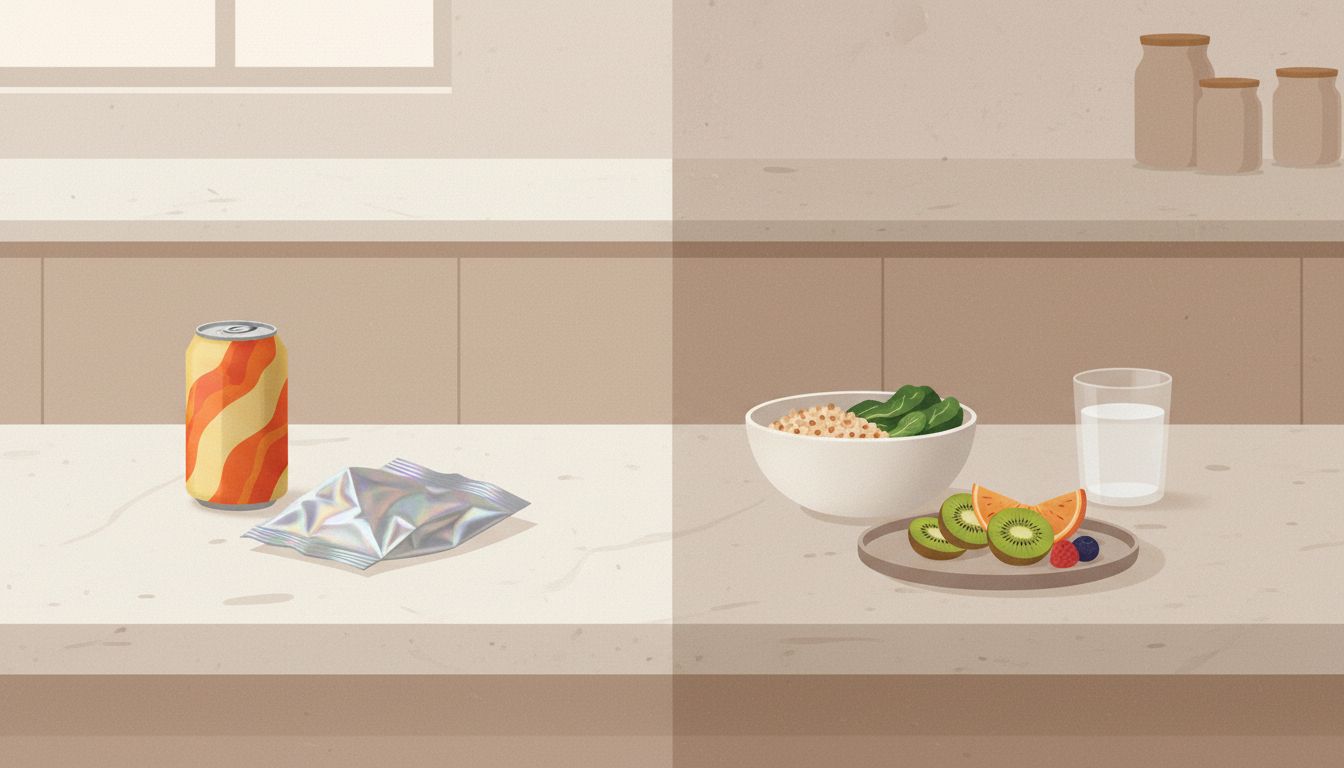
The real difference: quick spikes vs steady fuel
Here’s the simplest way I think about it:
- Bad dopamine feels like an energy drink: a sharp spike, a quick lift, and then a crash that makes you reach for another one.
- Good dopamine feels like a real meal: it’s steadier, less dramatic, and it leaves you actually okay afterward.
“Bad dopamine” is usually novelty + instant reward
Think: scrolling short-form video, refreshing email obsessively, online shopping “just browsing,” snacking on sugar when you’re already stressed, another episode when you meant to go to bed.
These activities aren’t “bad” because they’re immoral. They’re “bad dopamine” because they train your brain to expect high stimulation for low effort. The reward is intense and immediate—so your brain learns to crave it, especially when you’re tired or anxious.
And over time, the ordinary rewards that used to feel good (a calm morning, progress on a project, a walk, a simple meal) start to feel… underwhelming. This is how you end up saying, “Why can’t I focus anymore?” when the deeper issue is: your reward system is exhausted.
“Good dopamine” is effort + meaning + recovery
Think: morning daylight, movement, finishing something small, cooking a meal that makes tomorrow easier, a real conversation, cleaning your space for ten minutes and feeling your shoulders drop.
Good dopamine is often quieter. It doesn’t always feel thrilling in the moment, which is why it’s easy to overlook. But it pays you back instead of charging interest.
Mental clarity isn’t something you “find”—it’s something you build by choosing rewards that don’t steal from tomorrow.
How this plays out in real life (aka: why your afternoons disappear)
Let’s make it very real, because this is where most advice gets annoying.
1) The afternoon slump that turns into a digital black hole
You’re doing decent work until mid-afternoon. Then your brain hits resistance—maybe you’re hungry, maybe your nervous system is overstimulated, maybe your task is just boring.
You reach for your phone because it offers:
- novelty (new content)
- tiny social rewards (messages/likes)
- a sense of “escape” with zero effort
Bad dopamine works fast. But afterward you come back foggier—so the task feels even harder—so you reach again.
2) The “I deserve to relax” evening that quietly wrecks your sleep
You’re not wrong: you do deserve to relax. The problem is when “relax” defaults to high-stimulation rest (bingeable shows, multitasking with your phone, bright screens right up until sleep).
That kind of rest postpones recovery. You go to bed later than you planned, sleep lighter, wake up less restored… and the next day you crave more quick hits because you’re running low again.
3) The deadline snack cycle where nothing tastes satisfying
When you’re under pressure, food becomes a tool. Sugar and salty snacks are easy dopamine. But the crash is real—energy dips, mood dips, and suddenly you’re not just behind on work, you’re also negotiating with your own nervous system.
None of this means you need to become a monk or delete every app. It just means you need a system that helps your brain access better rewards when you’re most vulnerable to the cheap ones.
The core idea: become a “dopamine curator,” not a dopamine chaser
When people hear this topic, they often assume the solution is willpower or a dramatic “dopamine detox.” In real life, that usually lasts 36 hours and ends with you eating cereal out of the box while scrolling.
A calmer (and more effective) approach is to curate your dopamine the same way you curate your space:
- make the good stuff easier to reach
- add friction to the stuff that hijacks you
- build default routines that guide you when you’re tired
In other words: you don’t need a new personality. You need better defaults.
Good dopamine vs bad dopamine: the “swap, don’t stop” method
Here’s the first system I recommend because it’s realistic: don’t try to remove all bad dopamine at once. Just create a few planned swaps—specific moments where you know you’re likely to crash and you give yourself a better option.
Swap #1: The 3 PM “phone itch” → a 7-minute reset
When you feel the urge to scroll, try a tiny reset that still gives reward, just without the crash:
- step outside for daylight (even a balcony/window counts)
- walk one block while listening to one song
- refill water + eat something with protein (not as a diet rule—just as brain support)
If you want this to actually happen, let your phone help you instead of hijack you:
Tools that make the swap easier
- Opal or Freedom: schedule a daily “scroll block” during your weakest window (for many people: 2–5 PM). The point isn’t punishment—it’s removing the reflex option.
- Spotify “one-song rule”: build a tiny playlist called “Reset.” One song only. When it ends, you go back to work. (This works because it’s contained and frictionless.)
Swap #2: “I can’t start” → a completion-based dopamine loop
Good dopamine loves completion. Not big, dramatic completion—small, visible wins.
A simple system: one list for “must do,” one list for “done.”
- Your “must do” list should be painfully small (3 items max).
- Your “done” list can be as long as it wants, including “replied to email,” “booked appointment,” “started laundry.”
This sounds almost silly, but if you’re mentally overloaded, you need proof that you’re moving. Proof creates motivation.
Tools that make this feel satisfying
- Todoist (simple, clean, fast): great for recurring tasks and tiny check-offs.
- Forest (focus timer): if you like a visual reward, it turns “I stayed with my task” into something you can literally see.
Swap #3: Evening “decompression” → low-stimulation recovery
If your whole day is high stimulation (notifications, decisions, screens), actual recovery has to be lower stimulation—or it doesn’t work.
Try creating a small “closing routine” that signals safety to your brain:
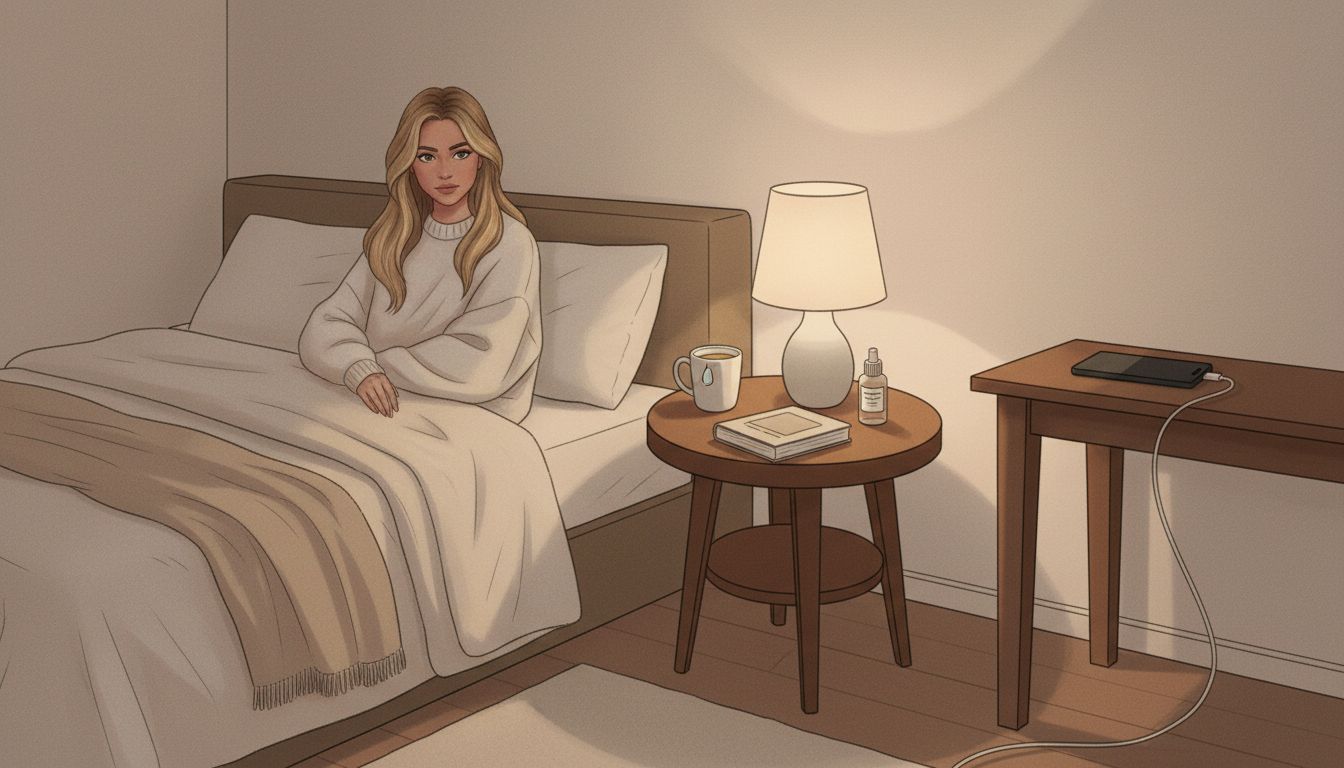
- dim lights
- charge your phone out of reach (or at least off the bed)
- one comforting activity that doesn’t spike you: shower, stretching, reading, skincare, prepping tomorrow’s coffee
Tools that reduce the pull
- f.lux (desktop) or Night Shift/Night Light (built-in): warmer screens earlier in the evening.
- A scheduled Do Not Disturb that turns on automatically at a set time (so you don’t have to decide when you’re tired).
The goal isn’t to be perfect at night. It’s to make it easier to stop when you’re done—so you can actually wake up with some capacity.
A quick self-check: what kind of dopamine are you living on?
If you’re unsure where your energy is going, try this tiny audit (two minutes, no journaling spiral required):
- What do you reach for when you feel resistance?
- Does it leave you clearer—or more scattered?
- Does it make tomorrow easier—or harder?
You’re not “addicted to your phone.” You’re likely exhausted, overstimulated, and under-rewarded in the ways that actually restore you. Once you start noticing your patterns through the lens of good dopamine vs bad dopamine, the next steps become much more practical—because you’re no longer trying to fix your life with discipline. You’re redesigning the moments where your brain is currently making the choices for you.
And that’s where we can start setting up a few simple routines that create steady energy—especially on the days when your motivation doesn’t show up on time…
The “steady energy” routines that carry you when motivation doesn’t
When your brain is already tired, it won’t reliably choose the best option—it’ll choose the easiest option. So the goal is to make the “good” option the easiest one in the moments you typically unravel: transitions, stress spikes, and end-of-day emptiness.
Think of the next few ideas as scaffolding. You’re not trying to become a perfectly regulated person. You’re building a handful of autopilot routines that keep you out of the tired-but-wired spiral.
1) Build a “Transition Ritual” (because transitions are where you leak time)
Most bad-dopamine spirals start in the in-between moments:
- finishing a meeting
- submitting a draft
- coming home
- closing your laptop for dinner
Your brain hates abrupt drops in stimulation. So it reaches for a quick bridge (phone, snack, scroll). Instead, give it a tiny, planned bridge that doesn’t hijack you.
Try this 90-second transition ritual:
- Close the loop: write one sentence: “Next, I’m doing ___.” (This prevents the “what was I doing?” fog.)
- Reset your body: 3 slow breaths, shoulders down, unclench your jaw.
- Change input: stand up, rinse a cup, look out a window, step into a different room—any physical cue that signals “new chapter.”
This works because it gives you a hit of completion (good dopamine) and a nervous-system downshift (recovery) without the crash-and-crave cycle.
2) Create a “Good Dopamine Menu” for your worst windows
Decision fatigue is real. When you’re depleted, being told to “choose better” is basically a prank. So don’t choose in the moment—pre-choose now.
Make a short list (notes app, sticky note, whatever) called Good Dopamine Menu. Limit it to options that are:
- easy
- low-prep
- actually soothing
- available in 5–15 minutes
Example menu (pick 5–8 that fit your life):
- Walk outside for 8 minutes (no goal, just daylight)
- Make a snack with protein + fiber (Greek yogurt, nuts + fruit, cheese + crackers)
- One-song reset playlist (one song only)
- 10-minute tidy sprint in one area (counter, bathroom sink, couch zone)
- Text or voice note one friend (“No need to reply fast—just saying hi”)
- Stretch calves/hips for 5 minutes while the kettle boils
- “Set up Future Me”: refill water, plug in laptop, lay out tomorrow’s outfit
The magic isn’t in any single item—it’s that you’re replacing “search for relief” with “pick from a menu.” That’s how you stop the spiral without needing a heroic amount of willpower.
3) Use “paired rewards” to make boring tasks easier
If a task is important but your brain finds it dull or stressful, don’t force raw discipline. Pair it with a reward that’s pleasant but not overstimulating.
Examples of paired rewards:
- Admin emails + a specific drink you love (tea, iced coffee) that you only have during admin
- Cleaning + a comfort podcast (not short-form video)
- Budgeting + a candle + one calming playlist
- Workout prep + “after” ritual (hot shower, lotion, cozy clothes)
This is still dopamine—just the kind that trains your brain to associate effort with safety and payoff. Over time, you need less “convincing” to start.
Good dopamine vs bad dopamine in your environment: add friction (kindly)
The fastest way to change your habits is to change what your hands bump into all day. Environment design sounds dramatic, but it can be very low-key.
Make bad dopamine slightly annoying
- Move the apps: take social apps off your home screen (not deletion—just distance).
- Log out once: being logged out creates a pause where your brain can choose differently.
- Grayscale your phone for your high-risk window (many phones let you schedule this).
- Charge your phone away from the bed so nights don’t dissolve.
None of this is about shame. It’s about reducing “automatic reaching” when you’re tired.
Make good dopamine embarrassingly easy
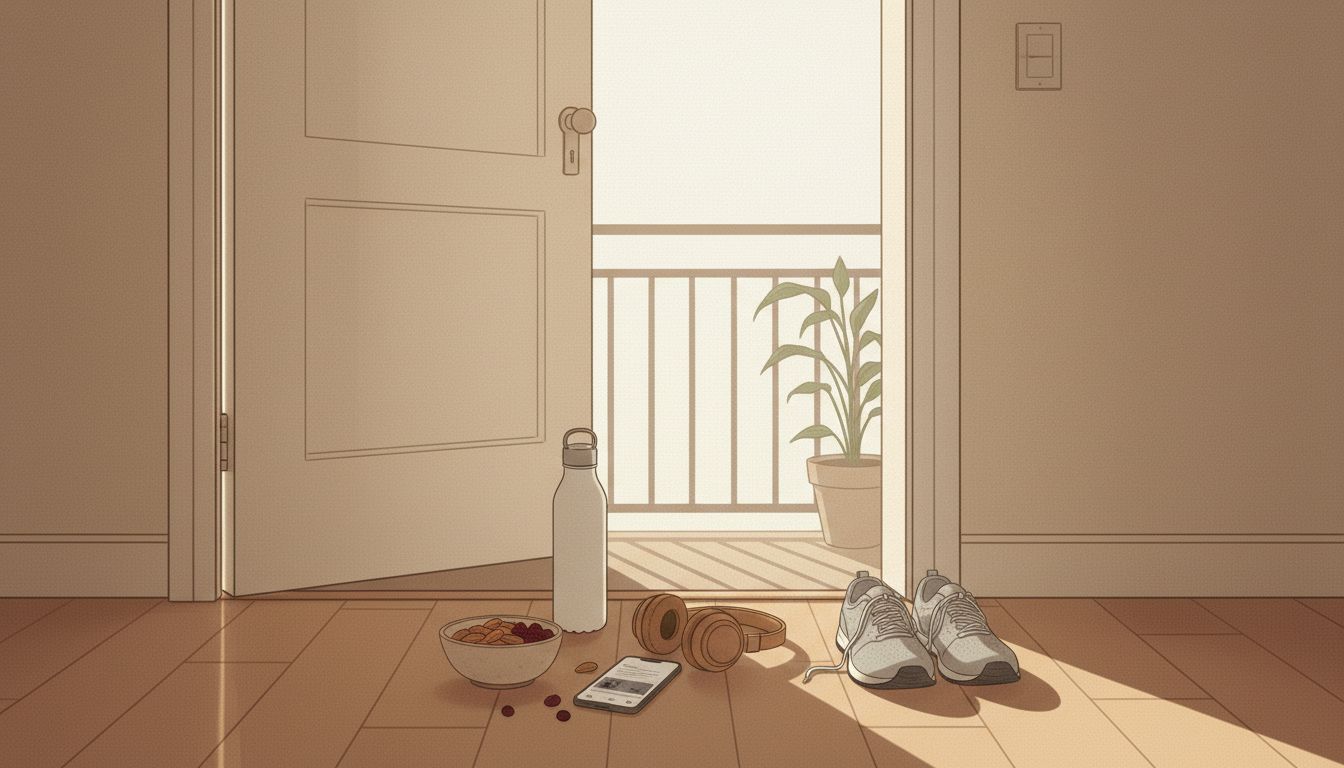
- Keep walking shoes by the door (not in the closet)
- Put a filled water bottle where you work
- Pre-prep 2–3 “brain snacks” you can grab without thinking
- Leave a book where you usually scroll at night (couch/bedside)
- Create one “calm corner” (even a chair + throw blanket counts)
This is the quiet secret of calmer living: you’re not relying on motivation. You’re relying on setup.
The weekly reset that prevents the “Monday crash”
If you only do one bigger system, make it this: a 25-minute weekly reset that reduces the mental tabs open in your head.
The 25-minute “Close Loops” reset
Set a timer. The goal is not to finish everything; it’s to stop carrying everything.
- 5 minutes: brain dump (everything swirling: tasks, worries, reminders)
- 10 minutes: sort into three buckets: “This week,” “Later,” “Ask/Delegate”
- 5 minutes: pick your “Tiny Three” for tomorrow (only 3 must-dos)
- 5 minutes: make the first step stupidly easy (open the doc, set out gym clothes, pre-chop one ingredient)
This reduces decision fatigue because tomorrow starts with clarity, not chaos. And clarity is one of the most underrated sources of good dopamine: your brain relaxes when it trusts you’ve got a plan.
You don’t need more discipline—you need fewer moments where your brain has to negotiate with exhaustion.
Conclusion: calmer living is a system, not a personality
If you’ve been judging yourself for “wasting time,” I want you to take that pressure off. When you’re overloaded, your brain will reach for fast relief. That’s not weakness—it’s wiring.
The shift is learning to spot good dopamine vs bad dopamine in real time, then designing your days so the steady options are the defaults: a transition ritual, a menu for your rough windows, gentle friction on the stuff that steals tomorrow’s energy, and small routines that close loops before they pile up.
Start with one swap. Make it ridiculously doable. Let it be imperfect but consistent. Calm doesn’t come from doing everything right—it comes from building a life that supports you on the days you’re not at 100%.
If you’d like extra visual support, we also share additional resources you can follow along with.