
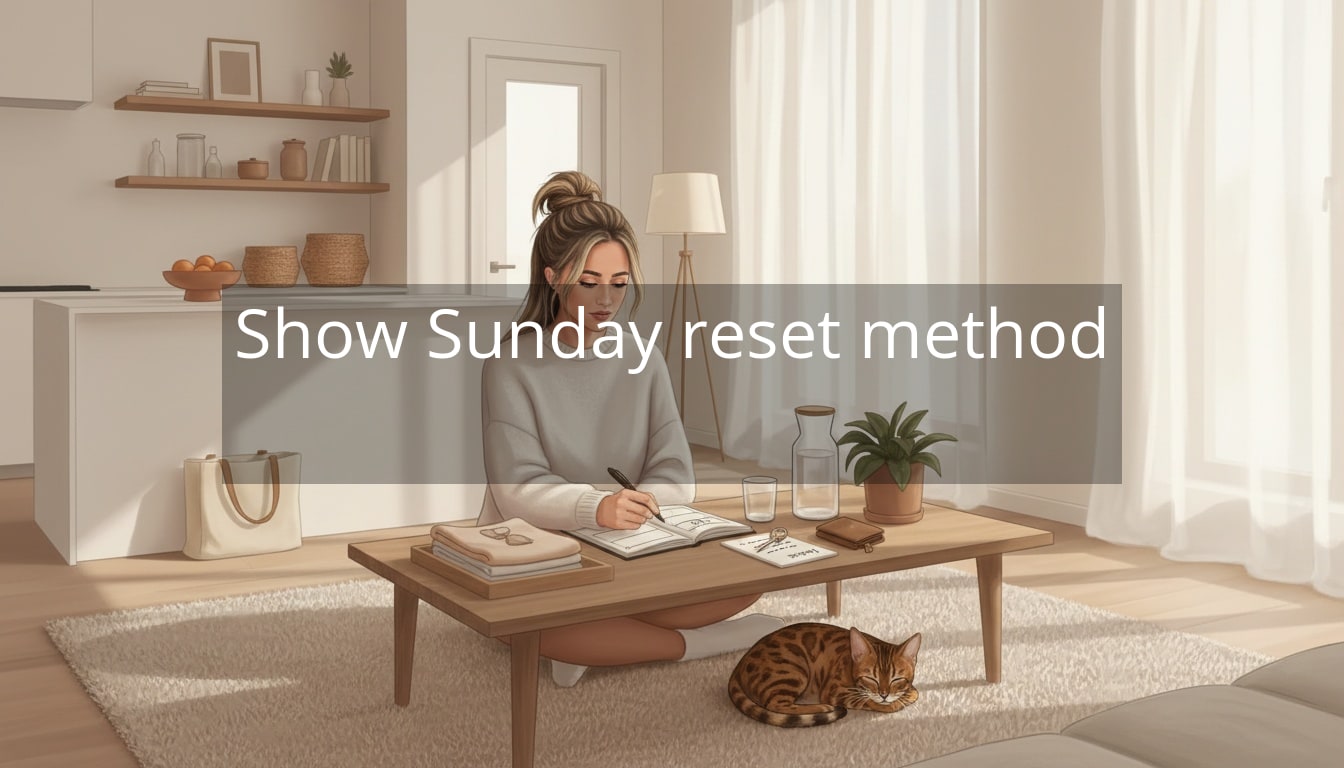
Your sunday reset routine doesn’t have to be a Pinterest-perfect cleanathon. It’s simply the thing that stops your Sunday night from turning into a brain-full of tabs open, replaying everything you didn’t get to.

Why Sundays start to feel heavy (even when you “did nothing”)
A lot of modern overwhelm isn’t from one huge problem—it’s from dozens of tiny, unfinished loops. The mug you meant to wash. The laundry you forgot to move over. The email you flagged but didn’t answer. The calendar you know you should check because Monday’s going to ambush you either way.
By the end of the week, your space starts mirroring your mental load. Visual clutter quietly signals “more to handle,” and your nervous system reads that as unfinished business. Add in constant notifications and late-night scrolling, and your weekend never fully becomes restorative—so Sunday evening arrives with that jittery, behind-before-I-start feeling.
“Clarity isn’t found in doing more—it’s found in removing what doesn’t matter.”
The mindset shift: reset, don’t restart
The core idea of a Sunday reset isn’t productivity for productivity’s sake. It’s a weekly maintenance ritual—30 to 90 minutes that puts you back in the driver’s seat. Not a full life overhaul. Just enough structure to make Monday feel spacious.
The secret is to focus on high-impact, low-effort moves in three areas: your surfaces, your schedule, and your basics (food, clothes, essentials). Think: “What would make Future Me exhale?”
A simple Sunday reset routine starter (no perfection required)
Start with quick wins that give you momentum:
- Set a timer for 15 minutes (phone timer or a Pomodoro app like Focus To-Do) and clear only what’s visible: kitchen counters, coffee table, desk, entryway. The goal is fewer “eye-catches,” not spotless rooms.
- Run one load of laundry and reset the absolute essentials: towels, sheets if needed, take out trash. If decision fatigue hits, choose the one thing that makes your week feel cleaner fastest.
- Do a 3-minute calendar scan: open Google Calendar/Apple Calendar and check Monday–Wednesday. Confirm any meetings, commute time, or appointments so nothing surprises you.
Once these are done, you’ll have enough mental quiet to move into the planning and self-care layer—without it feeling like another chore on the list.
A Sunday reset routine you can actually repeat (without losing your whole evening)
Once your surfaces are calmer, the next step is making Monday feel less like a pop quiz. This is where a reset turns into a system: a few repeatable choices that reduce the number of decisions you have to make when you’re tired, rushed, or already “behind.”
If you only remember one thing: you’re not trying to get your life together. You’re just creating a soft landing for the week ahead.
Step 1: Do a “friction audit” for Monday morning
Friction is that tiny resistance that makes you late, snappy, or tempted to skip breakfast. The goal is to remove one or two points of friction—because those are the ones that usually start the mental domino effect.
- Scan your entryway: Do you know where your keys, work badge, headphones, or sunglasses are? Put them where your hand naturally reaches.
- Check your tech basics: Plug in your laptop and headphones. If your phone is your alarm, charge it away from your bed if possible.
- Create a “launch pad” bag moment: Put your bag by the door with the non-negotiables inside (charger, water bottle, lunch container).
Real-life example: If Monday always feels chaotic because you’re hunting for the one clean travel mug, make that the reset. Wash it and set it next to the coffee. That’s a tiny move with an outsized payoff.
Step 2: Set up “meals that behave” (not a whole meal prep era)
A lot of Sunday stress comes from the same question showing up every day at 6 p.m.: “What are we eating?” You don’t need a full spreadsheet. You need a few easy defaults that keep you from ordering dinner out of decision fatigue.
- Pick 3 weeknight dinners you can make on autopilot (or rotate): a sheet-pan meal, a pasta, a protein + bagged salad, tacos, stir-fry, or a freezer option.
- Prep one flexible base: wash fruit, roast a tray of veggies, cook a grain, or hard-boil eggs.
- Do a 5-minute fridge sweep: toss anything questionable, move “use this next” items to eye level.
A simple script: “Two easy dinners + one leftovers night + one ‘whatever’s in the freezer’ night.” It’s not glamorous. It’s peaceful.
Step 3: The weekly plan that prevents the midweek spiral
Planning doesn’t have to mean color-coded perfection. Think of it as an agreement with yourself: “Here’s what matters, here’s what can wait, and here’s what I’m not doing.”
- Look at Monday–Wednesday first: those are the days most likely to ambush you.
- Choose 3 priorities for the week: not 17. Three. (One work, one personal, one life-admin works well.)
- Pre-decide two small supports: for example, “gym Tuesday at 6” or “grocery pickup Wednesday.”
- Add buffers: if you have back-to-back meetings, add a 10-minute “transition” block so your calendar stops lying to you.
Real-life example: If you have a big presentation Thursday, your Sunday reset might simply be blocking one 45-minute prep session on Tuesday—so you’re not doing it in a panic Wednesday night.

Step 4: Make the house feel cared for (in under 20 minutes)
This is the “future peace” layer: the few cleaning tasks that make your home feel like it’s working with you, not demanding things from you.
- Kitchen sink reset: empty sink, wipe counters, set the dishwasher running if you have one.
- Bathroom quick refresh: wipe the sink and mirror, swap hand towel, take out trash.
- Floors, but only the obvious parts: a quick vacuum in the main walkway is often enough.
If you live with other people, this is also the perfect time for a calm “5-minute team reset.” Everyone does one small thing: dishes, trash, toys, laundry pile. It keeps the emotional labor from defaulting to you.
Step 5: A gentle personal reset (so you don’t arrive at Monday already depleted)
Your nervous system counts too. A Sunday reset routine works best when it includes something that signals safety and closure—something that tells your brain, “We’re done now.”
- Pick one comfort cue: shower, hair wash, face mask, fresh sheets, or a long skincare routine.
- Choose tomorrow’s outfit: especially if mornings feel rushed or you’re in a style slump.
- Do a 10-minute wind-down: dim lights, charge devices, read a few pages, and let your brain stop performing.
If you tend to “revenge scroll” on Sunday night, try swapping in a softer alternative: a show you’ve already seen, a playlist while you tidy, or a short walk. It’s not about being strict—it’s about making it easier to fall asleep without your mind racing.
Your Sunday reset routine checklist (choose 5, rotate weekly)
The magic isn’t doing everything. The magic is having a menu of options so you don’t spend your reset deciding what a reset is.
- 15-minute surface clear (kitchen + one other area)
- One laundry loop (wash + dry + fold, or at least wash + dry)
- Trash + recycling out
- Fridge sweep + restock one staple (coffee, eggs, greens, snacks)
- Pick 3 dinners + quick grocery list
- Calendar scan Monday–Wednesday + add buffers
- Choose 3 weekly priorities
- Set out outfit + pack bag
- Bathroom quick wipe
- Fresh sheets or towel swap
Tip for busy weeks: If you only have 20 minutes, do: visible surfaces + calendar scan + one “Monday friction” fix. That’s it. That counts.
“You don’t need more time—you need fewer loose ends.”
Tools that make it easier (and quieter)
You don’t need fancy supplies, but a few simple tools remove a lot of mental effort.
- A repeating reminder: a Sunday evening calendar event called “Reset (45 min)” so you’re not relying on memory.
- A timer: 10–15 minute sprints keep you from turning this into an all-night project.
- A small cleaning caddy: microfiber cloths + all-purpose spray so you’re not searching room-to-room.
- A notes app or paper list: one running “open loops” list that you can review on Sundays and stop carrying in your head.
If you want structure without overthinking, create a tiny template in your notes:
- Next 3 Days: (appointments, meetings, commute)
- This Week’s 3 Priorities: (work / personal / life)
- Meals: (3 dinners + 1 lunch plan)
- One Thing to Make Monday Easier:
More support if you want it
If you like having guidance or a little external momentum, additional resources are available to help you build a reset that matches your lifestyle:
- Printable Sunday reset checklists (minimal, moderate, and “bare minimum” versions)
- Guided reset videos (30–90 minutes) you can play while you tidy and plan
- Weekly planning templates for Google Calendar or a notes app
- Simple meal-planning frameworks and grocery-list prompts
A calmer Monday is a system, not a personality trait
The point of a Sunday reset routine isn’t to become a person who always has it together. It’s to build a rhythm that gently reduces your mental load—so your week starts with a little space instead of immediate pressure.
Start small. Keep it repeatable. Choose the few actions that make you feel most supported, and let that be enough. A calm life isn’t built in a single day—it’s built in tiny, kind decisions you make for Future You, one Sunday at a time.
Telegram Galelar
Instagram @galelar_lis
YouTube @galelar
TikTok @galelar_lis