

It’s wild how decision fatigue can make a perfectly “normal” Wednesday feel like you’ve been sprinting all day. You look back at your calendar and think, Nothing catastrophic happened… so why do I feel completely wrung out?
Here’s the scene I keep hearing (and living, honestly): it’s around 7 PM, you finally sit down, and your body is technically home—but your brain is still doing laps. You answered emails, handled a meeting or two, maybe squeezed in a grocery run, maybe even did something “responsible” like remembering your friend’s birthday. No dramatic fire to put out. And yet you’re exhausted in that specific way that makes even relaxing feel like work.

That “busy” feeling isn’t always about how much you did. It’s often about how many times your mind had to shift gears, make tiny calls, and absorb incoming noise. Modern life is set up to drain you in small, constant withdrawals—so by evening, you’re overdrawn.
Why “Normal Days” Still Leave You Drained
When people say “I’m so busy,” what they often mean is: I was mentally on-call all day.
Not for one big, meaningful thing. For dozens of scattered things.
A normal day now includes micro-decisions and micro-interruptions that didn’t exist at this scale a decade ago: Slack pings, delivery updates, group chats, calendar reschedules, “quick questions,” a million tabs open, and the subtle guilt of knowing you could always be doing something. Even downtime gets contaminated—because your phone sits next to you like a tiny supervisor.
And the tricky part is that these drains are mostly invisible. You don’t get credit for them the way you get credit for finishing a project or running a meeting. But your nervous system absolutely counts them.

Let’s name the biggest culprits, because simply identifying them can be weirdly relieving (like, oh—so I’m not lazy, I’m overloaded).
1) Too many small decisions (the quiet energy leak)
What to wear. What to eat. Whether to answer that message now or later. Which task to start with. Whether you have time to work out. Whether you should “just” stop by the store.
None of these decisions are dramatic on their own. But together, they create that internal friction that makes you feel like you’re pushing a cart with one wobbly wheel all day.
This is where decision fatigue really shows up: by afternoon, even simple choices start to feel heavier than they should. And then you end up defaulting to the easiest option—scrolling, snacking, staying “busy” with low-stakes tasks—because your brain is trying to conserve energy.
2) No clear priorities (everything feels equally urgent)
On days when you don’t decide what matters first, your environment decides for you.
You start reacting instead of directing: email pulls you in, then a message, then a small “quick” task, then a meeting… and suddenly it’s late afternoon and you haven’t touched the one thing that would’ve made you feel genuinely accomplished.
It creates that specific end-of-day frustration: I did so much… why does it feel like nothing moved?
3) Constant phone checking (your brain never fully lands)
Even a quick glance at your phone isn’t neutral. It’s a context switch.
Your attention jumps tracks: from your task → to a notification → to remembering you need to reply → back to your task, but with a little residue of mental “open loops.” Do that a few dozen times and your day feels choppy, like you never got to sink into anything.
You don’t need to be addicted to your phone for it to affect you. You just need to be reachable.
4) Multitasking (it feels efficient, but it’s expensive)
A lot of modern women are basically running a background operating system all day:
- listening on a call while answering messages
- starting a task while also thinking about dinner
- half-working while half-scrolling
- “relaxing” while planning tomorrow
You’re rarely doing one thing at a time—which means your brain rarely gets the satisfaction of completion. Multitasking doesn’t just scatter your focus; it also makes your day feel longer and noisier.
5) No real breaks (your nervous system stays in “go” mode)
There’s a difference between “I sat down for 10 minutes” and “I actually rested.”
Most of us take breaks that are just more input—news, social media, random browsing—so the brain never gets a clean reset. It’s like trying to recover from a workout by… doing a different workout.
So even if you’re not technically working every minute, you still end the day feeling like you never stopped.
Clarity isn’t created by doing more—it’s created by removing what drains you quietly.
The Core Idea: Your Life Is Full of Invisible Decisions—So Build Defaults
If I could give you one calm, powerful reframe, it’s this:
You don’t need more discipline. You need fewer decisions.
A lot of “busyness” is just decision fatigue plus constant switching. And the antidote isn’t some intense life overhaul—it’s building defaults and containers so your day runs on rails more often.
Think of it like this: when your morning is full of tiny choices, you spend your best mental energy deciding… instead of creating, leading, solving, or enjoying your life.
So the goal is to design a day where:
- the small stuff is mostly pre-decided
- your priorities are visible
- your attention is protected
- your breaks are real
Not rigid. Just supported.
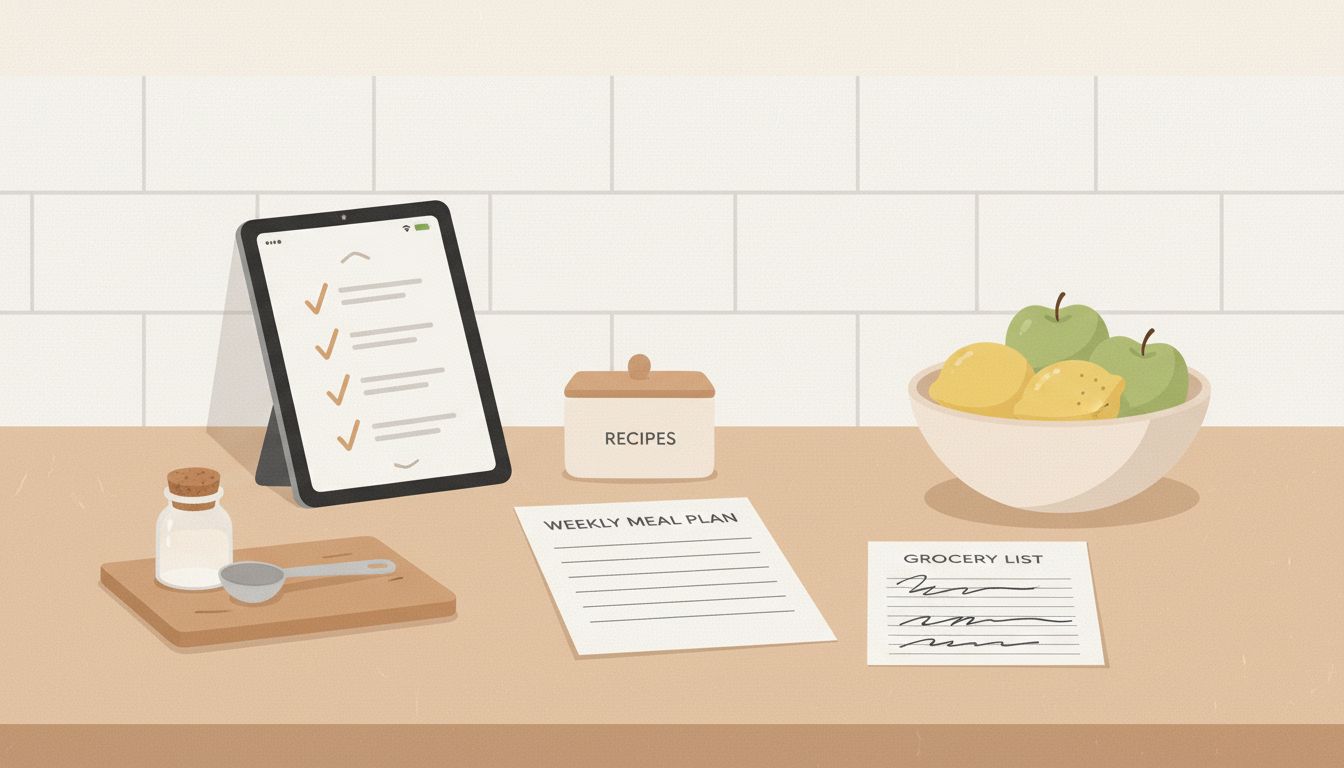
3 Gentle Systems to Reduce Decision Fatigue (Starting Today)
You don’t need to fix everything at once. Start where you feel the biggest drain. Here are a few systems that work especially well for busy, independent women because they don’t require perfection—just a little structure.
System 1: A “Decision Dashboard” for repeat choices
This is a simple place where you store your defaults so you’re not reinventing your life every day.
What goes on it?
- 5–10 go-to meals (including the “I’m tired” meals)
- your easy breakfast and snack list
- a basic outfit formula (or a weekly outfit rotation)
- a short “when I’m overwhelmed” reset list (more on this later)
Digital tool idea: Create a single page in Notion or a pinned list in Todoist called “Defaults.” The magic is that it becomes your stress-proof menu when your brain is cooked at 6 PM.
This is unsexy, but it works because it removes the daily friction: fewer choices, fewer spirals.
System 2: A priority filter that shows you what matters today
When priorities are fuzzy, everything starts screaming.
A simple filter I love is the 3–3–3 structure:
- 3 Big Wins (things that actually move your life/work forward)
- 3 Maintenance tasks (admin, messages, life upkeep)
- 3 Flex slots (buffer for the unplanned)
The point isn’t to micromanage your day. It’s to stop treating everything like it has equal importance. Because that’s how you end up spending your best hours on inbox gardening.
Digital tool idea: If you like a visual schedule, apps like Structured (or even Google Calendar) make this feel concrete—your “Big Wins” stop floating in your head and start living in time.
System 3: “Do Not Disturb zones” (not forever, just on purpose)
If your phone is always available, your attention belongs to whoever pings you.
Instead of trying to “use your phone less” in a vague way, create specific unreachable windows—even just one:
- 9:00–11:00 AM = focus time
- 2:00–3:00 PM = deep work sprint
- 8:00–9:00 PM = actual off-duty time
Digital tool idea: Use Freedom (or your built-in Focus modes) to block the apps that fragment you most. This isn’t about willpower; it’s about making the default environment calmer.
Because the truth is: you can’t out-discipline a device designed to steal your attention. But you can design boundaries that make decision fatigue less likely in the first place.
If you recognize yourself in this—if your days feel busy even when they aren’t objectively “too much”—that’s information, not a personal failing. It means your current setup is asking your brain to make too many micro-decisions, absorb too much input, and switch contexts too often.
The next step is getting even more specific: where decision fatigue hits hardest in real life (like the freelancer afternoon spiral, the working-mom evening pile-up, or the “quiet day” that somehow disappears), and how to build a few realistic guardrails so your time starts to feel like yours again—especially in the middle of the day when everything tends to unravel…
Where decision fatigue hits hardest (and the guardrails that actually help)
Let’s get super real: decision fatigue isn’t usually a morning problem. It’s a midday-to-evening problem—when your brain has already spent a full day answering, choosing, context-switching, and “keeping track.” So instead of trying to overhaul your whole life, we’ll put a few guardrails exactly where your day tends to unravel.
The Freelancer Afternoon Spiral (aka “I have freedom… so why am I stuck?”)
This is the classic loop: you start strong, then lunch happens, your energy dips, one tiny “quick check” turns into twenty tabs, and suddenly it’s 3 PM and you’re doing busywork because real work feels weirdly hard.
Guardrails that work:
- Pre-decide your “after lunch” plan. Create a default block like: 1:30–2:30 = easiest meaningful task. Not the hardest thing, not the fluffiest thing—the easiest task that still counts.
- Use a “one-tab rule” sprint. For 25 minutes, you’re allowed one open tab/app (besides the doc you’re working in). If you need something else, jot it on a sticky note and keep going.
- Keep an “If I’m stuck…” list. This prevents you from spending precious energy deciding how to restart. Example: “Open project doc → write three bullet points → send one update → set timer for 10 minutes.”
The Working-Mom Evening Pile-Up (aka “it’s not even that late, why am I drowning?”)
Evenings are where invisible labor piles up: feeding people, managing moods, remembering tomorrow’s needs, and trying to be present while also mentally planning the next 12 hours.
Guardrails that work:
- Create an “Evening Shutdown” mini-routine (10 minutes). Not a full reset—just enough to stop tomorrow from living in your head tonight. Example: glance at calendar, pick tomorrow’s top 1–3 priorities, set out one or two key items (lunch container, outfit, gym shoes).
- Choose your “dinner defaults.” Have 3 tiers: 5-minute dinner (eggs + toast, rotisserie chicken + salad kit), 15-minute dinner, weekend dinner. No browsing, no reinventing.
- Assign roles to time blocks. Example: 6–7 PM = logistics, 7–8 PM = connection, 8–9 PM = recovery. The point is that not all evening minutes should be multitasking minutes.
The “Quiet” Remote Workday That Somehow Disappears
These are the sneaky ones: no urgent meetings, no fires… just a slow leak of attention. Without structure, the day becomes a series of soft distractions and tiny tasks that keep you busy but not fulfilled.

Guardrails that work:
- Start with one visible outcome. Before email, write one sentence: “If today goes well, I will finish ______.” Put it at the top of your notes.
- Schedule “inbox windows.” Example: 11:30 and 4:00. Outside those windows, inboxes are closed. This alone reduces the constant micro-decisions about whether to check and respond.
- Build a mid-day reset you can’t negotiate with. A 10-minute walk, stretching, a tea on the balcony—something physical and low-input. If your break involves more information, it’s not really a break.
Four practical systems that make calm your default
1) The “Two Lists” method: one for doing, one for thinking
A major cause of decision fatigue is that your brain is trying to be both the executive (doing tasks) and the storage unit (holding reminders). Give your mind fewer open loops.
- Doing List: only tasks you will actually execute soon (ideally today/this week).
- Thinking List: ideas, worries, research topics, stuff you need to decide later, “remember to…” items.
The magic: you stop treating every thought like an urgent task. You acknowledge it, park it, and return to what matters.
2) The “15-Minute Weekly Setup” (tiny ritual, huge payoff)
You don’t need a three-hour Sunday reset. You need a quick moment where you remove friction before the week starts.
Your 15 minutes:
- Pick 3 “anchor meals” you can repeat (breakfast, lunch, dinner backup).
- Choose 1–2 outfits or an outfit formula for your busiest days.
- Look at your calendar and decide: Where are my Do Not Disturb zones?
- Write next week’s top 3 outcomes (not 30 tasks).
This is not about being hyper-organized. It’s about reducing the number of times you have to “figure it out” when you’re tired.
3) The “Rule of 3” for household and life admin
Life admin expands to fill every available pocket of time. Instead of letting it nibble at you all day, contain it.
- Three days per week you handle admin (example: Mon/Wed/Fri).
- Three categories only (example: money, appointments, home).
- Three actions max per session (example: pay bill, schedule appointment, order essentials).
Contained admin is calmer admin. And calmer admin means fewer background decisions running your whole day.
4) A “When I’m Overwhelmed” reset menu (so you don’t spiral)
When you’re overloaded, your brain wants a quick exit. Scrolling works because it’s easy—not because it’s restorative. Give yourself a menu of actually helpful exits that require almost no thinking.
Build a short reset list like:
- Drink water and eat something with protein.
- Step outside for 3 minutes of daylight.
- Set a 10-minute timer and tidy one surface (not the whole house).
- Do a 4-4-6 breath (inhale 4, hold 4, exhale 6) five times.
- Text one person: “Low bandwidth today—can we talk tomorrow?”
Notice none of these are “try harder.” They’re all nervous-system friendly. That’s the point.
How to make these systems stick (without becoming a productivity robot)
A gentle truth: the best system is the one you can follow on a bad day.
- Lower the bar for your first version. A “Decision Dashboard” can be a single note on your phone. Start there.
- Attach new habits to existing anchors. Example: “After I make coffee, I write my 3 Big Wins.”
- Measure the right thing. Don’t ask, “Did I do everything?” Ask, “Did I protect my attention at least once today?”
- Assume you’ll fall off. Your system should include a “restart” step. (Mine is: open my defaults list, choose the next tiny action, set a 15-minute timer.)
Because the goal isn’t to optimize your life into a spreadsheet. The goal is to create enough structure that you can show up to your life with more presence and less internal noise.
You don’t rise to the level of your motivation—you return to the level of your systems.
Conclusion: calm living is built, not earned
If you’ve been blaming yourself for feeling drained on “normal” days, I want you to release that. What you’re experiencing is often the totally predictable result of too many micro-decisions, too much input, and not enough default structure—aka decision fatigue, not a character flaw.
Start small: pick one default (a meal, an outfit formula, an inbox window), one protected focus block, and one real break. That’s enough to change the texture of your day. Over time, these tiny guardrails add up to something big: a life that feels yours again—calmer, clearer, and less mentally crowded.
If you’d like extra visual guidance and easy-to-follow examples for these routines, additional resources are available below: