
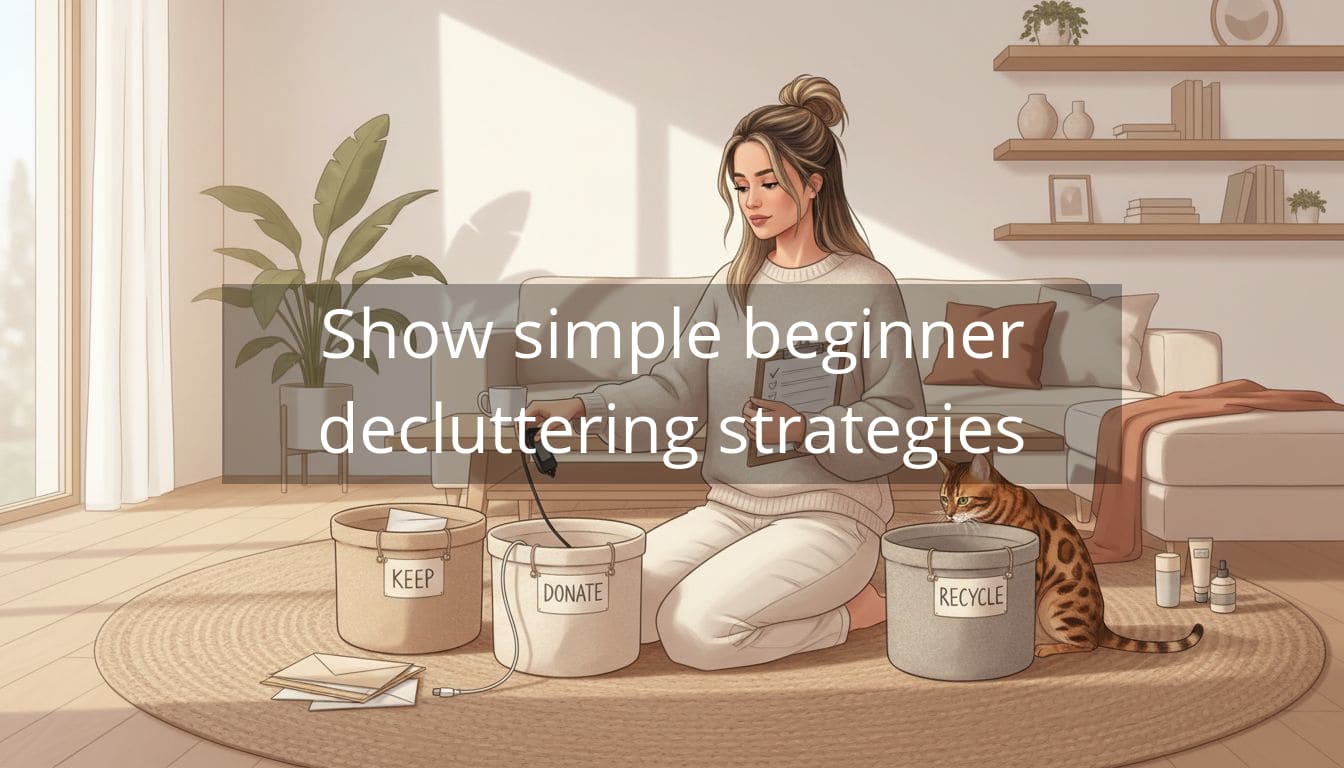
You can Google decluttering tips for beginners all day, but that doesn’t help when you’re already overstimulated—Slack pings, a half-finished to-do list, and a home that somehow gets messier even when you swear you haven’t bought anything new. The real issue isn’t that you’re “bad at organizing.” It’s that clutter quietly adds another layer of decisions to an already decision-heavy life.
Why clutter feels so exhausting (especially right now)
Modern life runs on open loops: tabs you’ll “read later,” returns you keep forgetting, clothes you might wear “when you have the right occasion,” and that drawer of random cables that makes you feel guilty every time you see it. Clutter builds because it’s easier to postpone a decision than make one in the moment. Multiply that by hundreds of items, and decluttering stops being a task—it becomes emotional labor.
The other sneaky reason? Most people try to declutter in giant dramatic sweeps. That’s like deciding to “get healthy” by running a marathon tomorrow. You end up tired, surrounded by piles, and weirdly discouraged.
“Clarity isn’t a big event—it’s the quiet result of small choices made consistently.”
Decluttering tips for beginners: the mindset shift that actually works
Here’s the core shift: start small enough that you can finish. Finishing is the win. Finishing builds trust with yourself. And trust is what makes you come back tomorrow without dread.
Try this simple system:
- Pick a micro-zone (one drawer, one shelf, one countertop—not “the kitchen”).
- Set a timer for 10 minutes using your phone or a gentle focus app like Forest or Focus To-Do. Short sessions prevent burnout and keep your nervous system calm.
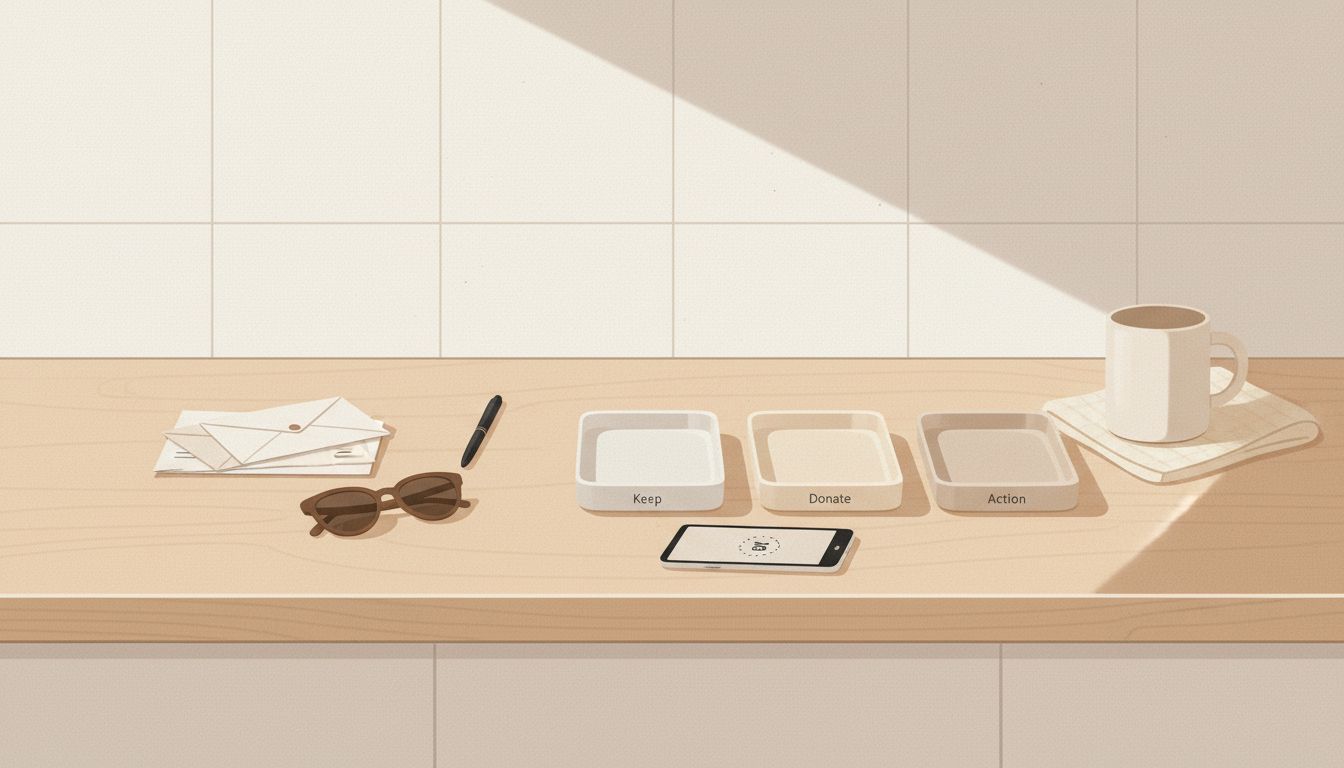
- Use four quick categories as you touch items: Keep, Donate, Trash, Action (repair/return).
If you have any energy left after the timer ends, you can keep going—but the goal is to stop while it still feels doable. That’s how decluttering becomes a routine instead of a weekend punishment.
Next, we’ll keep building momentum with “easy win” items and a couple of beginner-friendly methods that remove the guesswork entirely.

Easy-win decluttering tips for beginners (so you see progress fast)
If you’re already mentally maxed out, don’t start with sentimental items or the “mystery bin” in the closet. Start where the decisions are almost automatic. Easy wins are powerful because they create visible calm without requiring deep emotional energy.
Start with the “no-brainer” categories
- Expired: pantry items, spices you don’t recognize, old sunscreen, makeup past its prime, medication (follow local disposal rules).
- Broken: anything you’ve been “meaning to fix” for more than a season.
- Duplicates: three spatulas, five tote bags, eight travel mugs, twelve phone chargers for phones you don’t own.
- Doesn’t fit your life: shoes you can’t walk in, “someday” hobby supplies, clothes for a version of you that doesn’t exist on your calendar.
A quick real-life example: if your mornings feel chaotic, don’t declutter your entire closet. Declutter the getting-ready zone—the top drawer with hair ties, the counter with products you never use, the pile of “deal with later” near your mirror. You’ll feel the difference tomorrow morning, not “someday.”
Two beginner-friendly methods that remove the guesswork
The hardest part of decluttering is decision-making. So let’s reduce the number of decisions you have to make.
The Hanger Flip (for clothes you’re unsure about)
Turn all your hangers the same direction. When you wear something, put it back with the hanger flipped the other way. After 30–60 days (or a full season), the items that never flipped are telling you the truth: they aren’t part of your real life.
- If it’s a practical piece you truly need (like a blazer for interviews), keep it—but store it in a clearly labeled “occasion” section.
- If it’s just guilt and “maybe,” it’s a candidate for donation.
The “If I needed it, where would I look first?” test
This one is simple and weirdly effective: pick up an item and ask, “If I needed this, where would I look for it first?” Then put it there instantly.
This is how you create an intuitive home—one that doesn’t require a perfect label-maker setup to function. You’re organizing around your instincts, not someone else’s system.
Make the “Action” pile disappear without stealing your whole weekend
That fourth category—Action (returns, repairs, things to file)—is where clutter likes to come back and haunt you. The fix isn’t more motivation. It’s a small, contained system.
Create a tiny Action Station (one basket, one rule)
Choose one container: a tote, a basket, a slim bin—whatever fits your space. This is your Action Station. The rule is: anything that requires an errand or a follow-up goes here, not on random surfaces.
- Returns: keep the item + receipt + packaging together (future-you will be grateful).
- Repairs: only keep items you’d realistically pay to replace. If you wouldn’t pay $20 to replace it, don’t pay months of mental weight to keep it “to fix.”
- Appointments: if an item needs a service (tailoring, shoe repair), add a quick calendar reminder the moment it enters the basket.
Then set a recurring, low-drama reset: 15 minutes once a week—maybe Sunday afternoon or whenever you already transition into a new week. Not to do everything. Just to keep the “Action” pile from becoming a second closet.
Decluttering without the rebound: simple habits that keep your space calm
Most homes don’t get cluttered because someone “failed.” They get cluttered because the inflow is constant—mail, packaging, freebies, impulse buys, hand-me-downs, well-meant gifts. The goal is to build tiny points of friction that protect your space.
Keep an “Outgoing” donation bag where you’ll actually use it
Put a donation bag or box somewhere convenient: near the entryway, in your closet, or by the laundry. When you find an item that doesn’t belong in your life anymore, it goes straight in.
- When the bag is full, it becomes a quick drop-off task—not a big decluttering event.
- If drop-off is a barrier, schedule one pick-up or ask a friend to do a donation run together.
One-in, one-out (but make it gentle)
For categories that multiply fast—tops, skincare, books, mugs—try a soft version of one-in, one-out: when something new becomes a “keeper,” choose one existing item to release.
This isn’t about strict rules. It’s about preventing the slow creep back to overwhelm.
A 3-minute nightly reset that protects your mornings
If you only do one habit, make it this: set a timer for three minutes and reset one visible surface—your kitchen counter, coffee table, or entryway.
- Put obvious items back (no deep organizing).
- Throw away trash and recycling.
- Drop Action items into the Action Station.
It’s small, but it reduces that “I’m already behind” feeling when you wake up.
You don’t need more time—you need fewer decisions waiting for you.
When decluttering feels emotional (and what to do instead of forcing it)
Some items aren’t difficult because of the object—they’re difficult because of what it represents: money spent, a version of you you’re grieving, a relationship, a hard season, a hopeful plan that never happened.
When that happens, it’s okay to choose a calm middle step.
Try the “Maybe Later” box (with a deadline)
Pick a small box and label it “Maybe Later.” If you truly can’t decide, put the item in the box and set a date—30 or 60 days. If you don’t go looking for it, you have your answer without a big emotional scene.
- Keep the box small on purpose. A big box turns into storage.
- When the deadline arrives, donate most of it with confidence.
For sentimental items: curate, don’t keep everything
You don’t have to keep an entire category to honor a memory. Choose a few representative pieces and give them a “home” that respects them.
- One small memory bin per person/season (not six bags).
- Photograph bulky items you don’t want to store.
- Keep what you’d be happy to stumble upon later—not what makes you feel obligated.
A few extra resources if you want more structure
If you’d like more guidance and momentum, additional resources are available to support your process:
-
Short, beginner-friendly decluttering videos (great for body-doubling and staying motivated)
-
Printable checklists for micro-zones (kitchen, closet, bathroom, entryway)
-
Simple maintenance routines to keep clutter from rebuilding
A calm finish: your home doesn’t need to be perfect to feel lighter
The point of decluttering isn’t to create a showroom. It’s to make your everyday life easier—fewer piles to manage, fewer choices to postpone, fewer tiny stress signals in your line of sight.
If you’re using these decluttering tips for beginners and you only clear one drawer this week, that still counts. A finished micro-zone is proof that you can create order without burning yourself out. Keep it small, keep it kind, and let your systems do the heavy lifting.
You’re not chasing perfection—you’re building a home that supports you. Quietly. Consistently. And with a lot less mental load.
Telegram Galelar
Instagram @galelar_lis
YouTube @galelar
TikTok @galelar_lis