
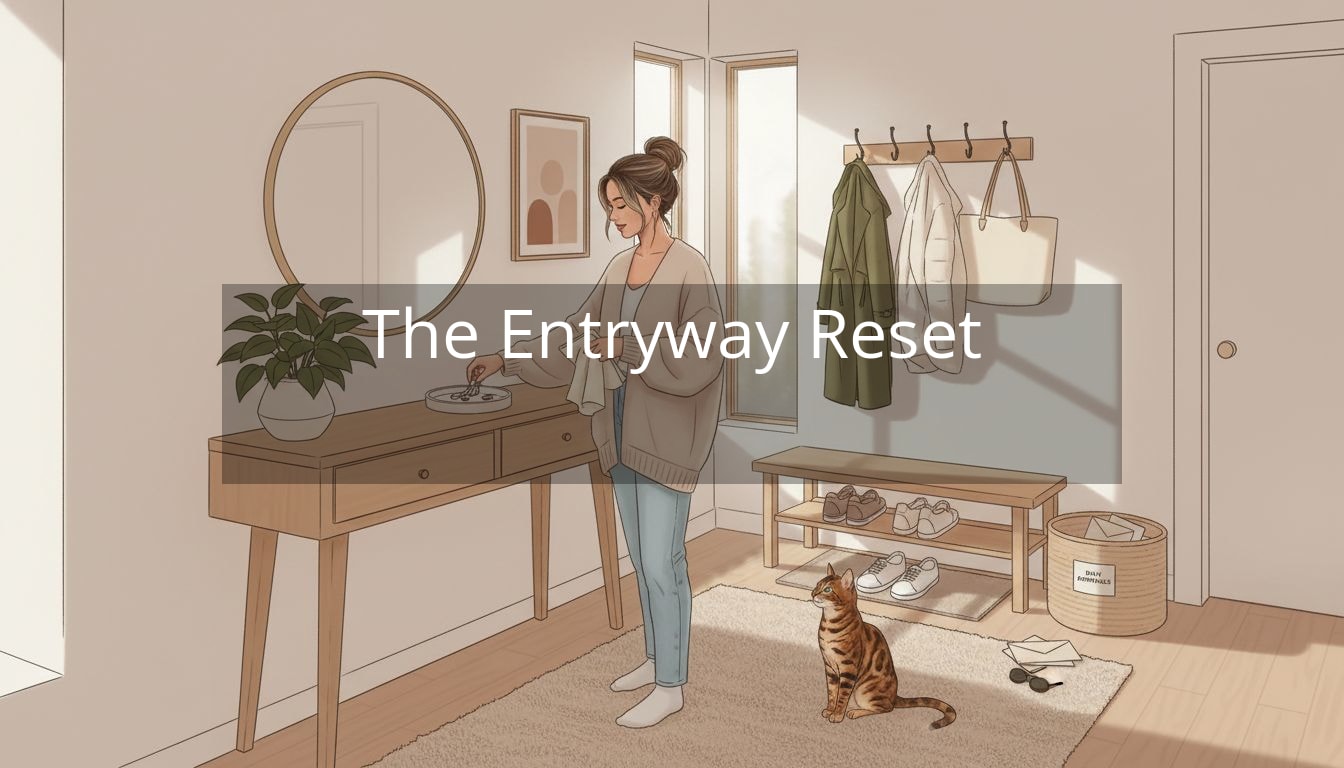
You know that moment when you finally get home and your brain is still “open-tabbed” from the day? An entryway reset is the tiny, almost boring habit that keeps that mental overload from turning into physical chaos the second you walk through the door.
Because it’s rarely the big stuff that makes a home feel unlivable—it’s the constant micro-mess you have to step over, sort later, and feel quietly guilty about.
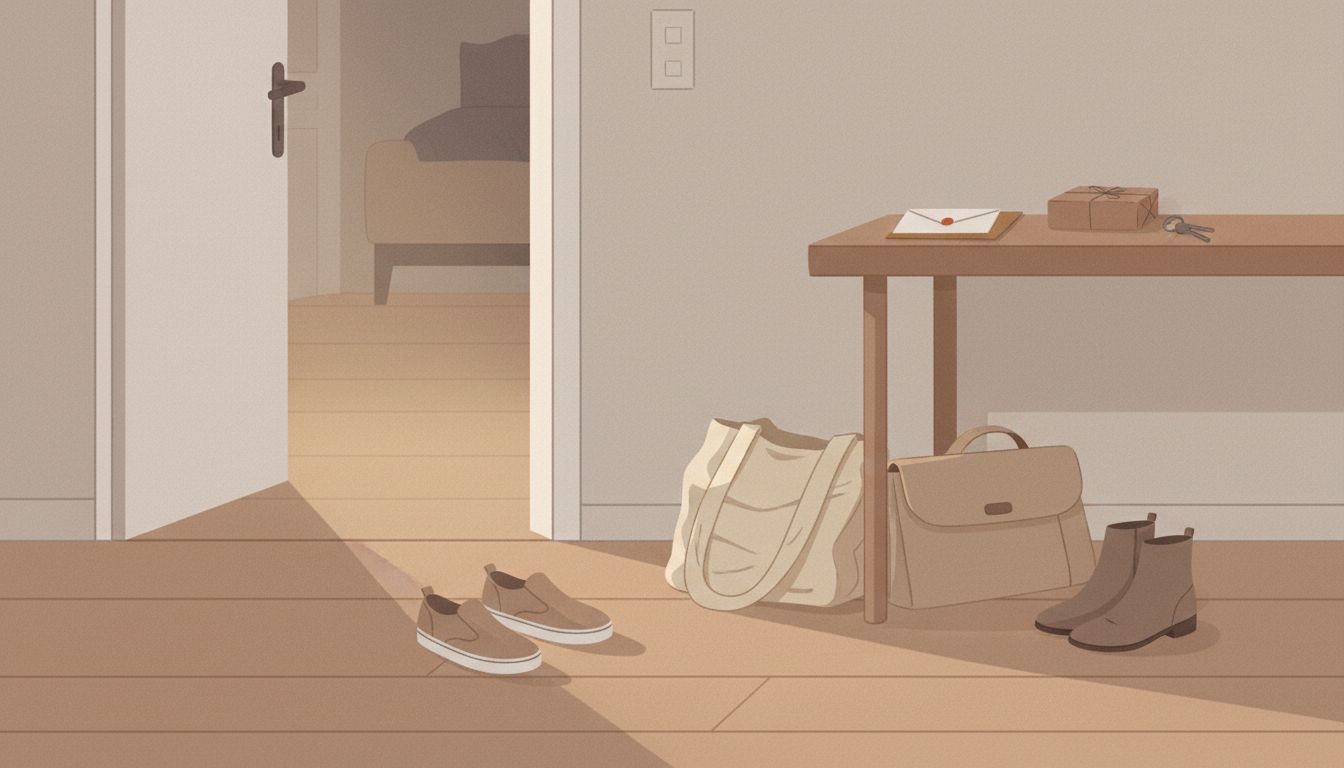
Picture it: you come in with your laptop bag sliding off your shoulder, a tote full of groceries cutting into your fingers, mail tucked under your arm, and your phone still buzzing with “quick questions.” You kick off your shoes, drop your keys “somewhere safe,” and promise yourself you’ll deal with it after you eat. Except “after” becomes tomorrow, and tomorrow becomes the weekend… and now the entryway is a cluttery little obstacle course that greets you before you’ve even had a chance to exhale.
That’s not a character flaw. It’s physics (and modern life).
Why the front door becomes the messiest part of your home
Your entryway is the highest-traffic square footage you have. It’s where you transition between two realities:
- Outside: errands, work, noise, decisions, other people’s needs
- Inside: your refuge, your routines, your ability to reset
And because you’re usually arriving home tired (or distracted, or hungry, or juggling five things), your brain goes into the most efficient mode it has: drop and run.
The entryway turns into a “temporary” holding area for:
- coats that will “go up later”
- bags you’ll “unpack in a second”
- mail you’ll “sort after dinner”
- shoes that land wherever your feet stop
Here’s the sneaky part: this isn’t just visual clutter. It’s decision clutter—a pile of tiny unanswered questions you have to resolve later.
Where are my keys? Did I pay that bill? Why is my work badge missing? Is that package important? Why am I tripping over a tote bag I swear I put away?
And when you’re already managing your work (and your calendar, and your inbox, and your laundry, and your meals…), those tiny questions are the kind that push you from “I’m okay” to “I can’t deal with anything right now.”
The entryway becomes the first place your home stops feeling supportive.
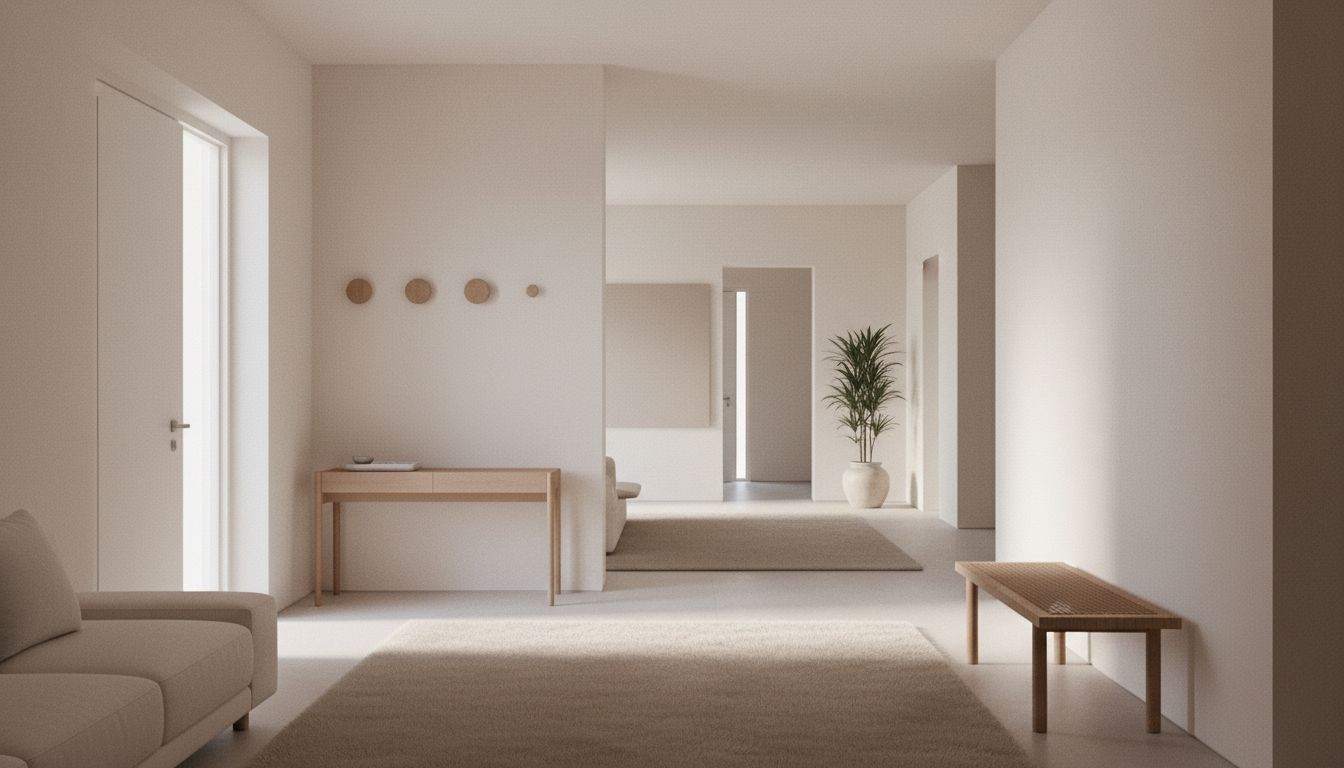
The core idea: your entryway is the gatekeeper of calm
If you take one thing from this article, let it be this: the entryway isn’t just a hallway. It’s a boundary.
It’s the one place you can stop clutter from migrating deeper into your home—into the kitchen counters, the dining table chair that becomes a coat rack, the bedroom floor that somehow collects tote bags like a magnet.
Think of it as an airlock: if you keep that one area contained, the rest of your space stays easier to manage. If it’s chaotic, the chaos spreads—fast.
And the fix is wildly simple. Not easy at first, but simple.
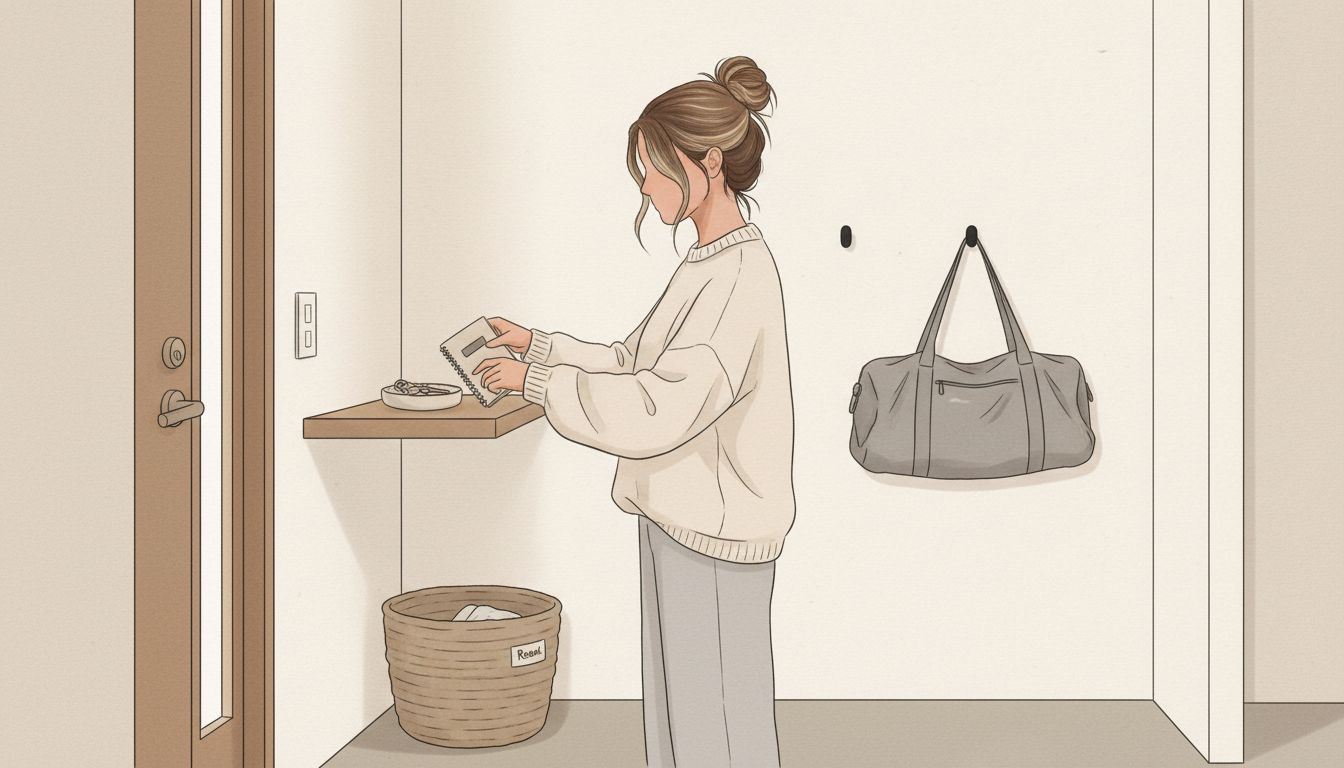
The entryway reset is four micro-habits you do right when you walk in:
- Hang the coat
- Put keys in one spot
- Park the bag in its spot
- Toss the junk mail immediately
That’s it. No full-on tidying. No “clean the whole house because I noticed one messy thing.” Just a tiny reset that keeps the mess from multiplying.
“Small resets create big relief—because they remove tomorrow’s problems before they’re even born.”
If you’ve ever felt like you’re constantly cleaning but never caught up, this is why the entryway reset hits differently: it’s not about cleaning. It’s about preventing the next mess.
Why we skip it (even when we know better)
If you’re thinking, “Okay, but I already know I should put things away,” same. The issue isn’t knowledge—it’s friction.
Most entryways fail because they require you to do organization with your hands full.
- You need two hands to deal with hangers, so the coat goes on a chair.
- Your keys don’t have a truly obvious home, so they go wherever.
- Your bag has no “parking spot,” so it ends up on the floor.
- The trash can is not nearby, so the mail becomes a stack.
And if you live alone or manage your life independently, there’s no one “resetting” the space behind you. Every skipped moment compounds until you’re doing a bigger cleanup on a night when you really needed rest.
So instead of asking for more discipline, we ask a better question:
How do we design the door area so the reset happens almost automatically?
The entryway reset works because it protects your attention
This is the part that can feel almost too grown-up to admit: clutter makes you feel like you can’t trust your own life.
When your essentials don’t have a home, you start “searching” constantly—wallet, keys, headphones, work badge, the return label you swear you set down somewhere safe.
That low-grade scavenger hunt drains energy you need for better things: cooking something decent, texting a friend back, going for a walk, working on your side project, or just sitting down without feeling like your surroundings are nagging you.
The entryway reset creates a consistent landing zone. And consistency is what your nervous system loves.
It tells your brain: We have a system. We’re not scrambling.
Build the reset around a few non-negotiable “homes”
Before you try to “be better” at the habit, make sure your entryway can actually support it. The goal is not Pinterest-pretty. The goal is functional, one-handed, and forgiving.
Here are the first simple systems that make an entryway reset realistic—even in a small apartment.
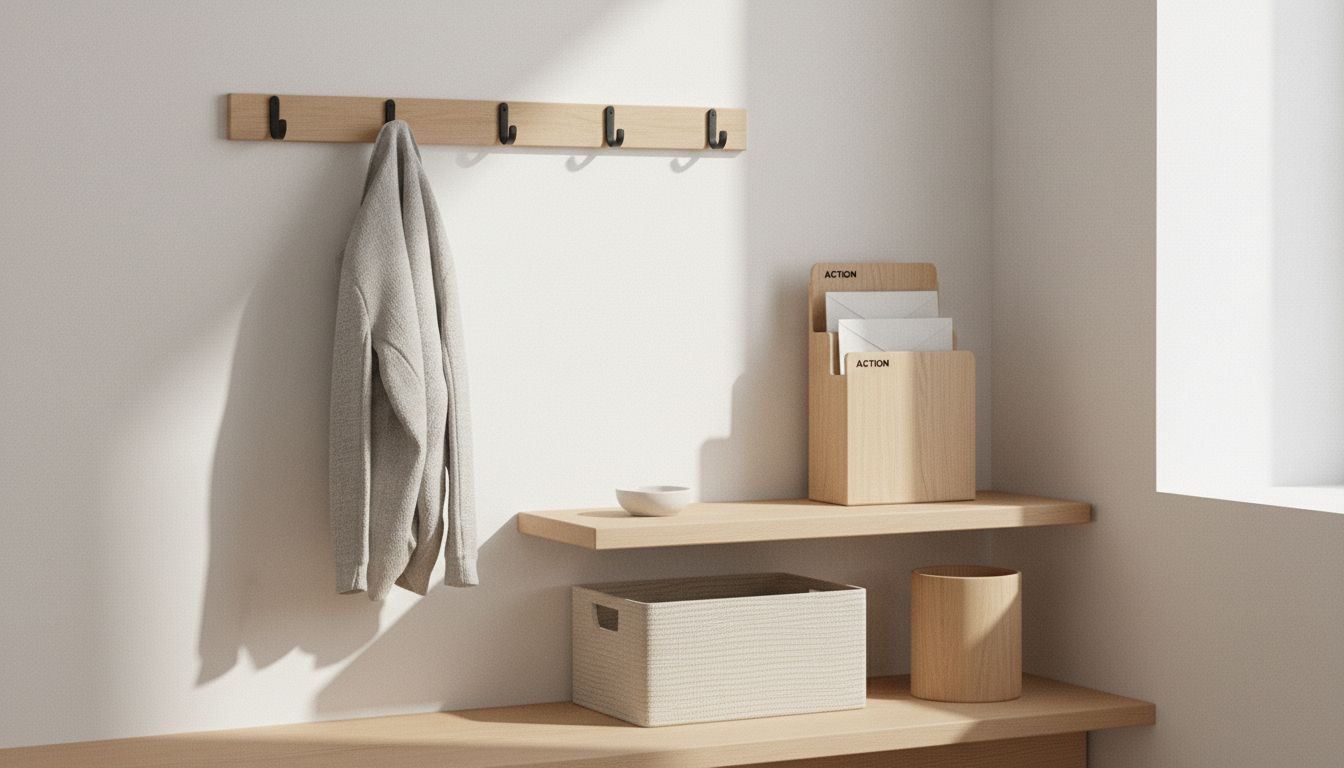
1) Hooks (because hangers are a setup)
If you have to open a closet, find a hanger, and finesse a sleeve while balancing a bag? Your coat is going on a chair.
Hooks are the lowest-friction solution. Ideally:
- one hook per daily coat/jacket (plus one spare)
- one hook dedicated to your most-used bag
If you can’t drill into walls, a freestanding coat rack or over-the-door hooks still gets you 80% of the benefit.
2) A single, obvious key drop zone
Keys should have one home. Not “usually here.” Not “in my bag unless I change bags.”
One home.
A small tray, bowl, or wall-mounted hook right by the door works. The best key drop zone is the one you can reach without thinking.
If you’re often walking in while checking your phone, consider stacking habits: key tray + a charger nearby. Not because you need more tech—because you’re already holding the phone, so the routine becomes one smooth motion.
3) Bag parking (so the floor stops being the default)
Most entryway clutter is bag clutter: work tote, gym bag, grocery tote, crossbody, laptop case.
Give bags a job title and a parking spot:
- “Work bag goes here.”
- “Gym bag goes here.”
- “Returns bag lives here.”
This can be a shelf, a bench, a basket, or a specific hook—what matters is that it’s assigned. The floor is only your default right now because nothing else is.
4) Mail triage at the door (not on the kitchen counter)
Mail is sneaky because it looks harmless. Then it becomes a pile, and suddenly you’re sorting paper like it’s your second job.
Your entryway reset needs a quick sorting rule:
- trash immediately (ideally with a trash can within arm’s reach)
- action items in one slim folder/bin
- everything else doesn’t come inside “to decide later”
Even a simple vertical file holder labeled “To Do” is enough to stop the paper creep.
A gentle way to make the habit stick (without becoming obsessive)
Once the “homes” exist, you’re not relying on motivation—you’re relying on choreography.
The easiest way to do that is to attach the reset to a moment that already happens every day: the door click.
As soon as you lock the door behind you, you run the four steps. The goal is not perfect tidiness; it’s containment. Think “30 seconds of future-proofing.”
If you like a little digital accountability (or you’re the type who forgets new habits the second life gets busy), you can also track “Entryway Reset” as a recurring daily task in something like Todoist or Streaks. Not as a guilt tool—more like a tiny check-in that says, “Did I make life easier for tomorrow-me?”
Because tomorrow-me deserves a calmer morning than frantic key-hunting and stepping over yesterday’s tote bag.
And once the basic reset is in place, you can start tightening the system in small, strategic ways—especially for the moments that usually break it, like weekends, grocery runs, and those nights you walk in carrying way too much…
…and those nights you walk in carrying way too much
Let’s make your entryway reset resilient for real life: the “I have 12 things in my hands” nights, the Saturday errand pileups, and the weeks when your capacity is simply lower.
Make the reset easier than the mess: a few smart upgrades
The goal here isn’t a prettier entryway. It’s an entryway that works when you’re tired, distracted, or running on fumes. Think: fewer steps, fewer decisions, fewer places for stuff to “rest” temporarily.
1) Create a “hands-full landing pad” (so nothing hits the floor)
If the floor is the first available surface, it becomes the default. Give yourself a better default within one step of the door:
- A small table or shelf for the two things you’re most likely to be holding (phone + mail, lunch bag + keys, etc.).
- A basket or bin underneath for the “I can’t deal with this yet” category (more on that in a second).
- A clear surface rule: if it doesn’t belong to the entryway system, it can’t live on the landing pad.
This one change prevents the spiral where one dropped thing becomes five, and five becomes a weekend cleanup.
2) Add a “Reset Basket” for the exceptions (because life will always have exceptions)
Even the best systems break when life gets messy. So instead of pretending you’ll do everything perfectly, create a dedicated container for the overflow:
- One basket only (this is important—limits keep the system honest).
- It holds temporary items: returns, something you need to take out tomorrow, something that belongs upstairs, that random charger.
- A daily or every-other-day rule: empty it during a low-effort moment (while coffee brews, while you’re on a call, while dinner reheats).
Why it works: you’re not creating clutter—you’re creating containment. Your entryway can still look and feel calm even when you’re in a high-demand week.
3) Give weekends their own mini-system
Weekends create a different type of entryway chaos: more bags, more receipts, more packages, more “things in transition.” Instead of forcing your weekday system to handle it, add two weekend-specific supports:
- A “Returns + Outgoing” bag on a hook (or in a bin). The rule: if it’s leaving the house, it goes straight in there.
- A package zone (even a single square of floor space) so boxes don’t migrate into your living area. Break them down when you have energy, not as a moral requirement the second you walk in.
This keeps errands from turning into visual noise that lingers all week.
The “one-touch” version of the entryway reset (for low-energy days)
Some days, four steps will feel like a lot—and that’s normal. On those days, use the one-touch standard: each item gets one decision, and then you’re done.
- Coat: hook (or coat rack) once
- Keys: tray/hook once
- Bag: parking spot once
- Paper: trash or “Action” slot once
If you can’t complete a step, that’s when the Reset Basket earns its keep. The point is to stop the spread—especially on the days when you’re not up for extra effort.
Make mornings easier: set up your “launch pad” at night
One of the most underrated benefits of an entryway reset is that it can quietly fix your mornings. A calm exit is a calm start.
A simple 60-second evening “launch pad”
- Put tomorrow’s essentials in your bag (badge, headphones, wallet, keys if you don’t need them overnight).
- Set shoes where you’ll step into them.
- If you pack lunch or a gym kit, place it in the fridge or by the door—whichever prevents “I forgot it” panic.
You’re not trying to become a hyper-optimized person. You’re just removing morning decisions that cost you time and nervous system bandwidth.
Shared space? Make the system “obvious” (so you’re not managing everyone)
If you live with a partner, roommates, or kids, the entryway can become a silent battleground because nobody knows what “put away” means in that specific space. The fix isn’t nagging—it’s clarity.
- One hook per person (even if it’s not perfectly aesthetic).
- One bin per person for daily carry items (hat, gloves, dog leash, etc.).
- Labels if needed—not forever, just until the habit is automatic.
- A visible “capacity limit”: when the bin is full, something has to leave. This prevents slow creep.
This is how you avoid becoming the default household “resetter” without ever agreeing to the job.
When the reset breaks: a no-shame recovery plan
You will have weeks where the entryway reset falls apart. Travel, deadlines, sickness, burnout, a string of late nights—normal. The win is having a restart script that doesn’t require a full Saturday cleanup.
The 3-minute entryway rescue
- Grab a trash bag and remove obvious trash/junk mail.
- Put keys/wallet in their home immediately (protect tomorrow morning first).
- Sweep all “elsewhere items” into the Reset Basket to sort later.
That’s enough to get your floor back, your essentials predictable, and your brain a little quieter.
“Make it easier to do the right thing than the easy thing.”
Conclusion: calm starts at the threshold
A calm home isn’t built through one big declutter. It’s built through tiny systems that protect your attention—especially at the moments when you’re most tired and least interested in making decisions.
The entryway reset works because it’s not about being “neat.” It’s about making your home feel like it’s on your side. You walk in, you close the day, you put a few things where they belong—and you get to move into your evening without the quiet pressure of unfinished micro-messes.
Start small. Make the next right action easy. And let your entryway become the soft boundary that keeps your life from spilling all over your space.