
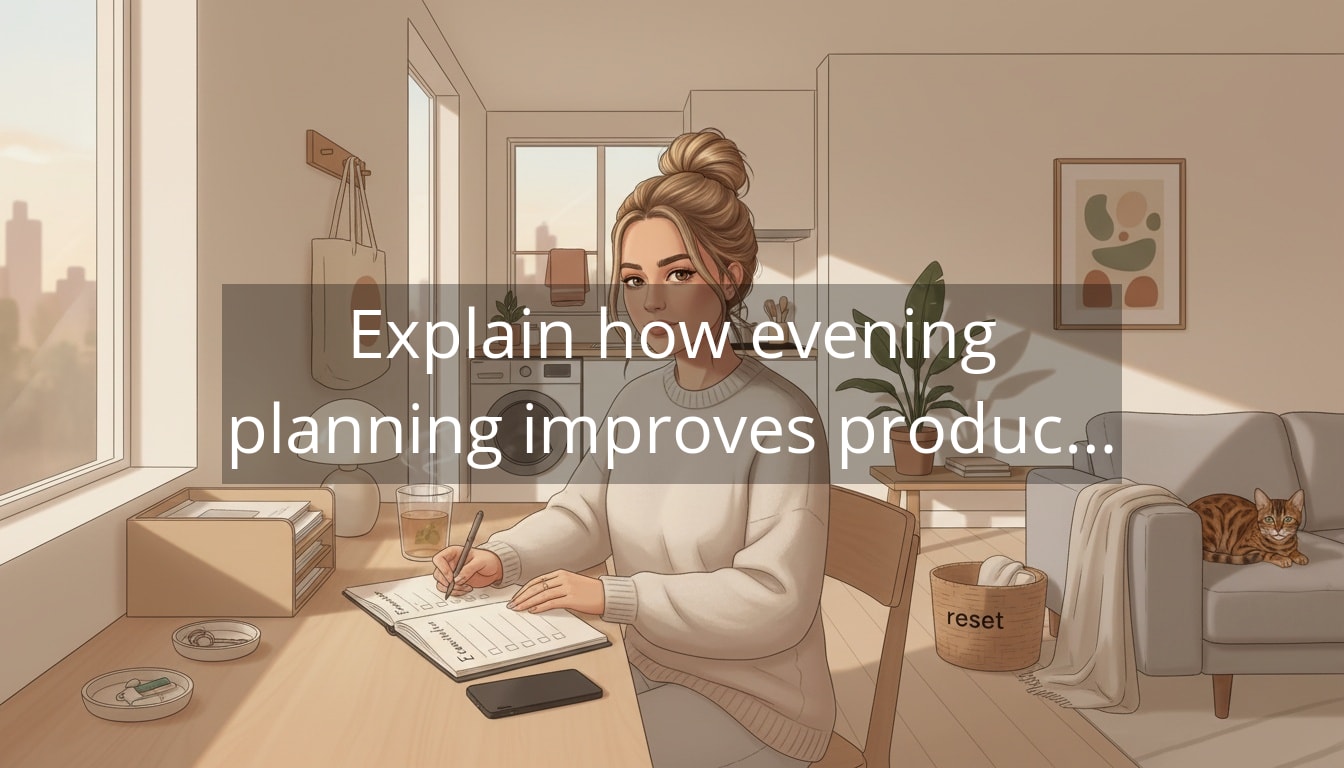
Your evening routine for productivity doesn’t start with a fancy candle or a perfect skincare lineup. It starts the moment you close your laptop and realize your brain is still running—replaying messages, half-making tomorrow’s decisions, and quietly panicking about everything you didn’t get to.
If that sounds familiar, it’s because evenings have become the “leftover container” of the day. We’re technically off work, but we’re still mentally on-call. You make dinner while answering one more email. You sit down to “rest” and somehow end up scrolling until 11:30, not even enjoying it, just trying to turn your thoughts down.

Here’s what’s really happening: your mind hates open loops. Unfinished tasks (even small ones) keep pinging for attention, and without a plan for tomorrow, your brain tries to solve your life in the background—usually right when you want to sleep. Add decision fatigue and constant digital noise, and it makes sense that mornings can feel chaotic before you’ve even had coffee.
The Mindset Shift: An Evening Routine for Productivity Is a Reset, Not a Hustle
A good evening routine isn’t about squeezing in more. It’s about creating a clean handoff between “today” and “tomorrow,” so you can stop carrying everything in your head.
Clarity is a form of self-respect.
Think of it like closing tabs. You’re not finishing your whole life at 9 PM—you’re just telling your nervous system, we’re safe, we have a plan, we can power down now.
Start With Two Small Systems (That Actually Reduce Mental Load)
First: do a 10-minute work closeout. Not “finish everything,” just capture it. Jot unfinished tasks into a notes app (Apple Notes, Google Keep) or a task manager like Todoist. Then physically shut your laptop and move it out of sight if you can.
Second: do a tomorrow quick-plan. In your planner or Notion, write 3–5 priorities and one “must-do” that makes the day feel anchored. Keep it simple—clarity beats ambition at night.
If you only did those two things, you’d already feel the difference: fewer spinning thoughts, fewer morning decisions, and a night that actually feels like it belongs to you.
Build an Evening Routine for Productivity That Covers the “Life Admin” Stuff (So It Stops Haunting You)
Once you’ve captured your work loose ends and picked tomorrow’s priorities, the next layer is simple: handle the tiny logistics that turn into big friction at 7:42 AM.
This is the part most of us skip because it feels boring… until you’re standing in a towel, realizing you’re out of clean underwear and you still haven’t replied to that school email.

The 15-Minute “Future Me” Reset
Set a timer for 15 minutes and do a quick sweep of the things that most often derail your mornings. You’re not deep-cleaning your home or becoming a new person. You’re removing predictable obstacles.
- Reset one surface: kitchen counter, coffee table, or your desk (choose the one you see first in the morning).
- Set up breakfast/lunch: put the oats on the counter, pack leftovers, or at least decide what it will be.
- Lay out clothes: full outfit if possible (including shoes if your mornings are rushed).
- Charge devices: ideally outside the bedroom if you’re trying to reduce scrolling.
If you live with a partner or roommates, this can be a shared rhythm: “15-minute reset and then we’re done.” It creates a boundary that feels supportive, not strict.
A Simple “Closing Shift” Script for Your Brain
If your mind tends to keep working even after you’ve done the closeout, try a short script that signals completion. It sounds almost too easy, but it works because it’s a clear cognitive endpoint.
- Today is complete enough.
- My tasks are captured.
- Tomorrow has a plan.
- Now I rest.
You can say it in your head while you turn off lights, wash your face, or lock the door. The repetition is the point—it trains your nervous system to recognize the transition.
Protect Your Energy With a Tech Boundary (Without Going Off the Grid)
For a lot of us, the thing that quietly wrecks sleep isn’t a lack of willpower—it’s that our phones are designed to keep our brains alert. One more message. One more video. One more “quick check” that turns into forty minutes.
Instead of aiming for a dramatic detox, try a realistic boundary you can keep:
- Pick a tech “dim time”: 60 minutes before bed, switch to low-stimulation only (music, audiobook, gentle show if you must).
- Create a “parking spot” for your phone: a specific charger outside the bedroom, or at least across the room.
- Use a shortcut list: if you need your phone at night, keep one folder with only calming options (podcast, book app, sleep sounds) so you’re not wandering into social media.
And if your job or family situation requires you to be reachable, that’s okay. You can still reduce the mental noise by choosing how you’re reachable—like allowing calls from favorites only, or setting an “if it’s urgent, call twice” rule.
When You Can’t Stop Thinking: The “Worry Container”
If you’re the kind of person who gets into bed and immediately remembers everything you’ve ever forgotten, give your thoughts a designated place to land.
Keep a small notebook by your bed and create two sections:
- Not Now: worries, ideas, reminders, anything that feels urgent at 11 PM.
- Tomorrow: the one next action (email X, call Y, add Z to list).
This works because your brain isn’t actually asking you to solve the whole problem at night—it’s asking you not to forget. When you write it down, the “ping” quiets.
A Calm Wind-Down That Still Supports an Evening Routine for Productivity
Here’s the part people get wrong: calm and productive are not opposites. A good wind-down makes you more productive because it improves sleep, improves mood, and reduces morning chaos.
Pick one thing that genuinely feels like rest. Not self-improvement. Not “catching up.” Actual downshifting.
- Reading: something light enough that you don’t get wired (save thrillers for weekends if they keep you up).
- Stretching: 5 minutes on the floor while listening to music.
- Shower + skincare: not as a performance, but as a cue to your body that the day is ending.
- Short walk: even around the block—especially if you’ve been inside all day.
- Journaling: one page, no rules.
If you want structure without overthinking it, try this three-step wind-down:
- Body: wash face, shower, stretch, or make tea.
- Space: lights lower, one surface reset, bedroom slightly tidier.
- Mind: notebook dump, two-minute reflection, or a few slow breaths.
That’s it. You’re not creating a perfect night. You’re creating a smoother tomorrow.
You don’t need more discipline—you need fewer decisions.
Make It Stick: The “Minimum Version” for Busy Nights
Some evenings you’ll have the energy for the full routine. Some evenings you’ll be tired, social, hormonal, traveling, caring for someone, or just human. The goal is consistency, not perfection—so create a minimum version you can do even on chaotic nights.
Try this “bare minimum” checklist (10 minutes total):
- 2 minutes: capture open loops (quick brain dump into Notes/Todoist).
- 3 minutes: pick tomorrow’s top 3 + the one “anchor” task.
- 5 minutes: prep one thing (outfit OR lunch OR reset one surface).
If you do only that, you’ve still completed the most important job of an evening routine: taking your day out of your head and putting it somewhere reliable.
A Realistic Example (Because Life Is Never as Neat as a Checklist)
Let’s say you finish work, your kitchen is a mess, and you’re already behind on sleep. You don’t need to “fix everything.” You do this:
- Write down the three things that matter tomorrow (one work priority, one personal/admin task, one health/home thing).
- Put your laptop away and plug your phone in a set spot.
- Set out your clothes and pack whatever lunch you can (even if it’s basic).
- Do a quick shower and get into bed 20 minutes earlier than usual.
That night wasn’t flashy. But the next morning? You’re not starting from chaos. You’re starting from a plan.
Extra Resources to Support Your Routine
If you want more support building a calmer night (and a smoother morning), here are a few helpful resources to explore:
- Printable evening checklist: a simple one-page routine you can tape inside a cabinet or keep by your bed
- Digital planning templates: a “tomorrow quick-plan” layout for Notion or any notes app
- Guided wind-down ideas: short reading lists, journaling prompts, and gentle stretch sequences you can rotate through
Conclusion: A Calmer Night Creates a Kinder Tomorrow
Your evenings don’t need to be perfect to be powerful. A steady evening routine for productivity is just a small, repeatable way of telling yourself: “I don’t have to hold everything at once.”
When you close the loops, choose tomorrow’s priorities, and remove a few points of friction, you reduce the mental load that’s been following you around like background noise. You sleep with less tension. You wake up with fewer decisions. And you start building days that feel calmer—not because life is easy, but because your systems are.
Start tonight with the smallest version that feels doable. That’s how sustainable routines are made: gently, consistently, and with a lot of self-respect.
Telegram Galelar
Instagram @galelar_lis
YouTube @galelar
TikTok @galelar_lis