
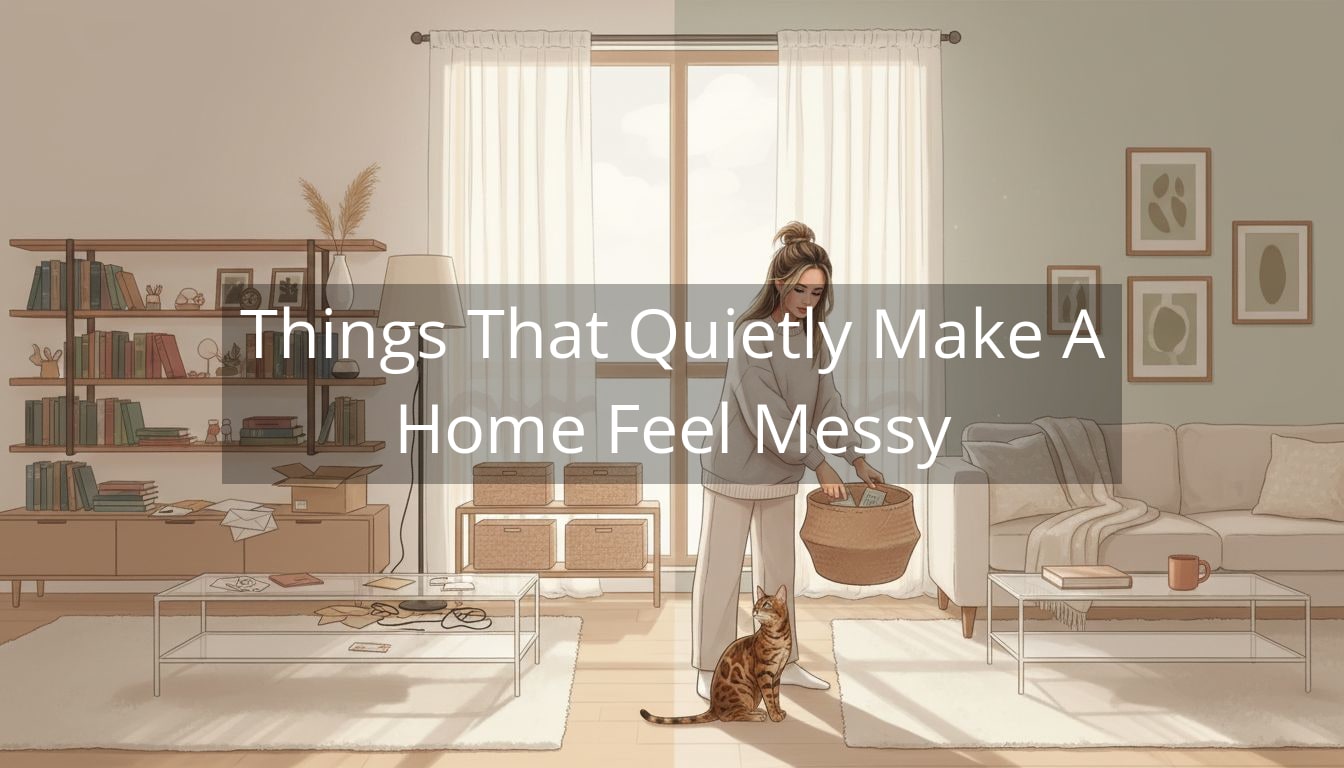
You know that feeling when your home is technically clean, but your brain still can’t relax? That’s usually visual noise—the subtle, constant “busy-ness” your eyes keep tripping over, even after you’ve done the responsible adult things like vacuuming, wiping, and folding.
It’s honestly one of the most frustrating kinds of overwhelm because it makes you question yourself. You did clean. You put in the time. The counters are disinfected. The laundry is done. And yet the room still feels like it’s quietly buzzing, like there’s a dozen tiny open tabs in your mind you can’t close.
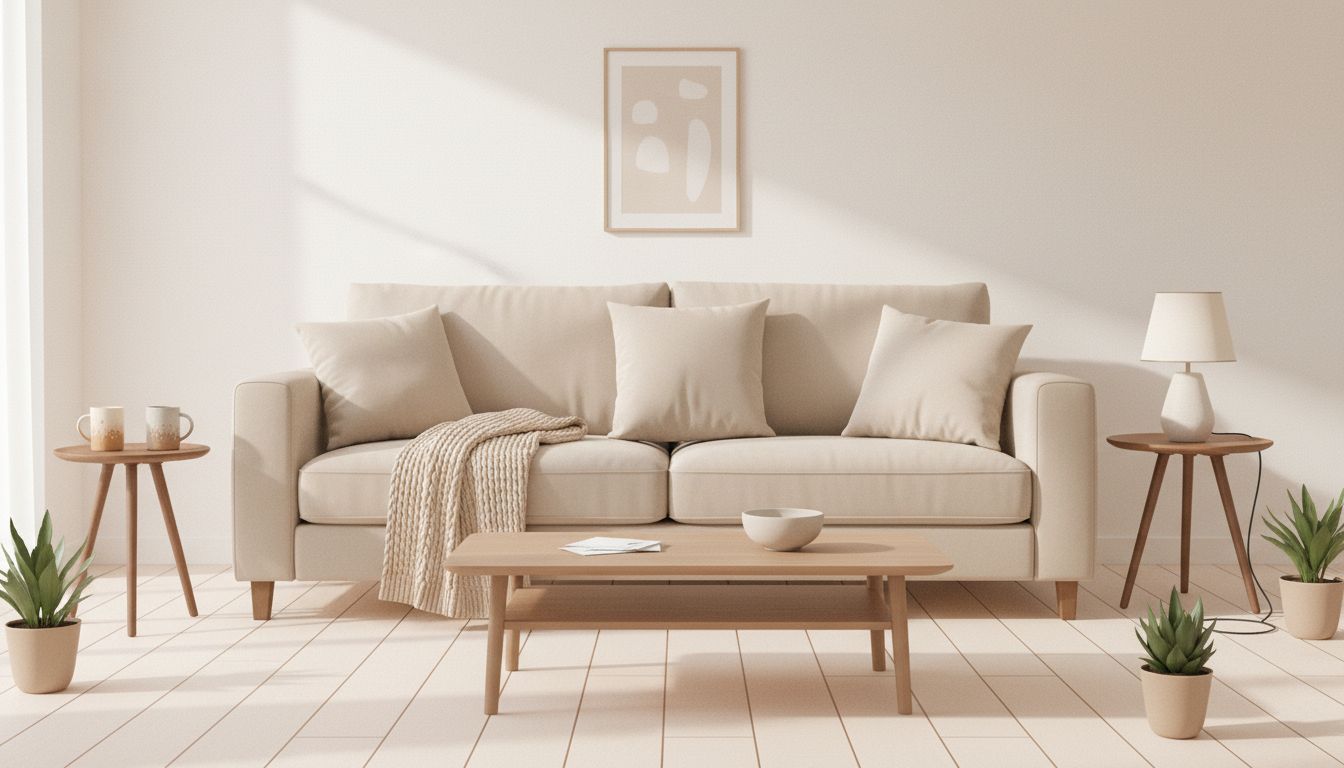
If you’re already carrying a heavy mental load—work deadlines, life admin, maybe a side project you care about, and the ongoing task of feeding yourself like a functional human—this matters more than it sounds. Because your home isn’t just where you live. It’s where your nervous system is supposed to downshift.
Why “clean” can still feel chaotic (and why it’s not your fault)
A lot of us were raised with a pretty simple definition of messy: dirt, laundry piles, and visible trash. So we clean for that. But modern life creates a different kind of mess—one that’s less about hygiene and more about constant micro-decisions.
Here’s what’s happening in the background:
- Your eyes are always scanning. Even when you’re “resting,” your brain is taking in your environment and making quick judgments: Put that away. Deal with that. Remember this. Don’t forget that.
- Visual clutter registers like unfinished business. A stack of mail on the table isn’t just paper—it’s future effort. A cable draped across the floor isn’t dangerous, but it signals disorder. Five products on the bathroom counter aren’t “mess,” but they read as “too much.”
- Decision fatigue makes it worse. At the end of the day, you don’t want to assign homes to objects. You want to drop your bag, eat something easy, and be done. So the items collect in the most convenient spots—and the visual noise builds.
And because most of it is “small,” it’s easy to dismiss… until you notice you’re more irritable at home than you want to be. Or you keep bouncing between tasks because you can’t focus. Or you avoid inviting a friend over even though everything is technically fine.
Clarity isn’t created by doing more—it’s created by removing what quietly asks for your attention.
The sneaky sources of visual noise (the stuff that’s not “mess” but still drains you)
Visual noise is rarely one dramatic disaster. It’s usually five or six little hotspots that repeat every day.
Think of it like this: your space can be spotless, but if the silhouette of the room is busy—lots of items on surfaces, lots of lines and piles and “almost-sorted” stuff—your brain still reads it as chaos.
A few of the biggest culprits:
1) Counter “skylines”
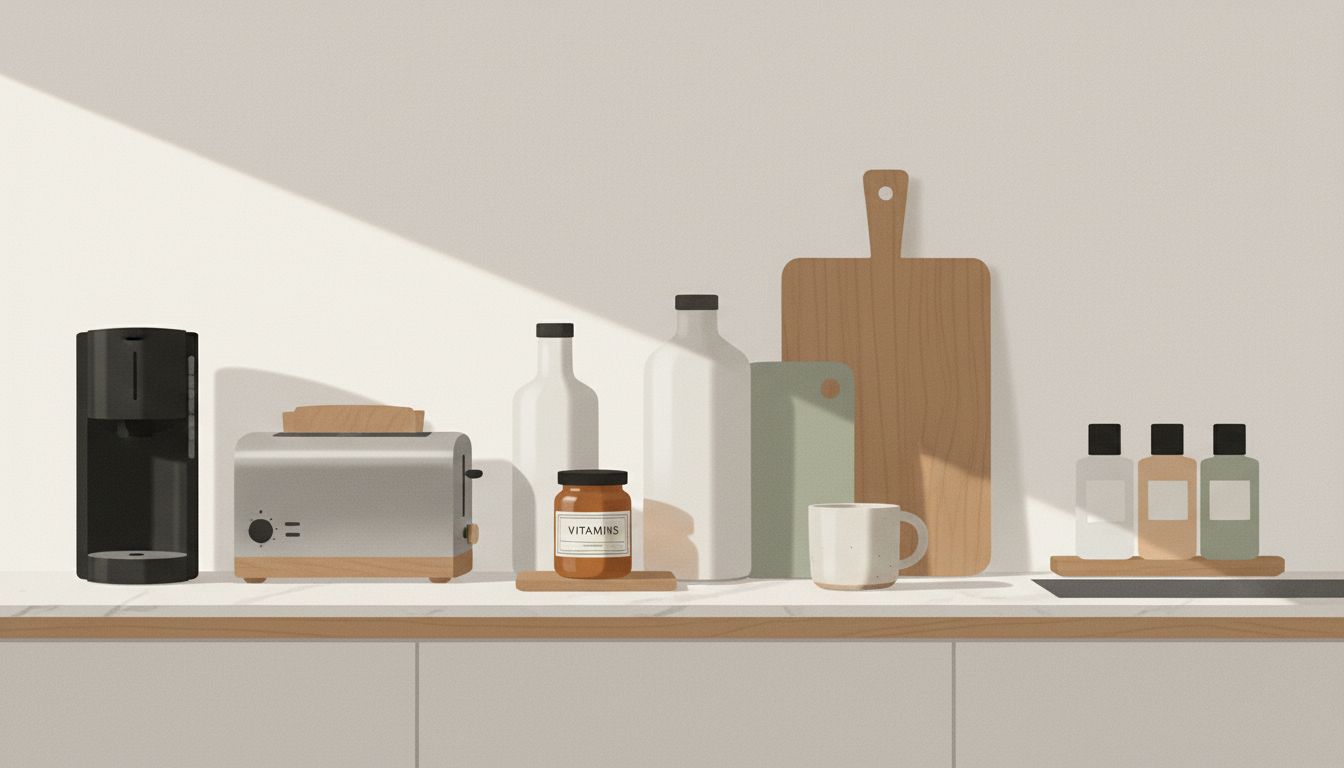
Kitchen and bathroom counters are the loudest surfaces in most homes. Not because they’re dirty—but because they’re visible from across the room, and they tend to collect lots of small items.
A typical example: coffee maker, toaster, vitamins, olive oil, a couple of mugs, a cutting board leaning against the backsplash, skincare products, hair tools… none of it is wrong. But together it creates a visual “cityscape” that makes the whole space feel busier than it is.
2) Cables that break the calm
Cables are pure visual static. They create messy-looking lines even in an otherwise minimal room: chargers on the nightstand, cords looped under a desk, TV wires, laptop cables across the kitchen island.
And the annoying part? You can be the cleanest person alive and still lose the battle to modern electronics.
3) Paper piles (aka delayed decisions)
Mail, printouts, receipts, returns, forms, notes you meant to file—paper is the most common “I’ll deal with it later” category. It’s also the category that turns a dining table into a stress zone.
Because paper doesn’t just sit there. It represents tasks. Every time you see it, your brain pings you: That’s not handled.
4) The entrance “drop zone”
This is the moment your day hits your home—the shoes, the bag, the keys, the jacket, the deliveries, the random item you meant to return.
If the entry is chaotic, it tends to tint your whole experience of the house. It’s the first thing you see when you walk in, and the first place your eyes land when you’re leaving (often already running late). Even a small pile here can make everything feel slightly out of control.
5) Overfilled shelves that look “styled”… until they don’t
Shelves are tricky because they start out with good intentions: books you love, meaningful objects, cute baskets, framed photos, candles.
But when shelves get too full, they stop reading as curated and start reading as crowded. The eye has nowhere to rest. You can’t dust easily. Things tip, overlap, and visually blur together—especially if the items vary a lot in shape and color.
Where visual noise hits hardest (real life, not Pinterest life)
If you’re thinking, “Okay, but I don’t have time to live in a showroom,” same. The goal isn’t sterile perfection. The goal is reducing the specific clutter that creates the most mental drag.
Here are the moments visual noise tends to spike for busy, capable women:
- The post-work dump. You walk in carrying your day, your bag, maybe a package, maybe groceries, and your brain is already done making decisions. So everything lands on the nearest surface. By evening, your space is “fine,” but it feels like a low-grade mess you can’t unsee.
- The dining-table workspace. You set up with good intentions—laptop, notes, a couple of papers. Then a receipt. Then a cable. Then a sticky note. Suddenly the table becomes a semi-permanent project pile, and you lose that psychological sense of “I’m off now.”
- The morning rush. Counters fill up with to-go mugs and products. Towels get a little crooked. A rug slides slightly out of place. None of this is dramatic, but everything becomes visually loud by noon.
Again: not a character flaw. A systems problem.
The core idea: don’t “deep clean” more—reduce the visual decisions
Here’s the shift that helps the most: tackling visual noise isn’t about becoming a minimalist or doing massive decluttering marathons.
It’s about creating fewer visible categories that your brain has to process.
When you reduce visual decisions, a room feels calmer even if you still live a full, real life in it. That means we focus on:
- surfaces (what’s left out)
- lines (cables, piles, scattered items)
- default homes (where things automatically go without thought)
And you only need a few simple systems to start getting that “exhale” feeling back.
Start here: 3 low-effort systems that immediately reduce visual noise
1) The “Clear Counter Minimum” (not empty, just quieter)
Instead of trying to keep counters perfectly bare, decide your minimum calm version.
Pick one small section of counter that stays clear—like a 12-inch strip beside the stove, or one section of bathroom counter. This becomes a visual anchor.
Then set a gentle rule: only true daily essentials earn a spot on the counter. Not “weekly,” not “nice to have,” not “I might use it.” Daily.
Practical examples:
- Coffee maker? Maybe yes.
- Vitamins? Put them in a drawer with a small organizer so the routine stays easy without the visual clutter.
- Skincare you use twice a day? Consider a small tray or bin under the sink, so you can pull it out and put it back without thinking.
A tiny upgrade here is drawer dividers or a shallow bin system under the sink—so the counter doesn’t become the storage unit.
2) A paper “inbox” that stops the table from becoming a decision graveyard
If paper is currently living in little stacks around your home, the goal is not to sort everything perfectly. The goal is to stop paper from spreading.
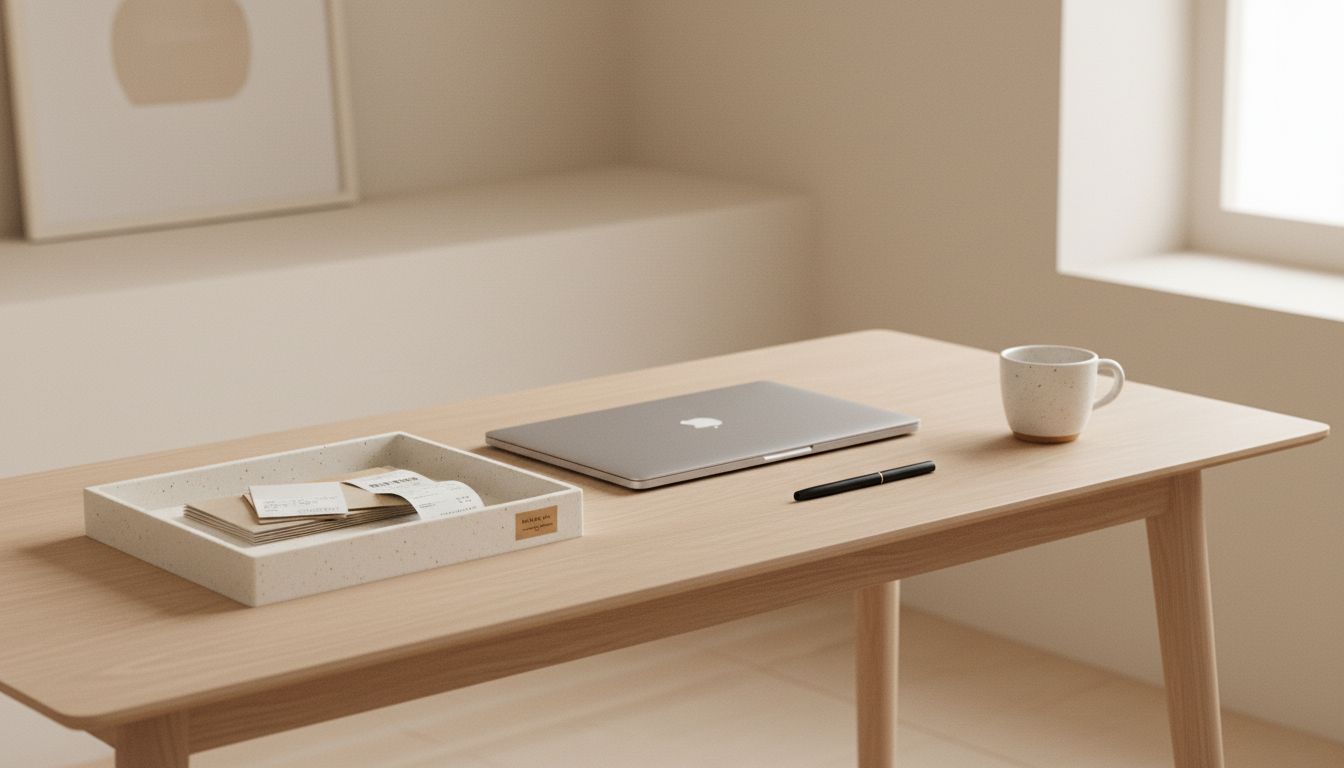
Create one physical inbox—just one. A slim tray, a magazine file, a folder, even a pretty box if you want it to blend in. Mail, receipts, forms: all paper goes there.
Then make it easy to process in two small moves:
- Action (pay, reply, schedule, scan)
- File (keep digitally or store physically)
If you want to go lighter and more modern with it, this is where a digital tool actually helps instead of complicating your life. Notion or Evernote can work beautifully as a simple “paper hub” if you keep it minimal: a few tags like Bills, Home, Warranty, Taxes. Scan with your phone, drop it in, done.
The win isn’t becoming perfectly paperless overnight. The win is: your dining table stops feeling like a to-do list.
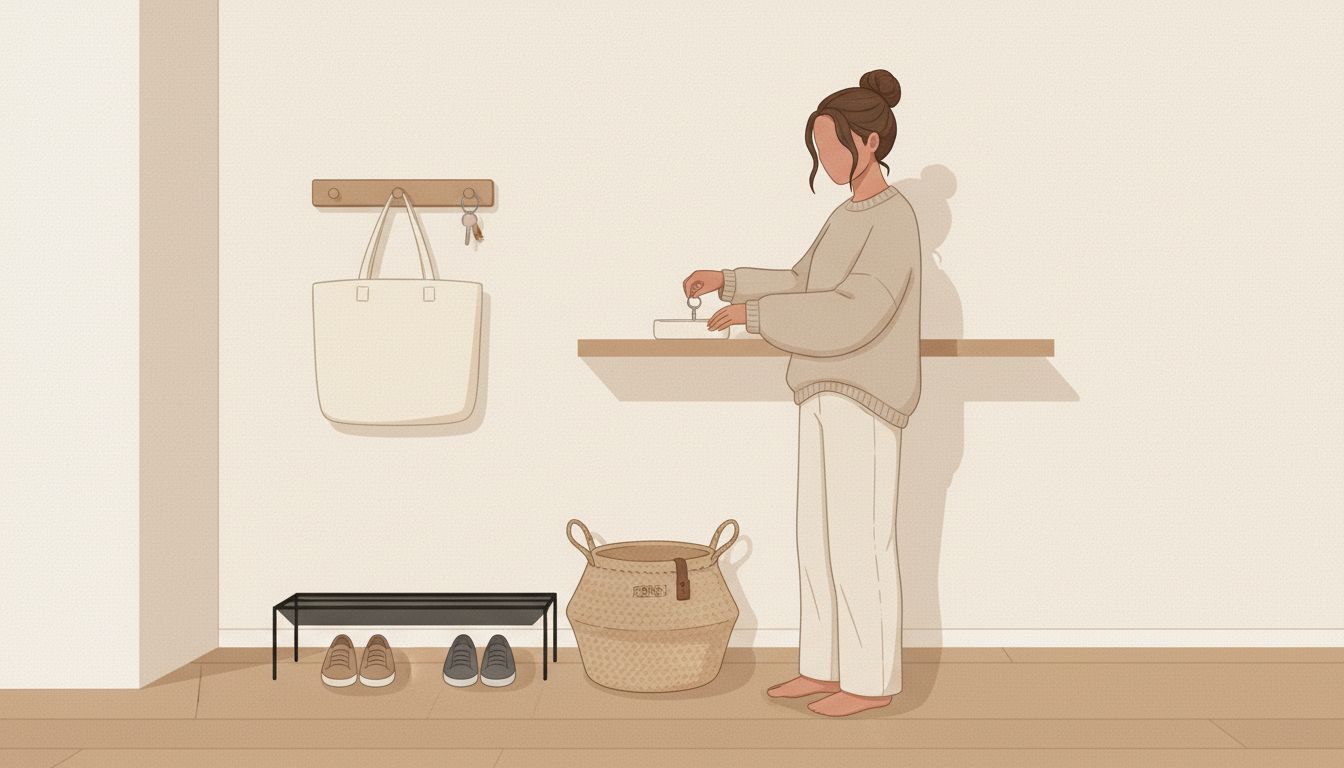
3) The “Landing Pad” at the entrance (so your day doesn’t explode on impact)
Your entryway doesn’t need to be big to be functional. It needs a few clear homes that match what you actually drop the second you walk in.
The basic set:
- a hook (or two) for keys + bag
- a shoe spot (rack, tray, or cubby)
- a small basket for “random returns” (things that need to go back out)
What makes this work is not aesthetics—it’s friction. The lower the effort, the more it sticks. If the shoe rack is three steps away in a closet, shoes will still land by the door. If the key hook is hidden, keys will still land on the counter.
This is one of those systems that pays you back daily, because it prevents that first layer of visual noise from ever forming—and once this area feels calmer, you tend to treat the rest of the house more gently too.
At this point, you may already be noticing a theme: we’re not trying to become people who “never make mess.” We’re building a home that can absorb real life without looking like it’s constantly mid-scatter. Next, it helps to go after the two biggest “multipliers” of visual noise—the ones that make every room look busier than it is… especially when you’re tired and just trying to get through the week.
The two biggest multipliers of visual noise (and how to tame them fast)
If you only fix two things, fix these. They’re “multipliers” because they make every room look busier than it is—even when you’ve cleaned—simply by adding extra lines, extra objects, and extra decisions.
Multiplier #1: Open surfaces that become “storage”
Most of the time, the clutter isn’t the problem. The surface is. When a counter, table, dresser, or nightstand becomes the default place for things to land, your home starts looking perpetually mid-task.
Try this simple rule: surfaces are for using, not storing. That doesn’t mean empty. It means intentional.
- Pick one “allowed cluster” per major surface. Example: your nightstand gets a lamp + book + water only. Everything else (lip balm, receipts, hand cream) gets a small drawer bin.
- Use a tray to contain what must stay out. A tray turns “scattered” into “contained.” Your eyes read it as one item, not twelve.
- Give loose items a nearby “home within arm’s reach.” This is key. If the home is across the room, the surface will win because tired-you will choose convenience.
A quick example (kitchen counter): If the counter keeps collecting vitamins, oil, salt, supplements, and random packets, create a “daily + weekly” split.
- Daily: 1–2 items that truly earn their spot (coffee maker, maybe a utensil crock).
- Weekly: everything else in a single bin in a cabinet or pantry. You’re not making life harder—you’re making the counter quieter.
Multiplier #2: Unreal “maybe” categories (paper, cables, and half-finished projects)
These are the items that don’t have a clear identity in your home. They’re not trash, not properly put away, and not exactly “decor.” They’re pending. And pending things are loud.
So we stop asking, “Where should this live?” and start asking, “What category is this?”
- Paper becomes: Action or Archive.
- Cables become: Daily (charging) or Stored (spares).
- Projects become: Active (this week) or Parked (not this week).
Once something has a category, it can have a home. And once it has a home, it stops living on your dining table like an unpaid intern.
Room-by-room resets that don’t require a full Saturday
Here’s the kind of practical that actually works: pick one room, do a 10–20 minute reset, and stop. You’re not “fixing your whole life.” You’re reducing the specific visual triggers that drain you most.
Kitchen: quiet the skyline
- Do a 2-minute counter sweep. Put anything that isn’t used daily into one temporary bin (don’t decide yet—just remove).
- Create one drawer/bin called “daily helpers.” Vitamins, tea bags, protein bars, matches—whatever you use often but don’t want to see all day.
- Contain the “always out” group. If you keep oil + salt + pepper out, put them on a small tray so they read as one calm unit.
Bedroom: remove the micro-stress
Bedrooms get visually noisy in tiny ways: unread books, laundry that’s “not dirty,” skincare, chargers, hair tools. This is where your brain should have the easiest time downshifting.
- One basket for “not dirty, not clean.” This single item solves an absurd amount of chaos. No more chair piles.
- Nightstand rule: three things max (plus a tray if needed). The fewer items you see right before sleep, the calmer your body reads the space.
- Charge intentionally. If cords are everywhere, create one charging spot (a small station or a hidden power strip behind the nightstand) and store the rest.
Bathroom: make routines easy without leaving everything out
Bathrooms are classic hot zones because we mistake visibility for convenience. You can keep routines effortless without keeping everything on the counter.
- Use a “get ready” bin. Put your daily skincare/makeup in a small bin under the sink. Pull it out, use it, put it back. Same routine—less visual clutter.
- Limit duplicates. If you have three half-used moisturizers visible, your brain reads it as decisions. Pick one “active” product; store backups.
- Fix the crooked stuff. Straighten towels and rugs. It sounds almost silly, but those small misalignments are surprisingly loud to the nervous system.
Living room: create “empty space” on purpose
Living rooms often look messy because the eye has nowhere to rest—too many objects on every shelf, table, and surface.
- Give yourself permission to leave shelves partially empty. Not everything needs to be filled. Empty space is not “wasted”; it’s calming.
- Group small decor into odd-number clusters. Three items together looks intentional; three items scattered looks like clutter.
- Hide one category. For example: remotes in a lidded box, or kid/pet items in one basket. If you hide just one visually noisy category, the whole room reads calmer.
The “maintenance” plan: stay calm without constantly tidying
This is where it becomes a system instead of a temporary clean spree. The goal isn’t to tidy more. It’s to tidy smaller, more predictably—so visual noise doesn’t get a chance to build into a weekend project.
A simple daily rhythm (10 minutes total)
- 2 minutes: Clear one hotspot surface (usually the kitchen counter or dining table).
- 3 minutes: Reset the entry (shoes in place, bag hung, paper into the inbox).
- 5 minutes: “Close the room” you’re ending your night in—quick straighten, lights off, done.
Keep it gentle. If you miss a day, you didn’t fail—you just pick it up tomorrow. You’re building a home that can recover quickly.
The weekly “quiet sweep” (20–30 minutes)
Once a week (or every other week), do a low-drama scan for the specific things that create the most noise:
- Papers: empty the inbox; handle action items; archive or recycle.
- Cables: put stray chargers back into one labeled spot.
- Shelves: remove anything that migrated there without permission.
- Drop zones: return random items to their actual homes.
This matters because a lot of visual clutter is simply “items that lost their way.” Your weekly sweep is you guiding them back—without turning it into a whole production.
When it still feels messy: the mindset that keeps you from spiraling
If you’re someone who’s competent and used to handling things, visual noise can feel oddly personal—like you “should” have it together. But a home is an active environment. Stuff moves. Life happens. The win is not perfection. The win is having default resets that bring your space back to calm quickly.
A helpful question when you feel that buzz of “ugh, my place is a lot” is:
- Is this actually dirty? (Needs cleaning)
- Or is it visually loud? (Needs fewer items in view)
- Or is it decision clutter? (Needs a category + a home)
That question alone can keep you from deep-cleaning when what you really need is a five-minute surface reset and one basket.
You don’t need more willpower—you need fewer decisions waiting for you in plain sight.
Conclusion: calmer rooms, calmer mind
When you reduce visual noise, you’re not just making your home look better. You’re giving your brain fewer things to track, fewer micro-decisions to make, and fewer reminders of unfinished business. That’s real relief—especially when your days already demand a lot from you.
Start small. Pick one multiplier (surfaces or “maybe” categories) and set up one tiny system that makes life easier: a tray, a bin, a paper inbox, a hook by the door. Those little defaults add up fast. And over time, your home starts to feel like it’s on your side—quietly supporting you instead of asking for more.
If you’d like extra visual guidance, there are additional resources you can check out below.

Leave a Reply