
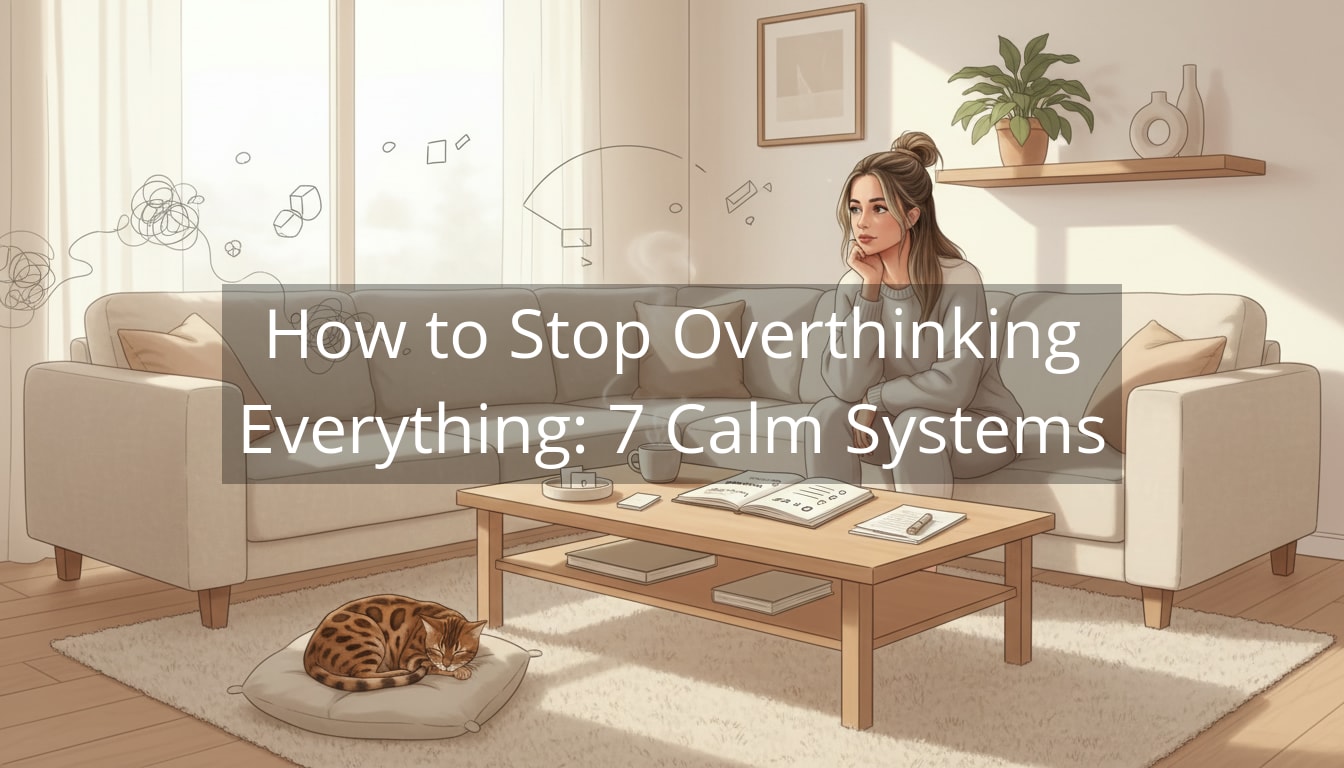
If you’ve been Googling how to stop overthinking everything at 11 PM while your tabs, texts, and to-do list all feel slightly unfinished, you’re not alone. For a lot of women juggling work, life admin, relationships, and the constant low hum of notifications, overthinking doesn’t show up as “dramatic anxiety” — it shows up as mental noise that never fully switches off.
One comment replays in your head during your commute. One unanswered email suddenly feels loaded. One small decision — what to say, what to wear, whether you handled something badly — stretches into a full internal debate. That’s what makes overthinking so exhausting: it feels productive, but it rarely creates clarity.

How to Stop Overthinking Everything Starts With Noticing the Loop
Overthinking is basically your brain getting stuck in a mental holding pattern. It replays the past or rehearses the future, hoping that one more round of analysis will finally create certainty. But instead of leading to action, it keeps you circling the same thought.
This tends to happen more when you’re already mentally overloaded. Stress, lack of structure, decision fatigue, and too much unfiltered input from your phone can all make your mind more likely to spiral. When your nervous system is tired, your thoughts get louder.
The first mindset shift is simple: not every thought deserves your full attention.
Clarity often begins the moment you stop treating every thought like an emergency.
That small reframe matters. You do not need to solve every possible outcome, decode every interaction, or mentally prepare for every version of tomorrow.
Start With Small Interruptions, Not Big Fixes
If you want a practical system for how to stop overthinking everything, begin by naming it in real time. A quiet “I’m overthinking right now” can be surprisingly powerful. It creates a little distance between you and the spiral.
From there, use a fast interruption tool. The easiest one is what I think of as a mental channel change: shift your attention to something immediate and concrete. Refill your water. Put laundry away. Write tomorrow’s top three tasks in your notes app. Open a breathing app like Calm or Insight Timer and do one short reset.
Another helpful boundary is the five-minute worry window. Set a timer, let yourself think the thought, even write it down, and then stop when the timer ends. This works especially well if your mind tends to attach itself to the same issue all day.
You can also start tracking patterns gently. A notes app, mood tracker, or even a recurring phone reminder can help you notice when overthinking shows up most often — late at night, after meetings, during unstructured weekends — which is usually where the real insight begins.
Telegram Galelar
Instagram @galelar_lis
YouTube @galelar
TikTok @galelar_lis
Build a Simple Decision System for the Thoughts That Keep Returning
Once you’ve started noticing the loop, the next step is making your brain work less hard. A lot of overthinking comes from treating every thought like it needs a fresh decision. But most thoughts don’t need deeper analysis. They need a category.
When something keeps circling, try sorting it into one of these three buckets:
- Can act on now — send the email, clarify the plan, make the appointment
- Can schedule — add it to your calendar, task list, or notes for later
- Cannot control — someone else’s mood, a past conversation, a future outcome
This sounds simple, but it creates real relief. Instead of asking your brain to solve everything at once, you’re giving it a clear next move.
For example, if you keep replaying a meeting and wondering whether you sounded unprepared, ask yourself: is there an action here? If yes, maybe you send a follow-up email with one clarifying point. If no, it may belong in the “cannot control” bucket, which means the work is not to think more — it’s to let the thought pass without feeding it.
Use a “Close the Loop” List
Many women who struggle with mental spirals are not overthinking nothing. They’re carrying dozens of tiny open loops: order the birthday gift, reply to the school email, book the dentist, check the budget, text your friend back, figure out dinner. None of these are huge on their own, but together they create background mental pressure.
A dedicated “close the loop” list can help. Keep one note on your phone for unfinished items that are taking up more brain space than they deserve. Then, once a day or a few times a week, spend 10 to 15 minutes clearing what you can.
Your list might include:
- Things you need to reply to
- Small tasks you’ve mentally postponed
- Decisions you keep revisiting
- Conversations you need to initiate
- Life admin that keeps floating in the background
The goal is not to become hyper-organized. The goal is to stop your mind from acting like a storage unit.
How to Stop Overthinking Everything by Reducing Input
If your mind feels busy all the time, it’s worth looking at what’s constantly going in. Overthinking often gets worse when your brain has no quiet edges. Too many notifications, too much scrolling, too many opinions, too much context-switching — it all adds up.

This is where gentle input boundaries can make a big difference.
- Turn off non-essential notifications for a few days and notice what changes
- Create one or two phone-free pockets in your day, especially in the morning or before bed
- Avoid reading emotionally loaded messages when you’re already tired
- Use “read later” or notes apps instead of trying to process everything immediately
- Unfollow accounts that leave you feeling mentally crowded, not inspired
Think of this less as discipline and more as protecting your attention. If your brain is overstimulated, it will try to process everything at once, and that’s often when tiny concerns start feeling much bigger than they are.
Create an Evening Off-Ramp for Your Mind
Late-night overthinking has its own personality. Everything feels more complicated when you’re tired, your defenses are down, and there’s no structure left in the day. One of the kindest things you can do for yourself is create a simple evening off-ramp.
This doesn’t need to be a perfect night routine. It just needs to signal to your brain that the day is closing.
A realistic version might look like this:
- Do a two-minute tidy of one visible space
- Write down tomorrow’s top three priorities
- Put any lingering worries into a note labeled “not for tonight”
- Dim lights and stop checking messages for the last 20 to 30 minutes before bed
- Listen to a short meditation, sleep story, or quiet playlist
If you often find yourself mentally reviewing old conversations while brushing your teeth or lying in bed, this kind of routine can reduce the sense that your thoughts are free to roam indefinitely.
You’re not trying to force calm. You’re making calm easier to access.
Give Your Brain Fewer Chances to Spiral
One of the most practical ways to reduce overthinking is to make fewer decisions in your most depleted moments. This is especially helpful if you notice that spirals happen when you’re hungry, rushing, multitasking, or trying to figure out too many things at once.
A few small systems can help here:
- Choose outfits the night before busy days
- Keep 3 to 5 easy meal options on repeat
- Use templates for emails you send often
- Batch errands and routine admin into one block
- Set default choices for recurring decisions
These aren’t boring habits. They’re supportive ones. The less energy you spend reinventing routine decisions, the more mental space you keep for things that actually matter.
For example, if Sunday evenings often trigger spirals about the week ahead, a 15-minute planning reset can help more than another hour of thinking. Check your calendar, choose your top priorities, note anything you need to prep, and stop there. That gives your brain an endpoint.
You do not need a perfectly quiet mind to build a calmer life — just a few reliable ways to come back to yourself.
When the Thought Is Emotional, Not Practical
Sometimes overthinking isn’t really about the decision itself. It’s about the feeling underneath it. You may be analyzing a text message when what you really feel is rejection. You may be obsessing over a presentation when what’s actually coming up is fear of being judged.
That’s why logic alone doesn’t always solve the spiral. Sometimes the better question is not “What if this goes wrong?” but “What am I feeling right now?”
Try this quick check-in:
- What happened?
- What story am I telling myself about it?
- What feeling is underneath that story?
- What would help me feel supported right now?
The answer might be rest. Or reassurance. Or a clearer plan. Or a reminder that one awkward moment does not define you.
This is a useful shift because it moves you away from endless mental analysis and toward actual care. If your brain is asking for safety, more thinking usually won’t provide it. A grounding action often will.
Try a “Support Before Solutions” Rule
When you notice you’re spiraling, pause before jumping straight into fixing. Ask: do I need support before I need solutions?
Support can look like:
- eating something if you haven’t eaten in hours
- texting a trusted friend instead of rereading old messages
- taking a walk before making a decision
- getting out of your inbox for 20 minutes
- sleeping on it when everything feels sharper than usual
This is especially helpful for high-functioning overthinkers who are great at problem-solving but not always great at noticing when they’re simply overwhelmed.
Helpful Tools You Can Actually Use
You do not need a complicated self-improvement system. A few well-chosen tools are often enough.
- Notes app for brain dumps, open loops, and “not for tonight” thoughts
- Calendar blocks for tasks you keep mentally carrying but not doing
- Breathing or meditation apps like Calm or Insight Timer for quick resets
- Mood tracking to notice patterns between stress, sleep, and spiraling
- Timers for worry windows, admin sprints, or focused resets
The best tool is the one that lowers mental friction. If it takes too much effort to maintain, it probably won’t help when your mind is already tired.
And if overthinking is becoming constant, distressing, or hard to manage on your own, extra support can matter. Talking to a therapist or mental health professional can give you strategies that are more tailored to what’s actually driving the loop.
Deepen Your Calm: Related Resources to Explore
If you want more support around calm routines, mental clarity, and reducing everyday overwhelm, additional resources are available here:
- Mental Load Meaning: 7 Simple Systems for Calm & Clarity
- Evening Reset Routine: 5-Minute Steps for Calm Mornings
- Relax at Home: 7 Simple Systems to Finally Feel Calm
A Calmer Life Is Usually Built Through Smaller Systems
If you’ve been searching for how to stop overthinking everything, it may help to remember that the answer is rarely to become more mentally disciplined. It’s usually to become more supported.
Small interruptions. Clear categories. Fewer open loops. Less input. Better evening boundaries. Kinder self-check-ins. These are not dramatic changes, but they are powerful ones. They reduce mental load at the source, which is often what your mind has been asking for all along.
You are not failing because your brain gets busy. You may simply need calmer systems that help you carry less at once.
Start with one shift that feels realistic this week. Not all at once. Just one. A shorter worry window, a notes app brain dump, a phone-free bedtime, a close-the-loop list. Steady changes tend to work better than intense ones.
Calm living is not about having no thoughts. It’s about knowing how to meet your thoughts with a little more structure, a little less pressure, and a lot more self-trust.